





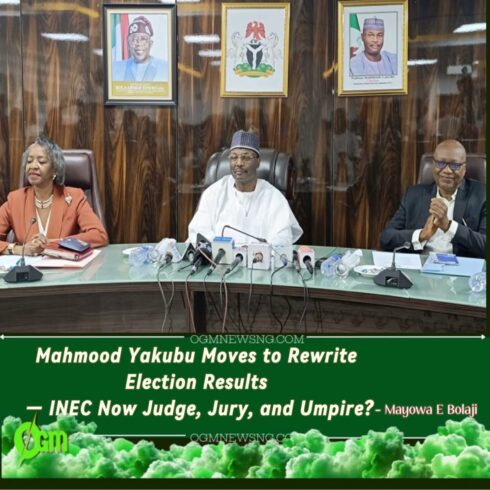
Mahmood Yakubu, Chairman of the Independent National Electoral Commission (INEC), has confirmed that the electoral body is currently drafting new regulatory frameworks that could allow for a comprehensive review—and possible reversal—of already declared election results. This move, according to him, is driven by mounting public pressure, increasing post-election litigation, and glaring discrepancies observed in recent electoral outcomes.
Mahmood Yakubu emphasized that while INEC’s current structure lacks provisions for reversing declared results outside court orders, the new guidelines would create a procedural window within the Commission to address manifest errors or fraudulent declarations. This proposal, however, is already generating heated debate, with critics warning it could undermine the finality of election outcomes and open the floodgates for executive manipulation.
Legal Experts Divided as INEC Treads Controversial Territory
Mahmood Yakubu reiterated that the Commission is consulting with constitutional experts, electoral lawyers, and retired justices to ensure that the proposed guidelines do not conflict with the 1999 Constitution or existing electoral laws. According to him, INEC must act within the bounds of legality while also correcting systemic flaws that breed mistrust in Nigeria’s democratic process.
However, several Senior Advocates of Nigeria (SANs) have argued that INEC cannot play the role of both umpire and judge. They warn that if the commission grants itself powers to tamper with finalized results, it could erode judicial independence and democracy. “It’s a slippery slope,” said one constitutional lawyer, “with devastating implications for electoral stability.”
Political Parties React: Suspicion, Support, and Accusations Fly
Mahmood Yakubu acknowledged that INEC has received mixed responses from political parties regarding the proposed review mechanism. While some parties welcome it as a long-overdue tool for self-correction, others allege it is a covert attempt to introduce post-election rigging in favor of the ruling elite.
Opposition leaders from the Labour Party and PDP have warned that INEC may be arming itself with authoritarian discretion that can be easily weaponized against candidates outside the political establishment. “This is not reform—it’s institutional capture,” one party official declared. Meanwhile, the APC praised the move, calling it a “revolutionary safeguard” for electoral integrity.
Civil Society Organizations on Alert: “INEC Must Not Be Above the Law”
Mahmood Yakubu told stakeholders during a recent roundtable that INEC will remain open to feedback from civil society organizations (CSOs), many of whom are expressing deep unease about the implications of the draft regulations. While CSOs have consistently called for increased accountability, many now warn against administrative overreach.
Groups like YIAGA Africa and the Centre for Democracy and Development (CDD) have asked INEC to publish a detailed draft of the proposed policy before implementation. “We want reform, not dictatorship,” said Samson Itodo, Executive Director of YIAGA. “INEC should not morph into a post-election tribunal. Its role must remain that of a neutral referee.”
National Assembly Keeps Silent as INEC Charts Legal Grey Zones
Mahmood Yakubu revealed that INEC had briefed select committees in the National Assembly, but no formal legislation is currently being proposed to support the controversial policy. This silence has raised eyebrows among watchdogs, with many interpreting it as quiet complicity or political calculation.
Some lawmakers argue that empowering INEC to reverse results without court intervention could be unconstitutional unless backed by statutory amendment. Nonetheless, others see this as a pragmatic step to prevent prolonged litigation and restore public trust. Yet the absence of clear legislative backing leaves the initiative floating in uncertain waters.
Implications for 2027: A Time Bomb or a Reset Button?
Mahmood Yakubu projected that the new result-review framework could be in full operation before the 2027 general elections if all consultations are concluded and legal hurdles cleared. He insists that the policy is not retroactive and would apply only to future elections under a strictly defined context.
Critics, however, argue that the real intention may be to control political narratives and engineer outcomes under the guise of procedural correction. As the countdown to 2027 begins, the battle lines between electoral reform and political manipulation may define Nigeria’s next democratic cycle. Whether Mahmood Yakubu’s INEC emerges as a visionary institution or an electoral overlord remains to be seen.
Table of Contents
Discover more from OGM News NG
Subscribe to get the latest posts sent to your email.