





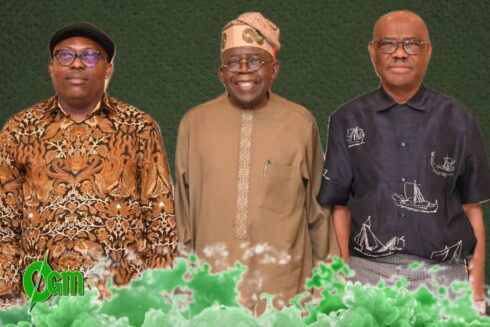
President Bola Ahmed Tinubu on Thursday held a high-level meeting with key political figures from Rivers State, including Governor Siminalayi Fubara, Federal Capital Territory (FCT) Minister Nyesom Wike, Speaker of the Rivers State House of Assembly Martins Amaewhule, and other lawmakers.
The meeting, which took place behind closed doors at the Presidential Villa in Abuja, marks the first time Governor Fubara has been seen publicly with President Tinubu since the controversial declaration of a state of emergency in Rivers on March 18, 2025. The president had, at the time, suspended Fubara, his deputy Ngozi Odu, and the entire House of Assembly over escalating political tensions and worsening security.
Photos from Thursday’s gathering painted a picture of reconciliation, with the president, Wike, Fubara, and Amaewhule smiling, shaking hands, and walking side by side — a sharp contrast to the months of hostility that engulfed the oil-rich state.
Crisis That Shook Rivers: How It All Started
The roots of the crisis date back nearly two years, stemming from a bitter power tussle between Nyesom Wike, the immediate-past governor of Rivers State, and his political protégé turned rival, Governor Siminalayi Fubara. Their once cordial relationship collapsed over control of the political machinery in the state.
The crisis reached a boiling point when the Amaewhule-led House of Assembly, loyal to Wike, threatened to impeach Fubara. The assembly accused the governor of failing to implement a Supreme Court order related to the political dispute and disregarding legislative authority.
Amid the rising tensions, President Tinubu, invoking Section 305 of the 1999 Constitution, declared a state of emergency, suspended the elected officials, and installed retired naval chief Vice Admiral Ibok-Ete Ibas as the sole administrator of Rivers State. The decision sparked nationwide condemnation from political leaders, legal luminaries, civil society groups, and opposition parties, who described it as an assault on democracy.
Inside the Peace Deal: What Was Discussed
Sources close to the Presidency revealed that the main agenda of the meeting was to broker peace and chart a path toward lifting the state of emergency. President Tinubu reportedly told both factions that continued political instability in Rivers was unacceptable, especially given the state’s critical role in Nigeria’s oil economy.
The president stressed the importance of adhering to constitutional processes and restoring democratic governance in the state. Discussions also touched on broader issues affecting Rivers, including the stalled Niger Delta cleanup, the resumption of oil exploration in Ogoniland, and strategies for maintaining law and order.
While no official communique was released, signals from the meeting indicate that both Wike and Fubara have agreed in principle to work together under a new power-sharing arrangement that would involve legislative reconciliation and the withdrawal of impeachment threats.
End of Emergency Rule? What Lies Ahead for Rivers
Observers believe the meeting marks a crucial turning point toward ending the state of emergency in Rivers. Footage from the meeting showed the key players — once bitter foes — exchanging smiles, handshakes, and walking together alongside lawmakers, signaling a de-escalation of hostilities.
A potential outcome could involve the immediate reinstatement of Governor Fubara, his deputy Ngozi Odu, and the Rivers State House of Assembly. It is expected that the state’s governance structure will return to civilian hands, pending the formal signing of a reconciliation agreement supervised by the federal government.
Additionally, President Tinubu is likely to direct Vice Admiral Ibok-Ete Ibas to begin transitioning out of his role as sole administrator once all parties commit to the terms of the peace accord.
Nation Reacts: Relief, Skepticism, and Cautious Optimism
The apparent breakthrough has sparked mixed reactions nationwide. Supporters of democracy and Rivers residents expressed relief at the prospect of ending the suspension of their elected officials. “This is a win for democracy if the agreements hold,” said prominent lawyer Femi Falana (SAN).
However, some observers remain skeptical about the sustainability of the peace deal. “The handshake today is good for the cameras, but the real test will be whether both sides stick to the agreement once the cameras are gone,” noted political analyst Dr. Chris Nwokobia.
For now, the nation watches closely as Rivers State stands on the brink of reclaiming its democratic stability, with President Tinubu positioning himself as the chief mediator in one of Nigeria’s most consequential political crises in recent years.
Table of Contents
Discover more from OGM News NG
Subscribe to get the latest posts sent to your email.