



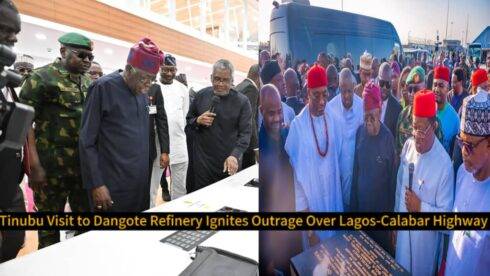
President Bola Tinubu, for the first time since assuming office, made a high-profile visit to the Dangote Refinery in Lagos on Thursday, signaling a shift in government-private sector synergy. The refinery, touted as Africa’s largest industrial project, has been under intense scrutiny regarding its production timelines and alleged political undercurrents surrounding subsidy removal and fuel importation delays.
Bola Tinubu’s presence, described by aides as both symbolic and tactical, came amid mounting pressure over Nigeria’s lingering fuel crisis and the NNPC’s contested monopoly on crude allocation. Industry watchers interpret this visit as a veiled challenge to existing oil cartels and a bold declaration of state interest in the full activation of domestic refining. Critics, however, argue that it is a belated move meant to pacify public frustration over fuel prices and import dependence.
Lekki Deep Sea Port: Tinubu Commissions Concrete Road Amid Land Ownership Controversy
Bola Tinubu proceeded to commission the long-awaited concrete access road leading to the Lekki Deep Sea Port — a project plagued by land acquisition disputes and accusations of elite land grabs. While the port is celebrated as a gateway to West African trade dominance, its development has been shadowed by tensions between local communities, Chinese contractors, and government authorities.
In his remarks, Bola Tinubu lauded the infrastructural ambition of the port, positioning it as pivotal to Nigeria’s maritime resurgence. Nonetheless, civil society organizations question the human cost of the mega-project, pointing to alleged evictions and poor compensation for displaced residents. The President remained silent on these concerns, choosing instead to emphasize job creation and regional competitiveness.
Lagos-Calabar Superhighway Resurfaces with 7th Axial Road Launch
President Bola Tinubu, flanked by top ministers and governors, officially kicked off the second section of the contentious Lagos-Calabar Superhighway, alongside the unveiling of the 25 km 7th Axial Road. The superhighway, which had previously been shelved over environmental and financial concerns, is now back in full swing — with fresh controversies surrounding ecological damage and opaque budgeting.
Critics accuse the administration of fast-tracking the project without adequate environmental impact assessments, especially in fragile coastal ecosystems. Tinubu, however, dismissed such reservations, asserting that the highway would serve as a “national economic artery,” enhancing inter-state trade, reducing transport costs, and unlocking tourism. Environmentalists warn of irreversible biodiversity loss and gentrification of coastal communities.
Bola Tinubu’s Infrastructure Push or Political Diversion?
As Bola Tinubu tours high-ticket infrastructure sites, detractors argue the flurry of inaugurations and groundbreakings are more political theater than developmental substance. With inflation soaring and public trust wavering, some believe the president is engaging in spectacle to distract from economic hardship and policy stagnation.
Bola Tinubu defended the timing of the projects, calling them “manifestations of the Renewed Hope agenda,” and dismissed claims of a smokescreen. Yet, observers remain skeptical, noting the absence of clear project timelines, procurement transparency, and community inclusion. As Nigeria’s debt profile rises, questions about project financing and foreign loans remain unanswered.
Dangote’s Monopoly Accusations Ignored as Tinubu Showers Praise
Bola Tinubu’s glowing endorsement of the Dangote Refinery stood in stark contrast to ongoing allegations of monopolistic privilege granted to the industrialist. The Dangote Group has been accused of receiving undue access to forex, crude oil allocation, and tariff waivers — sparking criticism from rival operators and economists warning of crony capitalism.
Despite these concerns, Tinubu hailed the refinery as “a symbol of Nigerian ingenuity and resilience,” calling Aliko Dangote a national hero. The lack of acknowledgment of market fairness and competition regulation stirred discomfort among stakeholders who fear long-term industry distortion if policies favor one conglomerate over a free and open market.
Public Reaction Mixed: Infrastructure or Illusion?
The Nigerian public has reacted with mixed emotions to Tinubu’s high-stakes infrastructure tour. While some citizens celebrated the developments as overdue progress, others voiced disillusionment over the absence of immediate economic relief. Social media buzzed with commentary — from praise of Tinubu’s “bold steps” to accusations of “elite window-dressing” disconnected from grassroots realities.
Tinubu, unbothered by the polarized views, maintained a confident stance, reiterating that his government would prioritize “foundational transformation” over populist gestures. Yet, with insecurity, food scarcity, and cost-of-living crises still prevalent, many wonder whether Nigeria’s infrastructure blitz is paving the way for prosperity or merely concealing systemic rot.
Table of Contents
Discover more from OGM News NG
Subscribe to get the latest posts sent to your email.