
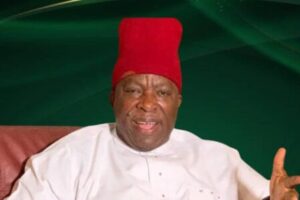

Samuel Ortom, former Governor of Benue State, has stirred the hornet’s nest with a rare political endorsement that defies partisan boundaries. In a dramatic shift from his previous positions, Ortom has called on Nigerians—regardless of political affiliation—to rally behind President Bola Ahmed Tinubu, emphasizing the importance of national unity over party politics. His endorsement has ignited a storm of discourse within both the APC and opposition circles, many of whom are surprised at Samuel Ortom’s dramatic change in tone.
Samuel Ortom’s endorsement came during a visit to the Federal Capital Territory (FCT), where he lauded infrastructural projects spearheaded by Minister Nyesom Wike. Describing Wike’s work as “monumental,” Ortom noted this was the first time he had witnessed transformative urban development since moving to Abuja in 2008. His praise comes at a time when Tinubu’s government is grappling with rising criticism over economic hardship and policy backlash—adding a fresh layer of complexity to Nigeria’s deeply polarized political terrain.
Samuel Ortom’s Apolitical Call: Naïve Idealism or Strategic Alignment?
Samuel Ortom’s plea—“Let us put politics aside and support what is good”—has been interpreted by analysts as either an act of statesmanship or a veiled political maneuver. Coming from a key figure in the opposition PDP, his statement has raised eyebrows, with critics suggesting that his new stance may be a calculated attempt to secure relevance in a Tinubu-dominated political order.
Observers argue that in Nigeria’s zero-sum political landscape, neutrality is often weaponized. Samuel Ortom’s praise of Wike—a PDP stalwart serving in an APC-led administration—has only intensified speculation about a quiet realignment of certain power blocs. His commendation of Tinubu’s decision to appoint Wike as FCT Minister has drawn attention to what many now see as the emergence of a centrist, power-sharing model in Nigeria’s executive appointments.
FCT Projects Under Wike: Samuel Ortom Highlights Urban Renaissance in Abuja
During his tour of Abuja, Samuel Ortom openly expressed admiration for ongoing projects under Wike’s urban redevelopment blueprint. Specifically citing the Kugbo and Mabushi transport terminals, Ortom likened the infrastructure to what is commonly seen in European capitals. “I’ve never seen anything like this in Nigeria’s public space,” he said, applauding the quality and speed of execution.
The former governor’s remarks have brought renewed attention to Wike’s controversial yet aggressive style of leadership. Critics often accuse Wike of authoritarianism and populism, yet Ortom’s support paints a contrasting picture—one where results supersede rhetoric. By likening the FCT’s transformation to a “city that now requires a guide,” Ortom has lent credibility to Wike’s ambitions of turning Abuja into a model capital for West Africa.
Tinubu’s Cross-Party Appointments: A New Era or Political Camouflage?
Samuel Ortom’s reference to President Tinubu appointing Wike despite party differences is arguably the most politically charged element of his statement. “If Mr. President was a partisan leader, he wouldn’t have appointed Wike,” Ortom stated, suggesting that capacity, not loyalty, defined Tinubu’s decision-making process. This assertion has prompted renewed debate on whether Tinubu is genuinely transcending party lines—or merely assembling a coalition of political heavyweights for strategic cover.
Political commentators remain divided. Some say Tinubu’s inclusivity demonstrates maturity and a commitment to national progress, while others believe it’s a tactic to silence dissent within the ranks of the opposition. Ortom’s endorsement, intentionally or not, adds fuel to this debate, portraying the President as a leader capable of pragmatic bridge-building in a deeply fragmented polity.
Opposition PDP Faces Dilemma as Key Voices Drift Toward Tinubu
Ortom’s comments are symptomatic of a broader identity crisis within the People’s Democratic Party (PDP). With Wike already serving under Tinubu and Ortom openly praising his initiatives, questions abound over the future direction of Nigeria’s main opposition platform. Will the PDP hold firm to its critical stance, or is a soft realignment already underway behind closed doors?
The blurring of ideological boundaries poses a serious risk to the PDP’s cohesion. While some party loyalists view Ortom’s remarks as betrayal, others interpret them as an honest call for unity in national interest. Yet, the bigger issue remains unresolved: Can an opposition party survive when its stalwarts begin endorsing the very government they are supposed to critique?
National Unity or Political Expediency? Nigeria Watches Closely
Samuel Ortom’s call for collective action may resonate with citizens exhausted by endless partisan bickering, but many remain skeptical. In a nation where political endorsements are often transactional, Ortom’s statement is being scrutinized for hidden motivations. Is this a genuine appeal for nation-building, or an early sign of political positioning ahead of the 2027 elections?
While the rhetoric of unity is appealing, trust deficits remain. Nigerians, now more politically aware than ever, demand more than words—they want transparency, results, and integrity. Whether Ortom’s bold remarks will inspire a wave of bipartisan cooperation or deepen the mistrust within party hierarchies remains to be seen. But one thing is certain: the former governor has successfully reignited national conversation around political loyalty, public service, and the future of governance in Nigeria.
Table of Contents
Discover more from OGM News NG
Subscribe to get the latest posts sent to your email.