







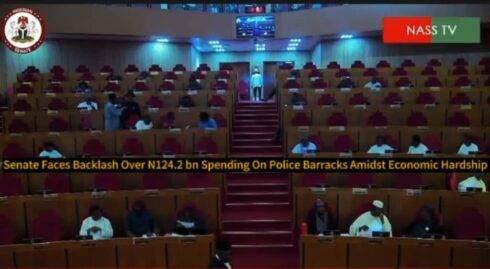
Senate has officially approved a staggering N124.2 billion earmarked for the renovation and upgrade of police barracks and stations across the country. This decision, reached during a heated plenary session, is part of a broader initiative to modernize the nation’s internal security architecture and enhance operational efficiency within the Nigeria Police Force (NPF). Lawmakers emphasized the dilapidated conditions of most police infrastructures, citing years of neglect and underfunding as the root cause of poor morale among officers.
Senate further justified the allocation by referencing recent security challenges and the urgent need for structural reinforcements in the police sector. According to the Chairman of the Senate Committee on Police Affairs, Senator Abdulhamid Dankwambo, the funds will cover structural rehabilitation, procurement of modern surveillance equipment, and the construction of new housing units for officers in underserved regions. However, the massive financial injection has not gone unnoticed by skeptics, sparking concerns over transparency and potential fund misappropriation.
Senate Faces Backlash Over Spending Amidst Economic Hardship
Senate’s decision to greenlight the N124.2bn spending package comes at a time when millions of Nigerians are grappling with unprecedented economic hardship. Critics argue that such a colossal budget could have been redirected to urgent sectors like education, healthcare, or unemployment alleviation. Economic analysts have questioned the timing, describing it as “tone-deaf” given the current fiscal strain on the average citizen.
Senate remains adamant that this investment is a step in the right direction. Senate President Godswill Akpabio stated that a secure nation is the foundation for economic growth and foreign investment. Yet, public confidence remains shaky, with social media platforms awash with criticism and allegations of misplaced priorities. Civil society organizations have also demanded a public audit of the project’s implementation to prevent looting disguised as infrastructural reform.
Senate Promises Oversight to Curb Corruption in Execution
Senate, acknowledging growing public skepticism, has vowed to institute strict oversight mechanisms to monitor the execution of the N124.2bn project. A subcommittee within the Senate Committee on Police Affairs will be tasked with monthly inspections and public reporting. This is an attempt to enforce accountability and ensure that the funds are not siphoned through fictitious contracts and over-invoicing, a practice historically rampant in government infrastructure projects.
Nigerian lawmakers leadership also disclosed plans to engage the Independent Corrupt Practices and Other Related Offences Commission (ICPC) and the Economic and Financial Crimes Commission (EFCC) in tracking the disbursement and utilization of the funds. Senator Ifeanyi Ubah warned that anyone found complicit in the diversion of the police infrastructure funds would face full prosecution. Yet, whether this tough talk will translate into concrete action remains uncertain, given Nigeria’s dismal track record in curbing institutional corruption.
Senate Debates Role of State Policing vs. Federal Infrastructure Boost
Senate reignited the long-standing debate over the relevance of state policing, with several lawmakers questioning whether revamping federal police structures will address systemic security failures. Proponents of state policing argue that merely upgrading facilities without decentralizing law enforcement is akin to “pouring water into a basket.” Senator Enyinnaya Abaribe stated that localized policing would yield better security outcomes and community trust.
Senate, however, maintains that the current move is a foundational step towards a more robust and capable federal policing system. They argue that a solid infrastructure backbone is crucial before experimenting with decentralized police models. This debate reflects broader ideological divides on security governance in Nigeria and may re-emerge as a flashpoint in the upcoming constitutional review hearings.
Senate Hints at Private Sector Involvement in Police Projects
Senate has hinted at involving private contractors and multinational firms in the execution of the N124.2bn police infrastructure upgrade. This approach is designed to inject efficiency, innovation, and accountability, Senate claims. Senator Tokunbo Abiru revealed that part of the fund may be used to pilot a public-private partnership (PPP) model, particularly in urban barracks redevelopment and the digitization of police command centers.
Nigerian lawmakers’s tilt towards privatization has drawn mixed reactions. While some see it as a necessary modernization strategy, others fear it could open the door to inflated contracts and opaque bidding processes. Already, murmurs have begun about which contractors are being favored for multimillion-naira deals. Transparency International Nigeria has called for open bidding and public scrutiny of contract awards, warning that unchecked PPPs may worsen rather than improve the police’s public image.
Senate Urges Police Reorientation to Complement Infrastructure Investment
Nigerian lawmakers underscored that physical infrastructure alone will not transform the Nigeria Police Force unless accompanied by ethical reorientation and personnel training. During deliberations, several senators voiced concerns over rampant police misconduct, abuse of power, and extortion, which often negate public goodwill regardless of infrastructural improvements. Senator Ireti Kingibe called for mandatory human rights training and psychological evaluations for all serving officers.
Nigerian lawmakers emphasized that the funds would also cater to training facilities, curriculum upgrades, and simulation centers for strategic crisis management. The aim is to cultivate a force that is not only well housed and well equipped but also professionally sound and people-centric. This holistic vision, if truly implemented, could mark a turning point in the relationship between the Nigerian populace and its law enforcement. However, as history has shown, good policy intentions often falter in execution.
Table of Contents
Discover more from OGM News NG
Subscribe to get the latest posts sent to your email.