




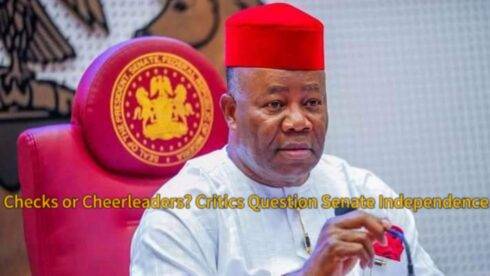
Senate President Godswill Akpabio has stirred political debate with a pointed statement addressing growing friction between Nigeria’s legislative and executive branches. “If you spend all your energy fighting the executive, who will work for Nigeria?” he declared during a recent Senate plenary session, suggesting that lawmakers should prioritize governance over confrontation.
This assertion has drawn sharp criticism from civil society groups and opposition lawmakers, who argue that the Senate’s constitutional role includes checking the executive’s excesses. Akpabio, however, emphasized that scrutiny should not be equated with hostility, underscoring the need for a collaborative rather than adversarial relationship to foster national development.
Checks or Cheerleaders? Critics Question Senate Independence
Godswill Akpabio’s remarks have reignited a longstanding concern among political analysts: the blurring of institutional boundaries in Nigeria’s democracy. His rhetorical question is being interpreted by critics as a subtle endorsement of executive overreach, weakening the Senate’s credibility as an independent arm of government.
Analysts argue that the legislative body, under Akpabio’s leadership, has increasingly leaned toward executive appeasement. This perception, they claim, undermines transparency and accountability—core tenets of democratic governance. The Senate’s recent track record of swift approvals and limited debate on critical executive proposals adds weight to these concerns.
The Presidency Reacts: Quiet Approval or Strategic Silence?
While the Presidency has yet to officially comment on Godswill Akpabio’s statement, insiders suggest quiet satisfaction within Aso Rock. According to a senior presidential aide, Akpabio’s position reflects a shared philosophy of “governance through synergy”—an approach the Tinubu administration is keen to promote amid economic and security pressures.
Nonetheless, the silence from the executive may be strategic. Publicly embracing Akpabio’s view could fuel narratives of legislative subservience, while distancing too strongly may appear disingenuous given recent cooperation between both arms on contentious fiscal policies and subsidy reforms.
Civil Society Groups Demand Legislative Accountability
In swift response to Godswill Akpabio’s statement, several civil society organizations have issued a joint communique condemning what they describe as “institutional submission masquerading as cooperation.” They warn that Nigeria’s fragile democracy cannot thrive without a legislature that is robust, questioning, and independent.
“Godswill Akpabio’s comments represent a dangerous precedent,” said Amina Yusuf, spokesperson for the Democratic Vigil Alliance. “The legislature must challenge, interrogate, and hold the executive accountable—not operate as a rubber stamp for presidential ambitions.” The coalition plans to stage a symbolic protest at the National Assembly Complex to demand clearer legislative boundaries.
Historical Echoes: Nigeria’s Struggle with Democratic Balance
Godswill Akpabio’s comments echo past eras in Nigeria’s political history where legislative bodies were perceived as either too combative or too compliant. From the turbulent relationship between President Olusegun Obasanjo and the National Assembly to the passive legislature under President Buhari, the dance between oversight and cooperation remains delicate.
Historians warn that democracy in Nigeria has often been threatened not by overt coups but by institutional erosion. “When the legislature abdicates its watchdog role in favor of blind loyalty, it sets the stage for authoritarianism,” noted Prof. Adewale Ogundipe, a political historian at the University of Lagos. Akpabio’s stance, they argue, must be critically examined within this historical context.
The Road Ahead: Reform, Recalibration, or Regression?
Godswill Akpabio has defended his leadership style as pragmatic, not partisan. He insists that “productive engagement” with the executive enables legislative effectiveness. However, calls for reform and recalibration are growing louder, especially from within his own party, where younger senators are increasingly vocal about asserting parliamentary integrity.
With 2025 shaping up to be a politically volatile year—given economic uncertainties, social unrest, and growing disillusionment—the Senate’s next moves could determine whether Nigeria advances toward democratic maturity or slips into institutional regression. Akpabio’s legacy, observers say, may well hinge on whether he fosters accountability or merely facilitates executive dominance.
Table of Contents
Discover more from OGM News NG
Subscribe to get the latest posts sent to your email.