




Kwara State Government champions the 70-metre mast as a beacon of unity and patriotism, insisting the soaring steel pillar—touted as the tallest flagpole in West Africa—will draw tourism, stimulate civic pride, and reposition Ilorin on the continental heritage map. Officials cite comparative landmarks in Dubai and Nairobi to argue that flag monuments can morph into profitable cultural assets.
Kwara State Government critics, however, denounce the project’s ₦1.2 billion price tag as performative extravagance amid lingering infrastructure deficits. Activists contend the symbolism is hollow when many rural wards still lack potable water and functional primary health centres, framing the pole as an audacious reminder of skewed budgetary priorities.
Procurement Puzzle: Transparency Under the Microscope
Kwara State Government maintains that the contract passed through “open competitive bidding,” listing three indigenous steel firms in its tender documentation. The Ministry of Works claims due diligence, Environmental Impact Assessments, and Bureau of Public Procurement (BPP) certification were secured before groundbreaking.
Kwara State Government detractors counter with Freedom-of-Information requests alleging redacted line items and accelerated approval timelines that skip standard public-hearing windows. Civil-society groups are pressing the state assembly for an investigative hearing, warning that opacity could erode investor confidence in Kwara’s touted “ease-of-doing-business” reforms.
Jobs Versus Jabs: Economic Windfall or Opportunity Cost?
Kwara State Government projects that flagpole-related tourism will inject ₦800 million annually into the local economy, citing ancillary kiosks, guided tours, and souvenir licensing that could create 500 direct jobs. The administration emphasizes a “renewable revenue stream” to justify the initial capital outlay.
Kwara State Government skeptics juxtapose those forecasts with the ₦650 million immunisation funding gap reported by the State Primary Healthcare Development Agency. Public-health advocates argue that reallocating even half of the mast’s budget could have financed 200 solar-powered cold-chain facilities, expanding vaccine reach to 14 underserved LGAs.
Urban Aesthetics: Revitalisation or Visual Pollution?
Kwara State Government frames the 12-hectare flagpole plaza as the anchor for an ambitious “Ilorin Riverfront Renewal,” promising amphitheatres, bike lanes, and LED-lit promenades calibrated for Instagram-era tourism. Concept art depicts landscaped lawns merging heritage motifs with contemporary minimalism.
Kwara State Government opponents cite preliminary environmental reviews highlighting increased carbon footprints from nightly floodlighting and potential congestion on the adjoining Ibrahim Taiwo Road. Architects within the Nigerian Institute of Town Planners warn that without parallel upgrades to drainage and traffic management, the plaza could morph into an urban bottleneck rather than a beautification milestone.
Political Optics: Legacy Project or Election Billboard?
Kwara State Government loyalists brand the mast a “legacy edifice,” linking it to the administration’s broader “Elevate Kwara” mantra. Strategists argue that monumental architecture cements political memory, giving future generations a tangible chronicle of current leadership’s vision.
Kwara State Government critics dismiss the timing—nine months before the 2026 gubernatorial primaries—as strategic showmanship designed to flood media cycles and dwarf opposition messaging. Analysts on local radio note that ribbon-cutting ceremonies have historically coincided with campaign seasons, positing the flagpole as an oversized campaign poster.
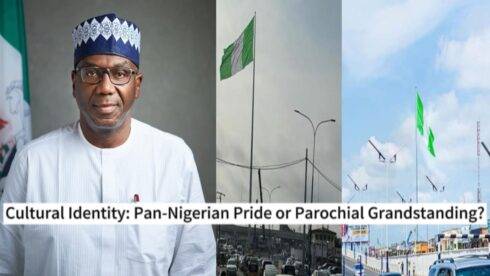
Cultural Identity: Pan-Nigerian Pride or Parochial Grandstanding?
Kwara State Government touts the mast’s 30-by-50-metre flag, stitched in Ilorin with locally sourced fabrics, as a rallying point for national cohesion. Plans include quarterly flag-raising ceremonies featuring school choirs singing the anthem in Yoruba, Hausa, Igbo, and Nupe to underline Kwara’s linguistic mosaic.
Kwara State Government traditional councils urge caution, noting that monumental symbols can backfire if perceived as state-sponsored vanity. Some elders worry that resources diverted to the flag might eclipse funding for cultural festivals like the Emir’s Durbar and the Egungun masquerade, diluting authentic heritage in favour of a single, monolithic narrative.
Table of Contents
Discover more from OGM News NG
Subscribe to get the latest posts sent to your email.