






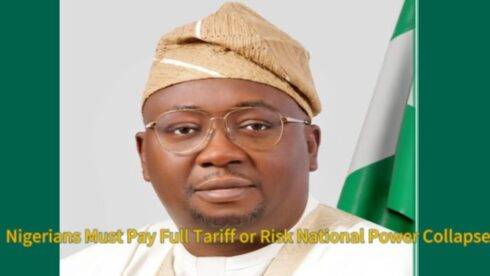
Adebayo Adelabu, Nigeria’s Minister of Power, has sparked national debate with his candid assertion that the country’s fragile economy can no longer shoulder the burden of electricity subsidies. Addressing the Chairmen of Nigeria’s Generating Companies (Gencos) in Abuja, Adelabu emphasized that the age of blanket subsidies is ending. “We must understand that our economy cannot sustain subsidies indefinitely,” he said, drawing a clear line between political goodwill and economic realism.
Adelabu’s declaration comes at a time when the nation is grappling with inflation, dwindling revenues, and growing energy demands. For decades, subsidies have been used as a political tool to appease the public, but the consequences have been staggering—crippling debts, discouraged investments, and a stagnated electricity market. By confronting this reality, the minister has thrown open the gates for an urgent national discourse that touches every socioeconomic class.
Power Tariffs to Reflect True Cost: Citizens Must Brace Up
Adebayo Adelabu has reiterated that electricity tariffs in Nigeria must begin to reflect actual generation and distribution costs. At the heart of this recalibration lies the assertion that all Nigerians, except those in dire economic straits, must now pay what he termed “the appropriate price” for energy. “Citizens must pay the appropriate price for the energy consumed,” Adelabu stated unequivocally, marking a shift toward market-based pricing.
The Nigerian Electricity Regulatory Commission (NERC) reported a stark discrepancy in its February performance report: while the actual cost of power generation averaged N116.18 per kilowatt-hour, consumers paid only N88.2. This N27.97 per kilowatt-hour subsidy gap—borne by the Federal Government—has become a ticking fiscal time bomb. Adelabu’s position is that unless consumers begin paying cost-reflective tariffs, the sector will crumble under the weight of inefficiency and debt.
N4 Trillion Debt Cloud: Gencos Threaten Sectoral Collapse
In a troubling revelation, Adebayo Adelabu acknowledged that the Federal Government currently owes over N4 trillion in unpaid electricity subsidies to Generating Companies. This outstanding debt, which has accumulated over years of delayed payments and policy inertia, threatens the very foundation of Nigeria’s power sector. “There is a need to pay a substantial amount of the debt in cash,” Adelabu emphasized, warning of a systemic breakdown if urgent action is not taken.
The implications of this debt are dire: Gencos are operating below capacity, international investors are staying away, and the national grid remains perpetually vulnerable to collapse. Adelabu has proposed a dual approach—immediate cash payments combined with promissory notes—to resolve the debt and stabilize operations. Without this intervention, experts fear an irreversible erosion of public confidence in Nigeria’s energy future.
Band A vs. Everyone Else: A Divisive Subsidy Structure
Adelabu shed light on the existing electricity subsidy framework, revealing that only about 15% of Nigerians, classified as Band A customers, do not receive subsidies. The rest—an overwhelming majority—still benefit from government cushioning. This structure has become increasingly controversial, as it disproportionately burdens the national treasury while shielding consumers from the true cost of consumption.
Critics argue that the Band classification system, while logical in theory, creates social tension and economic imbalance. Band A customers—mostly businesses and high-income households—bear the brunt of cost-reflective tariffs, while the broader population remains dependent on government largesse. Adelabu’s push for reform will require political tact, clear communication, and perhaps, temporary public backlash to implement a fairer, more sustainable model.
Targeted Subsidies: A New Direction for Energy Justice
To cushion the blow on the nation’s poor, Adebayo Adelabu reaffirmed that the Federal Government is committed to offering targeted subsidies. This approach, he argued, would direct financial relief only to those in genuine economic distress, while ending the blanket subsidies that have historically benefitted even the affluent. “The government will continue to provide targeted subsidies for economically disadvantaged Nigerians,” he assured.
This pivot toward targeted subsidies is seen as a cornerstone of Adelabu’s policy reform—a bid to instill energy justice and eliminate wastage. It echoes global best practices where subsidies are tied to income brackets and energy usage patterns. However, implementing such a framework will require a robust national database, cross-agency collaboration, and vigilant oversight to prevent corruption and abuse.
Public Reaction and the Road Ahead: Balancing Reform and Reality
Adebayo Adelabu’s statements have triggered mixed reactions across the country. While economists and energy experts commend the clarity and urgency of his message, consumer groups and labor unions are threatening protests. The average Nigerian, already squeezed by fuel subsidy removals and inflation, views the looming electricity tariff increase as another blow to household survival.
Yet Adelabu remains resolute. “We recognise the urgency of this matter. The government is committed to resolving this debt to stabilise the sector and prevent further crisis,” he said. The road ahead will require transparency, accountability, and a unified vision across ministries and stakeholders. If managed wisely, this could be the turning point Nigeria’s power sector desperately needs. If not, it could deepen mistrust and widen the socioeconomic divide.
Table of Contents
Discover more from OGM News NG
Subscribe to get the latest posts sent to your email.