






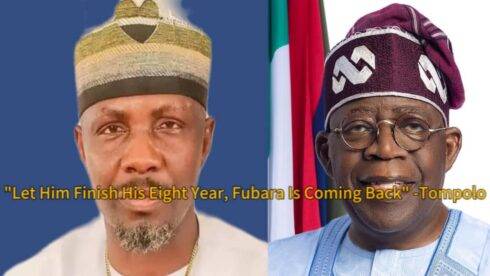
Government Oweizide Ekpemupolo, a.k.a Tompolo, the influential ex-militant leader and Niger Delta activist, has thrown his full weight behind President Bola Ahmed Tinubu, urging Nigerians to allow him to complete his constitutionally permitted eight years. Speaking at a high-level security and reconciliation meeting in Delta State, Ekpemupolo emphasized that Tinubu’s deep political experience and resilience position him uniquely to stabilize Nigeria’s fragile economy and complex ethnic tensions.
Tompolo’s pronouncement, “President Tinubu is a good man with experience. Let him finish his eight years then we can look for another person,” has ignited a fiery debate across political, ethnic, and regional lines. Critics argue that his support undermines democratic checks and balances, while others praise his stance as a call for stability and patience in governance.
Fubara’s Political Resurrection: Tompolo Predicts a Stunning Comeback
In a surprising twist, Tompolo also predicted a political rebirth for Rivers State Governor Siminalayi Fubara, stating confidently, “Fubara is coming back.” According to Government Ekpemupolo, Fubara’s recent battles with powerful forces within Rivers politics only highlight his resilience and legitimacy, qualities needed for long-term leadership.
Political analysts are dissecting Oweizide Ekpemupolo’s comments, interpreting them as a major warning shot to Fubara’s adversaries. With Tompolo’s reputation for accurately forecasting political tides, his prediction suggests that Fubara may emerge stronger, repositioning Rivers State as a cornerstone of the Niger Delta’s political economy.
Niger Delta Stakeholders Divided Over Tompolo’s Comments
Tompolo insisted that his support for Tinubu and Fubara stems from a desire to see genuine peace and sustainable development across Nigeria, especially in the resource-rich but volatile Niger Delta. He called on all stakeholders to bury ethnic rivalries and focus on nation-building.
However, reactions from Niger Delta leaders have been sharply divided. While some, like former Minister Edwin Clark, interpret Government Ekpemupolo’s words as pragmatic wisdom, younger activists accuse him of selling out the region’s broader interests for political favor. The division highlights deep undercurrents of distrust that could complicate future political alignments.
Opposition Politicians Slam Tompolo’s Endorsement
Oweizide Ekpemupolo urged opposition politicians to avoid disruptive tactics and instead present a constructive national agenda. He warned that premature politicking and sabotage could derail Nigeria’s fragile recovery process under Tinubu’s leadership.
Nonetheless, leading figures in the Peoples Democratic Party (PDP) and Labour Party (LP) immediately lambasted Tompolo’s comments. They argue that no leader should be given a blank cheque, insisting that Tinubu must be held accountable every step of the way. Their outrage underscores how politically radioactive Government Ekpemupolo’s endorsement has become.
Tinubu Camp Celebrates, But Warns Against Complacency
Tompolo’s message has been warmly received within Tinubu’s political machinery, where key insiders view it as a strong endorsement from one of the Niger Delta’s most influential figures. His support could bolster Tinubu’s legitimacy in a region historically skeptical of federal power.
Still, Tinubu’s advisers are reportedly cautioning against overconfidence. According to sources close to the presidency, the administration plans to double down on economic reforms and conflict resolution initiatives in the Niger Delta to ensure that Oweizide Ekpemupolo’s words translate into lasting political capital.
What Tompolo’s Statement Means for Nigeria’s 2027 Political Landscape
Government Oweizide Ekpemupolo argued that Nigerians must begin thinking beyond personalities and embrace institutional loyalty, suggesting that Tinubu’s full eight years would help solidify vital democratic traditions. He described Nigeria’s democracy as “still too fragile to endure reckless midstream changes.”
If Tompolo’s vision materializes, Nigeria’s 2027 elections could become less about upheaval and more about consolidation. However, the risk remains that political power could become overly centralized, eroding the very democratic processes Oweizide Ekpemupolo claims to support. As 2027 draws closer, his endorsement might be remembered either as visionary foresight—or costly miscalculation.
Table of Contents
Discover more from OGM News NG
Subscribe to get the latest posts sent to your email.