




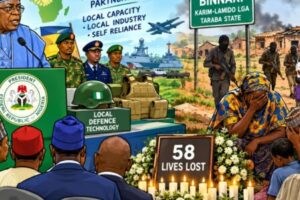





Nuhu Ribadu, Nigeria’s National Security Adviser (NSA), has sparked national debate following his recent statement on the security situation in Benue State. Speaking during a press briefing in Abuja, Ribadu confidently asserted, “We are not doing badly. In fact, we’ve done fairly well in Benue.” His words have stirred a wave of mixed reactions, especially among those directly affected by ongoing violence in the region.
Nuhu Ribadu, a former anti-corruption czar turned chief security strategist, emphasized that progress may not always be visible in headlines, but claimed that behind the scenes, “a lot of groundwork has reduced what could have been a full-blown catastrophe.” This optimistic tone contrasts sharply with reports from locals and independent observers who continue to document attacks, displacement, and fear in rural communities.
Local Residents Cry Foul: ‘We Are Still Under Siege’
While Ribadu paints a picture of improvement, residents of Benue paint a grimmer reality. Villagers from Guma, Logo, and Ukum LGAs say attacks have remained frequent, often targeting farming communities with deadly precision. Many blame herdsmen militia and bandits, accusing security forces of either arriving late or not showing up at all.
“They claim success from Abuja, but we bury our dead every week,” said Terseer Iorfa, a community leader in Gwer West. Civil society groups have also echoed concerns, insisting that federal pronouncements do not reflect conditions on the ground. Some argue that denial at the top only delays urgently needed reforms.
Political Fallout: Nuhu Ribadu’s Words Ignite Party Clashes
Nuhu Ribadu’s statement has quickly turned into political fuel, triggering intense exchanges between ruling party officials and opposition lawmakers. PDP members in Benue State House of Assembly have accused the NSA of “wilful ignorance,” arguing that his statement undermines the suffering of thousands of displaced people.
In defense, APC loyalists counter that Ribadu is merely telling an uncomfortable truth — that while the crisis persists, federal security interventions have indeed curbed its escalation. The back-and-forth threatens to further politicize an already volatile issue, as 2027 political calculations quietly begin to shape narratives around security performance.
Security Budget vs. Ground Reality: Where’s the Disconnect?
Ribadu insists that intelligence-led operations, military deployments, and community engagement programs have increased significantly in Benue. However, public records show that federal security allocations have not translated into visible infrastructure or presence in many hot zones. Critics argue that the disconnect lies not in planning but in poor execution and accountability.
Experts from think tanks like SBM Intelligence note that the metrics used to declare “fair success” are unclear. “How do you define ‘not doing badly’ when IDP camps keep expanding?” asked one security analyst. Ribadu, they argue, must reconcile statistics with lived realities if his words are to gain legitimacy.
Benue’s Farmers Bear the Brunt of Insecurity
Nuhu Ribadu acknowledges that “agriculture in Benue has taken a hit,” but maintains that steps are being taken to restore confidence in rural areas. However, farmers continue to abandon farmlands for fear of ambushes, affecting food supply chains across the Middle Belt and beyond. The economic cost is mounting.
Agro-traders from Makurdi say prices of staples like yam, maize, and sesame have doubled due to reduced farm output. “What we see is not improvement but silent starvation,” one trader told Gbas Gbos News. Ribadu’s assurances may sound strategic, but to the average farmer, they ring hollow without security on the roads and in the fields.
Public Trust in Government Response Dwindles
Despite Ribadu’s bold claim, trust in the federal government’s ability to secure Benue is waning. Religious leaders, traditional rulers, and youth groups have issued statements asking the government to “stop massaging failure and start acting decisively.” For many, hope is now replaced by resignation.
Nuhu Ribadu remains firm, stating that security is a long-term process. “We cannot fix years of decay in a few months,” he said. Yet, without a clear timeline or measurable benchmarks, such reassurances may do little to restore public confidence in the state’s future.
Between Rhetoric and Reality
Nuhu Ribadu’s declaration may have been aimed at calming nerves and projecting stability, but it has instead revealed the growing disconnect between Abuja and rural Benue. As farmers flee, politicians argue, and security remains elusive, the real question looms large: When will Benue truly be safe again?
Table of Contents
Discover more from OGM News NG
Subscribe to get the latest posts sent to your email.