









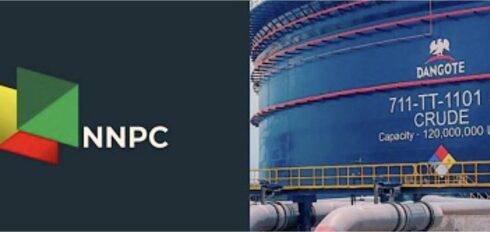
The Nigerian National Petroleum Company Limited (NNPCL) has initiated discussions with the Dangote Petroleum Refinery for the renewal of their naira-for-crude agreement, which is set to expire on March 31, 2025. The state-owned oil company confirmed the ongoing talks in a statement on Monday, debunking claims that the deal had been suspended until 2030 due to NNPCL’s alleged forward sale of crude oil.
This policy, which began in October 2024, was designed to strengthen domestic refining, reduce Nigeria’s reliance on costly fuel imports, and ultimately stabilize fuel prices. Under the initial six-month contract, Dangote Refinery received over 48 million barrels of crude oil to process into petroleum products. Since the facility commenced operations in 2023, a total of 84 million barrels have been supplied.
NNPCL Reaffirms Commitment to Local Refining
NNPCL’s Chief Corporate Communications Officer, Olufemi Soneye, reassured stakeholders that the company remains committed to providing crude oil to local refiners under mutually beneficial terms. He emphasized that the agreement with Dangote Refinery was always intended to be temporary and subject to review based on market conditions.
In its official statement, NNPCL clarified that discussions are ongoing to establish a new contract beyond the March 2025 deadline. “The contract for the sale of crude oil in naira was structured as a six-month agreement, subject to availability, and expires at the end of March 2025. Discussions are currently ongoing towards emplacing a new contract,” the company stated.
The NNPCL reiterated its commitment to supporting local refining capacity, ensuring a stable supply of petroleum products, and reducing Nigeria’s dependence on foreign imports. The continuation of the naira-for-crude policy aligns with the government’s broader economic strategy to strengthen the local currency and reduce the financial burden of foreign exchange expenses.
Government Officials Defend Naira-for-Crude Policy
The Chairman of the Technical Sub-Committee on the naira-for-crude deal, Zacch Adedeji, reaffirmed the government’s commitment to the policy, stating that its termination was never considered. He stressed that the initiative has demonstrated clear economic benefits, including price stability and improved foreign exchange liquidity.
Adedeji further explained that the policy framework ensures that local refineries, including modular refining plants, are prioritized in crude oil allocation. “The framework for domestic crude transactions is designed to promote a competitive and efficient pricing environment. There has been no decision at the policy level to discontinue this approach,” he stated.
The Federal Inland Revenue Service (FIRS) Chairman also assured that the Nigerian Upstream Petroleum Regulatory Commission (NUPRC) is actively monitoring compliance with the Petroleum Industry Act’s Domestic Crude Oil Obligations. This move is aimed at ensuring fairness in crude distribution and encouraging private sector participation in the refining sector.
Crude Oil Transactions and Financial Implications
Fresh findings indicate that crude oil worth approximately N486.31 billion was supplied to the Dangote Refinery between October and December 2024 under the naira-for-crude agreement. NNPCL’s financial records show that these transactions were valued at $373.76 million, with payments made at an Afrexim Bank-advised exchange rate in naira.
However, as of February 2025, $126.99 million (N199.96 billion) remained outstanding as unpaid obligations. The crude supplies were provided under a 45-day credit facility, with payments due after delivery.
An analysis of NNPCL’s records revealed fluctuations in crude allocations to Dangote Refinery. While October 2024 saw a peak allocation of 598,125 barrels in a single shipment, supply volumes dropped significantly in November, with only two approved transactions for the entire month. By December, crude deliveries totaled 799,737 barrels, valued at $59.88 million (N93.59 billion).
Stakeholders Urge Government to Expand Refinery Access
Commenting on the ongoing negotiations, the Publicity Secretary of the Crude Oil Refinery-Owners Association of Nigeria, Eche Idoko, urged the government to extend the naira-for-crude policy to modular refineries. He highlighted that while the government initially prioritized Dangote Refinery due to its capacity to produce petrol, smaller refineries also play a critical role in supplying diesel and other essential products.
Idoko argued that modular refineries could help stabilize fuel prices and reduce transportation costs, particularly for goods transported by diesel-powered trucks. He emphasized the need for the government to fulfill its promise of supplying 27,000 barrels per day to smaller refiners.
“We have seen a reduction in fuel prices and an improvement in the naira’s performance against the dollar. Given this success, the next phase should cover all local refineries, not just Dangote Refinery,” Idoko stated.
As negotiations continue, stakeholders are closely watching how the renewed agreement will shape Nigeria’s refining landscape. The expansion of the naira-for-crude policy could determine the sustainability of domestic fuel supply and the long-term stability of the nation’s petroleum sector.
Table of Contents
Discover more from OGM News NG
Subscribe to get the latest posts sent to your email.