









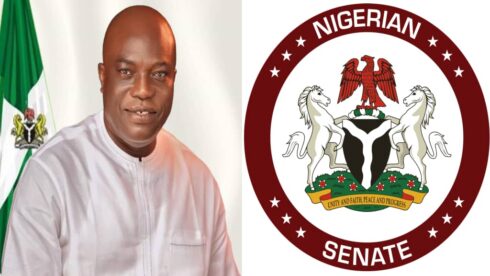
Neda Imasuen, the current Chairman of Nigeria’s Senate Committee on Ethics, Privileges, and Public Petitions, faced significant legal challenges during his tenure in the United States. In 2010, the Appellate Division of the New York Supreme Court disbarred Imasuen for professional misconduct. The court found that he neglected a legal matter entrusted to him by a client, Daphne Slyfield, and failed to cooperate with the Grievance Committee overseeing his conduct.
The disbarment order explicitly commanded Imasuen to desist from practicing law in any form, appearing as an attorney before any court, or holding himself out as an attorney and counselor-at-law. This ruling effectively terminated his legal career in New York and barred him from any legal practice within the jurisdiction.
Transition to Nigerian Politics: From Consultant to Senator
Following his disbarment, Neda Imasuen returned to Nigeria and embarked on a career in public service and politics. He served as a consultant for the European Union’s State Reforming Institutional Program (SRIP) and later joined the Nigerian Governors’ Forum as a Policy Consultant under the State Peer Review Mechanism Projects (SPRM). Between 2014 and 2015, he contributed to the development of the Single Treasury Account Policy as a Legislative Consultant for a World Bank Project in collaboration with SEEFOR in Asaba, Delta State.
In 2023, Neda Imasuen successfully contested and won the senatorial election for Edo South Senatorial District under the Labour Party platform. His election marked a significant transition from consultancy to active politics, culminating in his appointment as the Chairman of the Senate Committee on Ethics, Privileges, and Public Petitions.
Neda Imasuen: Ethics Committee Leadership Amid Controversy
As Chairman of the Senate Committee on Ethics, Neda Imasuen has been at the forefront of several high-profile decisions. Recently, his committee recommended the six-month suspension of Senator Natasha Akpoti-Uduaghan for alleged violations of Senate rules. The committee accused Akpoti-Uduaghan of bringing the Senate President and the Senate in general to public disgrace, leading to the recommendation of her suspension, withdrawal of salary and allowances, and the locking of her office for the suspension duration.
This decision has sparked widespread criticism, with observers questioning the committee’s impartiality and the motivations behind the suspension. Some have argued that the move is politically motivated, aiming to silence dissenting voices within the Senate.
Public Outcry and Questions of Integrity
The revelation of Neda Imasuen’s disbarment for fraud and misconduct in New York has ignited public outcry in Nigeria. Citizens and political analysts are questioning the integrity of having an individual with such a past oversee the Senate’s Ethics Committee. The disbarment, which stemmed from allegations of swindling a client and failing to provide legal representation after accepting substantial legal fees, raises concerns about the ethical standards upheld within Nigeria’s legislative body.
Critics argue that Neda Imasuen’s past actions are incongruent with the responsibilities of an ethics committee chairman, a role that demands the highest levels of integrity and accountability. The situation has intensified debates about the vetting processes for political appointments and the need for stringent ethical standards in public office.
Comparative Cases: A Pattern Among Nigerian Politicians?
Neda Imasuen’s case is not isolated; it mirrors a troubling pattern among some Nigerian politicians. For instance, Femi Gbajabiamila, the former Speaker and current Chief of Staff to the President, had his law license revoked in the U.S. over corruption allegations, including admitting to stealing $25,000 from a client.
These instances highlight a broader issue of individuals with questionable pasts ascending to high-ranking government positions in Nigeria. Such patterns undermine public trust and call into question the effectiveness of existing mechanisms to screen and vet public officials.
Calls for Reform: Ensuring Ethical Governance
In light of these revelations, there are growing calls for comprehensive reforms to ensure ethical governance in Nigeria. Advocates are urging for the establishment of more robust vetting processes for political candidates and appointees, emphasizing the need for transparency and accountability.
Furthermore, there is a push for revisiting and strengthening the code of conduct for public officials, ensuring that individuals with histories of misconduct are barred from holding positions of authority. These reforms aim to restore public confidence in Nigeria’s political institutions and promote a culture of integrity within governance structures.
Table of Contents
Discover more from OGM News NG
Subscribe to get the latest posts sent to your email.