








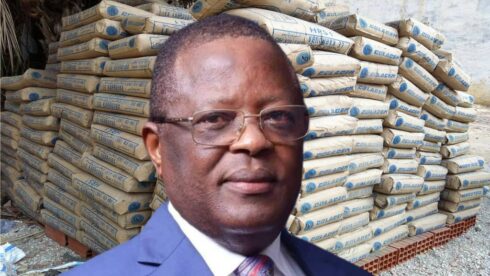
Minister of Works, David Umahi, has issued a stern directive to cement manufacturers, urging them to reduce prices to ₦7,000 per bag. Expressing concerns over the current market inconsistencies, he emphasized that when the exchange rate soared to nearly ₦2,000 per dollar, cement prices climbed from ₦7,500. However, despite the naira’s stabilization at approximately ₦1,400 per dollar, cement prices have remained as high as ₦9,500.
David Umahi, known for his no-nonsense approach, warned cement producers that failure to comply within a week would compel him to escalate the issue to President Bola Ahmed Tinubu. The minister’s statement reflects growing government efforts to regulate the pricing of essential commodities, ensuring that economic improvements translate into tangible benefits for Nigerians. Analysts suggest that his intervention could lead to a significant market shift if manufacturers heed the call.
Government Cracks Down on Price Manipulation in Construction Industry
The works minister’s ultimatum comes amid broader government efforts to curb inflationary practices in the construction sector. Cement, a crucial component of infrastructure development, has experienced drastic price hikes due to forex volatility, transportation costs, and alleged market manipulation. However, with recent economic stabilization, David Umahi insists that there is no justification for maintaining exorbitant prices.
Economic experts argue that manufacturers have long leveraged currency fluctuations as an excuse to inflate prices but are reluctant to adjust downward when the naira strengthens. David Umahi’s call for a ₦7,000 cement price cap signals a shift in government oversight, potentially setting a precedent for tighter regulatory scrutiny in Nigeria’s construction materials market.
Enugu-Onitsha Expressway: David Umahi Sets May 2026 Deadline
Beyond cement price regulations, Umahi has also turned his focus to critical infrastructure projects, particularly the Enugu-Onitsha Expressway. The minister revealed that a definitive completion deadline of May 10, 2026, has been set following discussions with MTN Nigeria and RCC, the construction firm handling the project. The road rehabilitation is financed under the Infrastructure Development and Refurbishment Investment (Tax Credit) Scheme, an initiative aimed at leveraging private sector resources for public infrastructure.
David Umahi, addressing concerns about slow project execution, made it clear that delays would not be tolerated. In a statement released by his media aide, Uchenna Orji, he emphasized that MTN, as a funding partner, would be held accountable for any financial bottlenecks that could hinder progress. The minister’s firm stance indicates an unwavering commitment to ensuring timely project delivery.
MTN and RCC Face Accountability Measures for Project Delays
During a high-level meeting in Abuja, Umahi engaged MTN and RCC executives alongside other top government officials, including Minister of State for Works, Mohammad Bello Goronyo, and the ministry’s Permanent Secretary, O.O. Adebiyi. He unequivocally stated that there would be no room for cost variations or price renegotiations until the project reaches completion.
David Umahi’s insistence on strict adherence to contract terms underscores the government’s resolve to prevent cost inflation and undue delays. He warned that any deviation from agreed terms would be met with stiff penalties, reinforcing the administration’s focus on accountability and transparency in infrastructure projects.
No Price Variation Until Completion, David Umahi Declares
Reiterating his position, David Umahi stressed that RCC must align with contractual procedures when addressing potential cost adjustments. He dismissed any prospect of arbitrary price variations (VOP), stating that such measures should only be considered under clearly defined contractual conditions. The minister’s approach signals a departure from past practices where contractors frequently lobbied for upward cost revisions mid-project.
By taking a firm stand against indiscriminate VOP adjustments, David Umahi aims to ensure that public infrastructure projects are executed efficiently, within budget, and according to initial agreements. This move is expected to bolster public confidence in the government’s ability to deliver key national projects without unnecessary financial burdens.
Implications for the Construction Industry and Nigerian Economy
David Umahi’s dual intervention—on cement pricing and road infrastructure—could have far-reaching implications for Nigeria’s construction industry. If cement manufacturers comply with the ₦7,000 price benchmark, housing and infrastructure costs may stabilize, making development more affordable for both public and private sector projects. Additionally, enforcing accountability on road projects could set a new standard for efficiency in Nigeria’s infrastructure sector.
His assertive approach aligns with President Tinubu’s economic policies aimed at fostering stability and sustainable growth. With mounting public pressure for economic relief, Umahi’s actions could mark a turning point in how the government manages essential commodities and infrastructure projects, ultimately shaping Nigeria’s economic landscape in the months ahead.
Table of Contents
Discover more from OGM News NG
Subscribe to get the latest posts sent to your email.