



The mineral-rich eastern region of the Democratic Republic of Congo (DRC) has been plagued by conflict for more than three decades, dating back to the 1994 Rwandan genocide. The aftermath of that tragedy saw an influx of Rwandan refugees, including members of the Hutu militias responsible for the genocide, into eastern Congo. This triggered a cycle of violence as ethnic tensions and struggles over resources escalated, leading to the involvement of numerous armed groups competing for control.
The instability in eastern DRC has not only led to widespread suffering but has also drawn in neighboring countries, further complicating the conflict. The region witnessed two large-scale wars in the late 1990s and early 2000s, often referred to as “Africa’s World Wars,” which resulted in the deaths of millions of people. Despite multiple peace agreements, armed groups continue to operate in the area, exploiting the region’s vast mineral wealth and leaving civilians caught in a continuous humanitarian crisis.
What Is Happening in Goma?
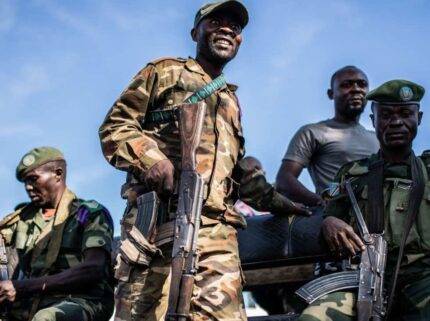
In a dramatic escalation, fighters from the M23 rebel group have captured almost all of Goma, a major city with a population of over one million people. Goma, located on the border with Rwanda and sitting on the shores of Lake Kivu, is a crucial economic and transport hub. The city serves as a gateway to mining towns that supply valuable minerals such as gold, tin, and coltan, a critical component used in mobile phones and other electronic devices.
The fall of Goma has triggered a severe humanitarian crisis, with UN aid agencies warning of widespread food and water shortages. Hospitals are overwhelmed with casualties, and bodies have been left on the streets as the conflict intensifies. The M23 rebels have also threatened to push their offensive further, possibly toward the capital, Kinshasa. However, analysts believe this is unlikely due to the vast distance—over 2,600 kilometers—between Goma and Kinshasa. The situation remains volatile, with fears that continued fighting could deepen the already dire humanitarian conditions.
Who Are the M23 Rebels and Is Rwanda Involved?
The M23, also known as the March 23 Movement, is a rebel group predominantly composed of ethnic Tutsis. They claim to have taken up arms to defend the rights of Tutsis in eastern Congo, arguing that previous peace agreements to protect their community have not been honored. The group emerged in 2012, swiftly gaining control of territory, including Goma, before being forced to withdraw following a military intervention by the Congolese army and a United Nations force. The rebels later agreed to be integrated into the national army, but in 2021, they resumed their insurgency, alleging that the government had failed to uphold its commitments.
The M23’s ties to Rwanda have long been a contentious issue. While Rwanda has repeatedly denied involvement, UN reports and Western governments, including the United States and France, have accused Rwanda of backing the group with weapons, logistical support, and even direct military assistance. In 2023, a UN experts’ report estimated that up to 4,000 Rwandan troops were actively fighting alongside M23 rebels. Despite peace efforts mediated by Angola, including a ceasefire agreement, the truce quickly collapsed, leading to renewed clashes. Rwanda maintains that it is being scapegoated and argues that the conflict stems from the Congolese government’s refusal to engage in dialogue with M23.
The crisis in eastern DR Congo remains one of Africa’s most persistent and deadly conflicts, fueled by ethnic tensions, geopolitical rivalries, and the lucrative trade in minerals. Without a lasting political solution, the region is likely to remain trapped in a cycle of violence, with devastating consequences for millions of civilians.
Rwanda’s Deep Connection to the Conflict
The origins of the current fighting in the Democratic Republic of the Congo (DR Congo) can be traced back to the 1994 Rwandan genocide, which claimed the lives of approximately 800,000 people, predominantly from the Tutsi community. The genocide ended when the Tutsi-led Rwandan Patriotic Front (RPF), commanded by Paul Kagame—now Rwanda’s president—overthrew the Hutu-led government. Fearing reprisals, an estimated one million Hutus fled into what is now eastern DR Congo, leading to long-term ethnic tensions. Among those who fled were members of the former Rwandan military and militias that had orchestrated the genocide.
Over the years, Rwanda’s government has repeatedly justified military interventions in eastern DR Congo by citing the presence of the Democratic Forces for the Liberation of Rwanda (FDLR), a Hutu militia with some members implicated in the genocide. Kigali describes the FDLR as a “genocidal militia” that threatens Rwanda’s security and Tutsi communities in eastern DR Congo. Rwanda accuses Congolese authorities of harboring and collaborating with the FDLR, a claim Kinshasa strongly denies. This complex ethnic and historical backdrop has fueled continued instability, with Rwanda unlikely to withdraw its influence unless it is assured that the FDLR no longer poses a threat.
The Battle Over DR Congo’s Mineral Wealth
While security concerns remain a key justification for Rwanda’s involvement in eastern DR Congo, multiple reports suggest that economic interests—particularly in the region’s vast mineral wealth—play a significant role in prolonging the conflict. DR Congo, along with United Nations (UN) investigators, has accused Rwanda of using the instability to exploit Congolese mineral resources, including gold and coltan. Coltan is a critical component in the manufacturing of mobile phones, cameras, and electronic circuits, making it a highly sought-after mineral in global markets.
The M23 rebel group, which has been linked to Rwanda, has seized control of several mineral-rich territories. A UN report in December 2023 revealed that approximately 120 tonnes of coltan were being smuggled into Rwanda every month under M23 control. Additionally, Rwanda’s mineral exports have seen a dramatic surge in recent years, with much of the extracted resources believed to originate from Congolese mines. Despite consistent denials from Kigali, accusations persist that Rwanda is leveraging the ongoing conflict to gain economic advantages while weakening DR Congo’s sovereignty over its resources.
The Role and Struggles of UN Peacekeepers
The UN peacekeeping mission in DR Congo, known as MONUSCO, has been active since 1999, with a current deployment of over 10,000 troops. However, its effectiveness has been widely criticized. Only the Force Intervention Brigade (FIB) within MONUSCO is authorized to conduct offensive operations against armed groups, a mandate that was instrumental in defeating the M23 rebels in 2013. Yet, with M23 resurging and other armed groups proliferating, MONUSCO has been viewed as ineffective by many Congolese citizens, prompting President Félix Tshisekedi to request the mission’s withdrawal. Though the UN initially planned to exit by the end of 2023, its mandate was extended into 2024 due to ongoing instability.
In response to MONUSCO’s perceived failures, the Southern African Development Community (SADC) deployed a military force to eastern DR Congo. However, the force has suffered significant casualties, with 13 South African soldiers and three Malawian troops killed in recent clashes with M23. South Africa’s President Cyril Ramaphosa warned that further attacks on its forces would be seen as a “declaration of war” against Rwanda. President Kagame dismissed these claims, accusing South Africa of engaging in offensive military actions. Meanwhile, Uruguay has also lost a soldier under MONUSCO, further raising concerns over the UN’s ability to contain the crisis.
With international actors divided, armed groups entrenched, and mineral interests fueling further instability, the conflict in eastern DR Congo remains one of Africa’s most volatile crises. The continued involvement of Rwanda, accusations of mineral exploitation, and the failures of peacekeeping efforts all contribute to a seemingly endless cycle of violence.
Table of Contents
Discover more from OGM News NG
Subscribe to get the latest posts sent to your email.