









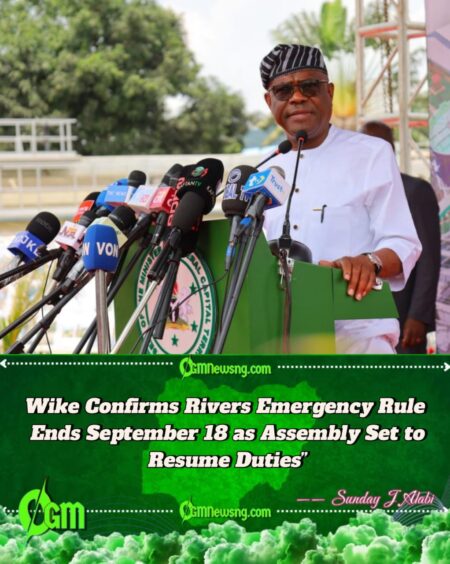
The Minister of the Federal Capital Territory (FCT), Nyesom Wike, on Saturday confirmed that the state of emergency imposed on Rivers State would officially expire on September 18, 2025. Wike made this disclosure after casting his vote during the ongoing local government elections in the state.
According to Wike, the expiration of the emergency rule will pave the way for the Rivers State House of Assembly to resume its legislative duties and allow the state to fully return to democratic normalcy. The minister Wike described the current situation as calm and expressed optimism that the transition back to standard governance would be smooth and uncontroversial.
Wike stressed that the peaceful conduct of the local government election was evidence that political stability had returned to Rivers. “As far as we are concerned, this election is peaceful, people are trooping out, and at the end of the day, the election has been conducted successfully and peacefully,” Wike said.
Background to the Emergency Rule
President Bola Tinubu had in March declared a six-month emergency rule in Rivers State to prevent what was feared to be a deepening political crisis. The intervention led to the suspension of Governor Siminalayi Fubara, his deputy, and the State House of Assembly.
The decision was met with mixed reactions across the country. While some stakeholders praised the move as necessary to prevent chaos, critics argued that it undermined the constitutional order and disenfranchised the people of Rivers. The measure, however, provided interim stability as a caretaker arrangement was instituted to oversee state affairs.
With the expiration date now in sight, attention has turned to how quickly Rivers can restore normal political processes and whether the crisis that triggered the emergency rule has truly been resolved.
Wike’s Optimism for Peaceful Transition
Wike, who has remained a central figure in Rivers politics, expressed confidence that conditions were right for lifting the emergency rule. Wike explained that the state and local governments now have representation, ensuring that democratic structures are in place.
“The coast is clear for the state of emergency to be lifted, being that the state government has its representative and the local government has its representatives, so we are good to go,” he said.
His statement reflects a shift from the climate of uncertainty that dominated political discourse earlier in the year. By highlighting the return of governance at both state and grassroots levels, Wike sought to reassure Rivers citizens and the wider Nigerian public that a return to normalcy is both imminent and sustainable.
Implications for Governance and Democracy
The end of the emergency rule marks a critical test for Rivers State’s political institutions. The State House of Assembly is expected to resume legislative duties immediately after September 18, reinstating a key arm of government that has been suspended for half a year.
Observers believe that the smooth reintegration of the Assembly and the executive arm of government will be crucial to re-establishing democratic checks and balances. Political analysts also warn that lingering tensions between rival factions in Rivers must be carefully managed to prevent a relapse into crisis.
At the grassroots level, the successful conduct of the local government elections is being viewed as a positive step towards restoring confidence in democratic institutions. The elected local councils are expected to provide the much-needed link between the people and the state government, particularly in delivering social and developmental projects.
What Lies Ahead for Rivers State
As Rivers prepares to exit emergency rule, the spotlight will remain firmly on how its political leaders navigate the return to constitutional governance. Governor Siminalayi Fubara, once reinstated, will face the challenge of reconciling with political rivals while ensuring continuity in governance.
For President Tinubu’s administration, the Rivers experiment will be seen as a precedent for handling political instability in other states. A successful transition could bolster confidence in federal interventions, while any renewed crisis might reinforce critics’ arguments against the use of emergency powers in democratic contexts.
Ultimately, the coming weeks will be pivotal in determining whether Rivers can move past the turbulence of the past months and reassert itself as a model of stability in Nigeria’s often volatile political landscape.
Table of Contents
Discover more from OGM News NG
Subscribe to get the latest posts sent to your email.