









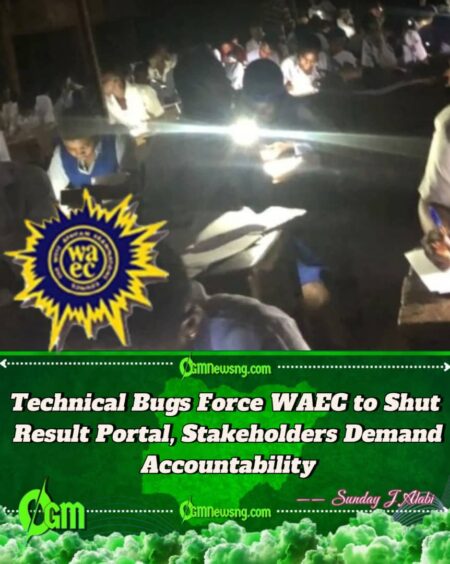
The West African Examinations Council (WAEC) has come under intense fire after technical glitches forced it to deny candidates access to the results portal for the 2025 West African Senior School Certificate Examination for School Candidates (WASSCE).
The disruption, which began shortly after the release of the results, sparked outrage among students, parents, and stakeholders. Many candidates reported being locked out of the portal, while others claimed their grades were altered or missing entirely. The Council confirmed on Thursday that it had identified “bugs” in its backend systems during a post-release review, prompting an immediate suspension of the portal.
A statement issued by the Head of Public Affairs, WAEC National Office, Moyosola Adesina, said the shutdown was necessary to ensure fairness and accuracy. “As part of our efforts to curb malpractice, WAEC introduced paper serialisation in Mathematics, English Language, Biology, and Economics. However, internal post-release checks revealed technical errors that require urgent correction,” she stated.
WAEC Promises Fix Within 24 Hours
WAEC stressed that the suspension was temporary and assured candidates that updated results would be available within 24 hours. The Council urged those who had already accessed their results to re-check from Friday to confirm the corrected versions.
“We extend our deep and sincere apologies to all affected candidates and the general public. We appreciate their patience as we resolve this matter transparently and urgently,” the statement read.
The clarification came less than 24 hours after WAEC announced the shutdown on its official X (formerly Twitter) handle, citing “technical issues.” The development added to public concern following Monday’s revelation by the Head of National Office, Dr. Amos Dangut, that only 38.32% of the 1,969,313 candidates obtained five credits, including English Language and Mathematics—marking the worst performance in a decade.
Stakeholders Question WAEC’s Preparedness for Digital Transition
The Nigeria Union of Teachers, the National Association of Parent-Teacher Associations of Nigeria (NAPTAN), and the National Association of Nigerian Students (NANS) were among those who reacted sharply to the crisis.
NAPTAN’s National President, Haruna Danjuma, while commending WAEC for admitting its error, criticised the rush to introduce full Computer-Based Testing (CBT) for future exams. “It is good to own up to mistakes, but moving WASSCE and NECO entirely to CBT by 2026 is unrealistic. Many students—especially in rural areas—lack both the infrastructure and skills to succeed in CBT exams,” Danjuma said.
He urged governments at all levels to equip schools with computers and begin computer literacy training from SS2 to prepare students for such a transition. “Right now, about 80–90% of rural students are not computer literate. Without proper groundwork, CBT will fail,” he warned.
Students’ Body Demands Leadership Shake-Up
The National Association of Nigerian Students took a more combative stance, accusing WAEC of gross incompetence. NANS Assistant General Secretary, Adejuwon Olatunji, condemned the Council for failing to thoroughly test its systems before the release, saying the glitch had caused “unnecessary psychological distress” to candidates and parents.
“This is not just regrettable; it is a clear sign of failed leadership. The result checker portal is the final step in a student’s long academic journey—any glitch at that stage is an unforgivable failure,” Olatunji stated.
He dismissed WAEC’s apology as insufficient and called for sanctions against those responsible. “Some students received wrong grades, others couldn’t access their results, and now WAEC quietly makes corrections. This is about more than tech failure—it’s about poor oversight, lack of accountability, and leadership that must change,” he added.
Education Integrity at Stake
The incident has reignited debates about the state of Nigeria’s education system, the integrity of public examinations, and the readiness of national institutions to embrace technological reforms.
With over 192,000 results withheld for alleged malpractice this year, critics say WAEC’s credibility depends not only on combating cheating but also on ensuring accuracy, transparency, and professionalism in its processes.
As the Council races to restore access to the results portal, the controversy has underscored a deeper question: can Nigeria’s examination bodies manage a smooth digital transformation without undermining the trust of millions of students and parents?
Table of Contents
Discover more from OGM News NG
Subscribe to get the latest posts sent to your email.