





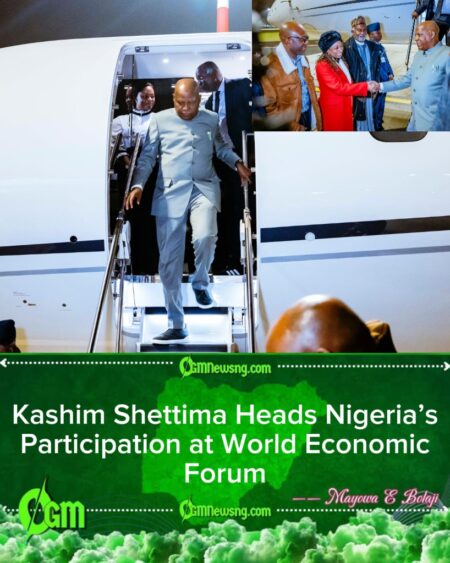
Vice President Kashim Shettima has arrived in Davos, Switzerland, to head Nigeria’s delegation to the 56th Annual Meeting of the World Economic Forum (WEF) holding from January 19–23, 2026. The high-level gathering brings together world leaders, investors, and policy experts to discuss pressing global economic and security challenges. Nigeria’s participation is expected to focus on investment attraction, economic reforms, and strengthening international partnerships.
On arrival, the Vice President Kashim Shettima was warmly received by the Minister of Foreign Affairs, Ambassador Yusuf Tuggar, the Minister of Trade and Investment, Dr Jumoke Oduwole, and senior officials of the Nigerian Mission in Switzerland. The reception underscored the importance the Federal Government attaches to the forum and Nigeria’s renewed commitment to economic diplomacy under President Bola Tinubu’s administration.
The Davos meeting offers Nigeria a strategic platform to present its reform agenda, particularly in the areas of energy transition, digital economy, food security, and infrastructure financing. With global investors seeking stable and emerging markets, the Nigerian delegation is poised to showcase opportunities in Africa’s largest economy and highlight ongoing efforts to improve the business environment.
Nigeria’s Economic Diplomacy Takes Centre Stage
Vice President Kashim Shettima is expected to engage in a series of bilateral meetings with global leaders, multinational corporations, and development partners. These discussions will centre on expanding foreign direct investment, boosting non-oil exports, and deepening technology transfer to Nigeria. Government officials say the delegation will project Nigeria as a destination for sustainable and profitable investments.
According to diplomatic sources, Nigeria will also participate in special sessions on artificial intelligence, climate financing, and global trade realignment. The country intends to leverage these conversations to secure partnerships that support its industrialisation drive and youth employment programmes. Shettima’s presence signals Abuja’s determination to play an active role in shaping global economic policies.
Analysts believe the Vice President Kashim Shettima engagements could yield tangible outcomes, including new investment commitments and cooperation agreements. Nigeria has in recent years
intensified its participation at the World Economic Forum to rebuild investor confidence and reposition the nation after economic headwinds caused by global inflation and energy shocks.
Ministers Outline Agenda for Davos Engagements
Minister of Trade and Investment Dr Jumoke Oduwole disclosed that Nigeria’s agenda at Davos will prioritise manufacturing, agribusiness, and the creative economy. She noted that the government would highlight incentives introduced to support small and medium enterprises and attract multinational production hubs into the country.
Foreign Affairs Minister Ambassador Yusuf Tuggar emphasized that the forum provides an avenue to strengthen Nigeria’s voice on African development issues. He stated that discussions would also address regional security, migration, and the need for fairer access to global finance for developing nations.
Officials of the Nigerian mission in Switzerland expressed optimism that the 2026 outing would surpass previous participations. They confirmed that several roundtables and investment showcases have been lined up for Vice President Kashim Shettima and members of his team, with expectations that the engagements will translate into concrete benefits for Nigeria’s economy and its citizens.
Table of Contents
Discover more from OGM News NG
Subscribe to get the latest posts sent to your email.