








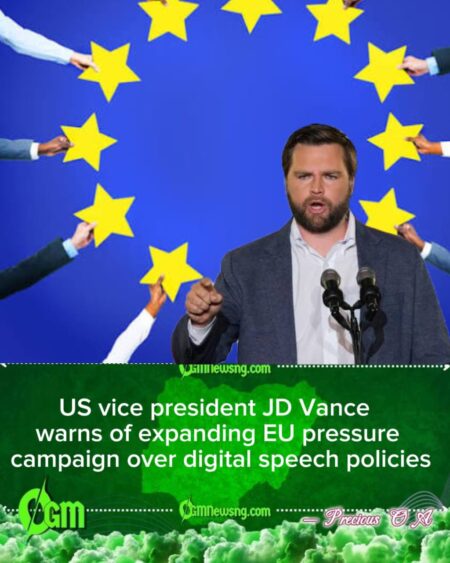
US vice president JD Vance issued sharp criticism of what he described as an increasingly aggressive regulatory push by the European Union to impose substantial financial penalties on the social-media platform X, alleging that the bloc is attempting to coerce the company into adopting speech-restriction practices that align with European political preferences rather than respecting the broader traditions of open discourse long upheld in the United States.
He framed this situation not merely as a disagreement over fines or compliance forms but as part of a much larger and steadily intensifying conflict over who ultimately gets to set the rules for global communication, describing the EU’s approach as a coordinated attempt to extend its regulatory reach far beyond its borders and into the daily operations of U.S.-based digital platforms.
JD Vance maintained that the alleged plan to fine X hundreds of millions of dollars reflects a calculated strategy designed to pressure American companies into policing speech according to European standards that often prioritize social cohesion over broad free-expression rights. He warned that such efforts, when combined with the increasingly expansive framework of the EU’s Digital Services Act, risk transforming what was once collaborative transatlantic tech regulation into a battleground defined by ideological disagreements about what citizens should see, say, and share online.
JD Vance also highlighted concerns that the EU’s enforcement posture could influence global technology firms to adopt more restrictive content-moderation practices long before formal penalties are imposed, fearing costly investigations or punitive action. He argued that this climate of regulatory pre-emption poses severe risks to open debate, innovation, and the stability of digital information networks, creating an environment where platforms act out of fear rather than principle.
FREE SPEECH AND CROSS-BORDER GOVERNANCE
JD Vance argued that the EU’s strategy represents a significant departure from the spirit of healthy regulatory cooperation, instead advancing punitive oversight that blurs the distinction between addressing harmful content and compelling ideological conformity. He described the issue as one rooted not in a genuine desire for safety or transparency but in a preference for imposing uniform speech standards across a diverse digital landscape.
Supporters of a more assertive American response contend that any cross-border approach to speech regulation must be evaluated with extraordinary caution, particularly when foreign governments appear increasingly willing to influence how U.S. platforms operate. They fear that if the EU’s version of content control becomes the de facto global standard, it could steadily erode U.S. constitutional norms and weaken the long-standing expectation that government involvement in speech issues must remain limited and carefully constrained.
Analysts noted that international digital governance has become a complex, friction-filled arena, with major powers adopting conflicting philosophies on speech, privacy, competition, and harm-prevention obligations. They suggested that the latest conflict highlights the difficulty of balancing national sovereignty with the interconnected nature of the modern internet, where information flows freely while legal jurisdictions remain tightly defined.
TECH INDUSTRY REACTION AND DIGITAL MARKET IMPACT
JD Vance expressed concern that EU pressure could impose costly administrative burdens on major tech companies, potentially diverting technological resources and funding away from product development, cybersecurity updates, and long-term innovation planning. He argued that compliance demands layered with legal ambiguity produce inefficiencies that ultimately harm both companies and consumers.
Several industry leaders cautioned that expanding regulatory mandates may create inconsistent operational obligations across geographic regions, forcing companies to maintain fragmented rulebooks rather than unified global systems. This fragmentation, they warned, leads to confusion among developers, legal teams, and content-moderation departments, reducing a platform’s ability to respond quickly to emerging threats or adapt to evolving user needs.
Observers added that escalating disputes between regulatory blocs introduce new layers of risk for companies already navigating overlapping legal landscapes. They argued that constant uncertainty forces companies to make cautious investment decisions, slowing growth and shaping long-term strategies around political pressures rather than technological ambition.
POLITICAL RESPONSE WITHIN THE UNITED STATES
JD Vance asserted that the U.S. government has an obligation to defend open-expression principles and resist foreign influence that seeks to impose restrictive standards on American platforms. He emphasized that the dispute is not a matter of corporate preference but one of national interest, where sovereignty and free-speech rights intersect directly.
Republican lawmakers voiced strong support for his stance, portraying the EU’s intentions as reflective of deeper ideological divides between governing philosophies that value state-guided communication versus those that prioritize citizen autonomy. They argued that defending American digital independence requires active resistance to regulatory overreach from abroad.
Some Democratic lawmakers, while acknowledging concerns about excessive foreign influence, urged caution, emphasizing that misinformation, extremism, and digital threats often transcend borders. They suggested that structured cooperation may still be necessary, even as the U.S. ensures that constitutional rights remain inviolable.
INTERNATIONAL DIPLOMACY AND EMERGING STRAINS
JD Vance warned that escalating disagreements over digital oversight risk generating diplomatic tension between the United States and the European Union, potentially complicating broader negotiations involving trade, technology sharing, and joint security initiatives. He stressed that digital platforms should not become pressure points in geopolitical maneuvering.
Diplomats noted that both sides must navigate these disagreements carefully to avoid undermining transatlantic alliances that remain essential for global stability. They also suggested that new dispute-resolution mechanisms may be necessary to manage future conflicts involving digital governance, given the increasing prominence of technology in geopolitical disputes.
Foreign-policy specialists added that control over digital platforms has evolved into a strategic arena in its own right, with nations seeking influence over online narratives, information flows, and competitive technology markets. They argued that the conflict reflects broader shifts in global power dynamics.
LOOKING AHEAD TO FUTURE POLICY DECISIONS
JD Vance reiterated his call for a more assertive American posture that firmly defends free-expression principles in global forums. He argued that failing to push back now would embolden foreign regulators to impose increasingly aggressive restrictions on speech and operational autonomy.
Administration officials are reportedly reviewing the situation, weighing how to maintain strong diplomatic relations without conceding authority over American speech norms. They acknowledged the heightened sensitivity of intervening in disputes involving sovereign regulatory bodies with differing political priorities.
Experts predicted that this clash may become a defining moment in international internet governance, potentially shaping how nations interact with multinational platforms and how platforms develop policies that must remain functional across legal and ideological divides.
Table of Contents
Discover more from OGM News NG
Subscribe to get the latest posts sent to your email.