






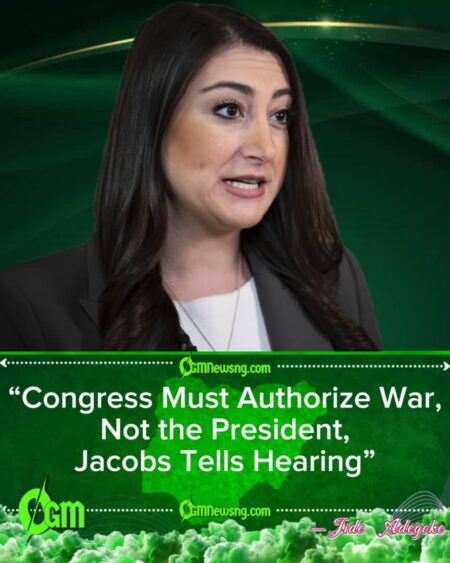
WASHINGTON, D.C. — U.S. Representative Sara Jacobs has sharply criticized President Donald Trump’s threat to deploy American military forces to Nigeria, calling the statement “reckless” and “unauthorized” during a congressional hearing on Thursday. The hearing, which examined allegations of Christian persecution in Nigeria, followed the Trump administration’s decision to redesignate Nigeria as a “country of particular concern.”
Jacobs emphasized that despite rising security tensions in the region, the U.S. Congress has not authorized the use of force in Nigeria and that unilateral military declarations carry serious diplomatic and legal consequences.
Sara Jacobs Opens Debate on U.S. Authority
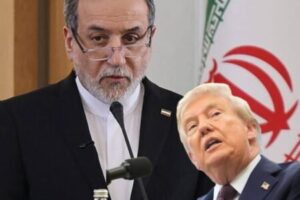
President Trump’s threat to send American troops “guns-a-blazing” into Nigeria became a flashpoint in the hearing, prompting Rep. Sara Jacobs to reiterate that Congress alone has the constitutional authority to approve military force. She argued that no such authorization exists regarding Nigeria and warned that bypassing Congress undermines the nation’s democratic processes.
Jacobs told the panel that even in discussions surrounding extremist violence in the region, broad presidential claims about deploying troops cannot substitute for lawful approval. She added that the president’s remarks risk fostering diplomatic tensions with Nigeria, a key U.S. partner in West Africa and an important regional actor in the fight against insurgency.
Sara Jacobs Warns of Diplomatic Fallout
Addressing the broader implications, Jacobs explained that President Trump’s threat of unapproved military action threatens to strain bilateral relations. She noted that the Nigerian government has frequently expressed concern over external interference, and any suggestion of unilateral U.S. deployment undermines Nigeria’s sovereignty.
She said the Trump administration should prioritize diplomatic engagement, security partnerships, and capacity-building programs rather than militarized rhetoric. According to Jacobs, responsible diplomacy requires acknowledging Nigeria’s complex domestic security environment and supporting local efforts rather than imposing foreign solutions.
Sara Jacobs Challenges the “Christian Persecution” Narrative
Jacobs also questioned the framing of violence in Nigeria as strictly “Christian persecution,” a narrative that heavily influenced the administration’s redesignation decision. While acknowledging targeted attacks on Christian communities, she argued that Nigeria’s conflict landscape is multidimensional—driven by terrorism, criminality, socioeconomic grievances, and climate-related disputes.
She stated that framing all violence as religious persecution risks misleading policymakers and can lead to ill-considered responses such as the president’s threat of military intervention. Instead, she urged a nuanced understanding of regional dynamics to ensure that U.S. responses address root causes rather than exacerbate tensions.
Sara Jacobs Calls for Evidence-Based Policy
Jacobs pressed witnesses and administration officials on whether intelligence assessments justified redefining Nigeria as a “country of particular concern.” She noted that no clear evidence had been presented to Congress indicating that conditions in Nigeria met the threshold required for such a designation.
Her critique of the process led to broader questions about whether the redesignation was politically motivated. She warned that decisions not rooted in fact can distort U.S. foreign policy and embolden extremist groups who view American overreach as an opportunity to rally local support. By contrast, she said, thoughtful policy informed by reliable intelligence strengthens both U.S. credibility and regional stability.
Sara Jacobs Urges Focus on Civilian Protection and Humanitarian Aid
Jacobs emphasized that communities in Nigeria’s conflict-affected regions urgently need humanitarian assistance, protection for displaced civilians, and support for local peacebuilding efforts. She said the administration’s focus on military threats detracts from the practical steps the U.S. can take to reduce human suffering.
She concluded that American resources should be directed toward expanding early-warning systems, supporting Nigerian civil society groups, and improving accountability mechanisms for security forces. These measures, she argued, will do far more to stabilize the country than “reckless threats of military action.”
Sara Jacobs Calls for Bipartisan Oversight
In her final remarks, Jacobs urged lawmakers on both sides of the aisle to reinforce congressional war-powers authority. President Trump, now serving his second term, has faced criticism from both parties for making unilateral military statements without consultation.
Jacobs warned that if Congress does not assert its constitutional role, future presidents may escalate military commitments across the globe without democratic oversight. She called for renewed debate over the Authorization for Use of Military Force (AUMF) and for updated laws that clearly define presidential limits in foreign conflicts.
Table of Contents
Discover more from OGM News NG
Subscribe to get the latest posts sent to your email.