




U.S. President Donald Trump remains one of the most consequential figures in world politics—a leader whose every move sends ripples across continents, shaping the conversations of diplomats, media outlets, and ordinary citizens alike. His second term in office has cemented his image as a disruptive force in the international order, challenging diplomatic traditions that have defined global relations for decades. From renegotiating trade agreements to reshaping defense alliances, Trump’s influence has touched nearly every region, and his every decision reverberates far beyond Washington’s walls.
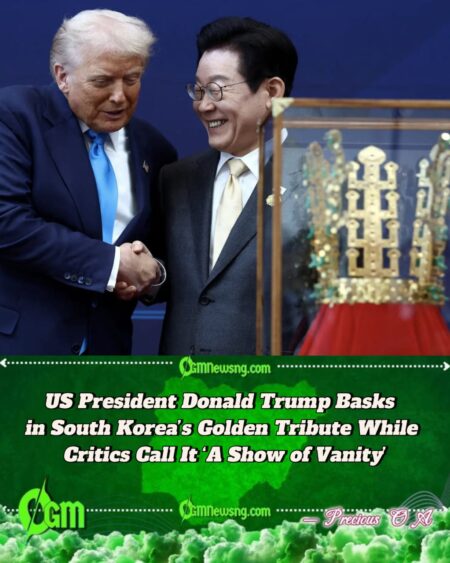
His recent visit to South Korea was not merely a political engagement; it was an event of global intrigue. The elaborate ceremony that awaited him, featuring a glittering golden crown and a meal of “beef patties with ketchup,” became a moment of international fascination—a spectacle that symbolized both admiration and irony, encapsulating the contradictions of American leadership under Trump’s unapologetically flamboyant rule.
Donald Trump arrived in Seoul to thunderous applause and a pageantry that rivaled a royal coronation. Streets were lined with banners bearing his name, while South Korean officials rolled out the red carpet in a display of opulence meant to honor their guest. In what was described as a gesture of friendship and respect, a shimmering golden crown was gently placed upon Trump’s head as cameras from across the world captured every second. The banquet that followed was meticulously planned around his famously simple culinary preferences: beef patties cooked to perfection, served with generous portions of ketchup—his signature condiment. The event, broadcast live on major networks, went viral almost instantly.
While Trump smiled broadly and waved to the cheering audience, political analysts around the world noted that beneath the golden sheen and applause lay a deeper message—a subtle yet calculated diplomatic act designed to appeal to Trump’s ego while simultaneously illustrating how global politics has adapted to his unpredictable style of leadership.
Donald Trump addressed the ceremony with his trademark bravado, calling it “a beautiful and tremendous show of respect.” His words, delivered before a hall filled with dignitaries, echoed the confidence that has come to define his presidency. To his supporters, the moment reflected global admiration for a strong and assertive leader unafraid to command the spotlight. Yet, for political observers and career diplomats, it carried a more complex symbolism.
The sight of an American president crowned abroad was, to many, a sign of shifting times—an indication that U.S. diplomacy has transformed from strategy to spectacle. “They flattered him, but they also framed him,” noted one South Korean political analyst, pointing out that the entire ceremony was a blend of charm, irony, and subtle satire, all executed with flawless precision.
The ceremony itself was steeped in layers of cultural and political meaning that went far beyond its surface glamour. To South Koreans, it was an opportunity to showcase their mastery of modern soft power—demonstrating how hospitality could serve as both a tool of diplomacy and a mirror of global dynamics. To the rest of the world, it was a vivid representation of the transformation of international relations in the Trump era, where image and performance often eclipse substance and negotiation. The golden glow, the smiling faces, and the flashing cameras painted a picture of harmony and respect, but underneath it all, seasoned diplomats recognized a quiet message of power redefined.
A Divided World Reacts to the Donald Trump Spectacle
Donald Trump once again found himself at the center of global conversation. Across continents, reactions to the Seoul spectacle varied dramatically, reflecting the world’s divided perception of his presidency. In Europe, newspapers described the event as “the coronation of populism,” highlighting what they viewed as Donald Trump’s transformation of politics into performance. In contrast, Asian commentators hailed it as a “strategic act of soft power,” a masterful demonstration of how smaller nations could navigate the unpredictable nature of American leadership. For South Korea, the event showcased not only cultural grace but also strategic brilliance—an ability to engage Trump’s personality while steering the diplomatic narrative to its advantage.
Donald Trump dominated international headlines as images of his golden crown and ketchup-covered banquet circulated across social media. Hashtags like #TrumpCrownedInKetchup, #GoldenFiddleDiplomacy, and #CrownOfIrony trended worldwide, with millions debating whether the display was one of genuine admiration or playful mockery. Supporters flooded online spaces with praise, declaring that no other world leader commanded such attention or received such extravagant receptions. Critics, however, viewed the event as a carefully orchestrated spectacle that catered to Trump’s vanity while subtly underscoring America’s diminishing moral and diplomatic authority.
Global analysts weighed in, describing the Seoul ceremony as a reflection of how international politics has adapted to Trump’s personality-driven leadership style. Nations that once approached Washington with caution and reverence now engage with the United States through performance and symbolism rather than persuasion. “The world has learned that Trump’s diplomacy runs on flattery and optics,” observed one European commentator. “They’re not mocking him directly—they’re speaking his language.” What was once described as the “American Century” has evolved into the “Age of Image,” where influence is measured not by treaties or institutions, but by the viral reach of a single photo op.
Donald Trump may have succeeded in keeping America at the center of global discourse, but the tone of that conversation continues to shift. His supporters see him as a visionary, redefining leadership with charisma and audacity. His detractors see him as a performer, turning serious diplomacy into an ongoing reality show. Either way, the event in Seoul reinforced a central truth about his presidency: that for Trump, being talked about—whether with admiration or ridicule—is the ultimate form of power.
The Theater of Power and America’s Changing Image
Donald Trump has reshaped the art of statecraft by fusing politics with performance, and his crowning moment in Seoul epitomized that fusion perfectly. The golden crown glittered under the lights, the cameras flashed endlessly, and the ketchup-coated beef symbolized a blend of American simplicity and global irony. For Trump, the event was a triumph of optics, proof that his presence could command attention and admiration anywhere in the world. For his critics, however, it was another reminder that America’s global influence, once anchored in diplomacy and principle, now relies heavily on personality and perception.
Donald Trump has long understood the persuasive power of visual symbolism. His rallies, speeches, and foreign trips are choreographed with precision to evoke emotion and spectacle. To his supporters, the crown represented victory, strength, and global respect—a sign that America had reclaimed its place atop the world stage. To his critics, it was a symbol of excess and self-adulation, a performance designed to entertain rather than to enlighten. Either way, the message was clear: the world was once again watching Donald Trump, and by extension, watching America through his lens.
Critics of the administration argue that the Seoul spectacle underscored a deeper issue—the erosion of America’s traditional diplomatic gravitas. They contend that while Trump’s theatrics may captivate audiences, they also diminish the serious, measured tone that once defined U.S. global leadership. The reliance on grand gestures and media-driven narratives, they say, has turned America’s foreign relations into a stage act where substance often plays second fiddle to showmanship. “Diplomacy used to be about strategy,” said one former ambassador. “Now, it’s about spectacle—and Donald Trump is its greatest showman.”
Donald Trump left Seoul with applause ringing in his ears and headlines blazing across the globe. But as the images of his gilded crown and ketchup banquet continue to circulate, they serve as a vivid metaphor for the evolving nature of American power: bright, bold, attention-grabbing, yet increasingly theatrical. The crown may have been symbolic, but the message it sent was unmistakable—America’s influence endures, though not as it once did. Under Trump, it gleams in gold, tastes of ketchup, and speaks the language of spectacle.
Table of Contents
Discover more from OGM News NG
Subscribe to get the latest posts sent to your email.