





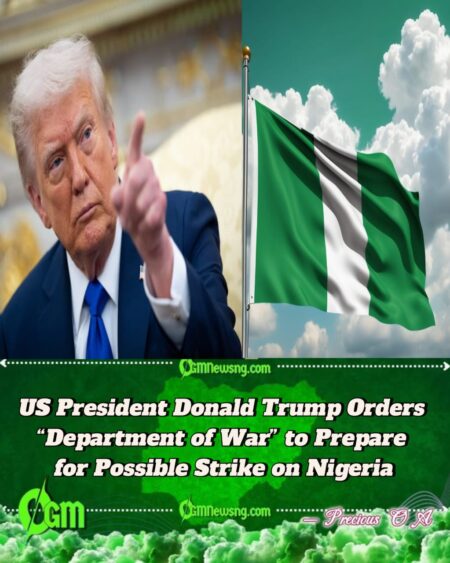
US President Donald Trump issued a direct instruction to the Department of War, telling defense planners to prepare for possible action against Nigeria, emphasizing that if America strikes, “it will be fast, vicious, and sweet.” His remarks came amid growing frustration within the administration over reports of religious killings and violent attacks on Christian communities in parts of Nigeria. The president’s words, stark and uncompromising, were seen as both a warning to Abuja and a signal of Washington’s readiness to use force if diplomatic appeals fail.
His declaration sent shockwaves across international diplomatic circles, with many analysts interpreting it as one of the most forceful statements by a sitting American president toward an African nation in recent years. The tone of the statement, layered with both moral urgency and military intent, underscored the president’s conviction that America’s power must be felt wherever human rights violations persist.
Donald Trump clarified that the United States will immediately halt all financial aid and humanitarian assistance to Nigeria, pending a comprehensive security review. Senior officials in Washington have since begun drafting contingency plans to assess potential military, cyber, and intelligence options should hostilities escalate. Analysts note that the president’s framing of the issue — invoking both moral urgency and military readiness — reflects his administration’s increasingly aggressive foreign policy tone.
White House insiders revealed that this was not an impulsive outburst but rather a carefully timed warning after weeks of internal deliberation and intelligence briefings. According to sources, Trump’s team believes that suspending aid will apply the right amount of pressure on Nigeria’s leadership to restore peace and demonstrate accountability in its security operations.
Donald Trump’s warning has drawn intense discussion within the Pentagon and the National Security Council, where aides are reportedly evaluating various strategic responses, from precision deterrent operations to full-scale intervention scenarios. While officials emphasized that no final decision has been made, the president’s order marks a significant escalation in tone and may compel rapid realignment of U.S. defense priorities in West Africa.
His administration maintains that America will not “stand idle while innocent Christians are slaughtered.” This sentiment, repeated by his senior advisers, has found support among certain evangelical and conservative circles in the United States, who view Trump’s statement as a moral stand against religious persecution. The Pentagon, however, remains cautious, aware that any military movement in Africa could quickly spiral into a prolonged conflict with unpredictable outcomes.
The White House argued that the instruction to prepare for action is intended primarily as leverage against Nigeria’s leadership rather than a guarantee of military conflict. Nevertheless, experts point out that even rhetorical threats from a sitting U.S. president carry heavy diplomatic weight, especially in volatile regions where alliances and perceptions shift quickly.
Legal and constitutional analysts have also begun debating whether such unilateral action, if executed, would require congressional approval or international authorization. Behind closed doors, foreign policy advisers are said to be weighing the political consequences of appearing too aggressive against the risk of appearing indifferent to human rights violations. The balance between deterrence and diplomacy, they say, has never been more delicate in Trump’s foreign policy playbook.
Nigerian Response and Humanitarian Concerns
Donald Trump’s statement provoked swift condemnation from Nigerian officials, who described it as a dangerous overreach and a violation of international norms. Abuja maintained that its government is actively combating extremist violence and that portraying Nigeria as negligent is both unfair and misleading. The Nigerian presidency called for calm while reaffirming the nation’s sovereignty, arguing that external threats would only destabilize ongoing counterterrorism operations and embolden insurgents.
Nigerian media outlets have since framed Trump’s warning as both a diplomatic provocation and a test of the country’s resilience on the global stage. Citizens have taken to social media with mixed reactions — some expressing anger over foreign interference, others pleading for international help to end the bloodshed that has plagued parts of the nation.
Donald Trump’s decision to suspend U.S. aid has sent shockwaves through humanitarian organizations operating in Nigeria. These groups warn that the abrupt withdrawal of funds could cripple life-saving programs that deliver food, medical care, and shelter to displaced populations. Aid coordinators argue that punitive economic measures may worsen the very crisis the United States seeks to address, especially in rural regions where local infrastructure and governance remain fragile.
Relief agencies, already stretched thin by ongoing insecurity, fear that suspension of funding could trigger a humanitarian catastrophe affecting millions. Despite these concerns, administration officials maintain that aid suspension remains one of the few non-military tools available to pressure foreign governments into compliance with international human rights standards.
International observers reacted with alarm, saying the situation highlights how quickly diplomatic relationships can unravel under public threats of force. African Union representatives and ECOWAS officials urged both Washington and Abuja to return to dialogue and prevent any slide toward military confrontation. Analysts warn that the optics of a U.S. strike on African soil could have long-lasting repercussions for American influence and regional stability. The European Union joined calls for restraint, emphasizing that cooperation, not coercion, should remain the foundation of U.S.–Africa relations. Many observers fear that any escalation could embolden extremist groups in the Sahel, who thrive on political instability and anti-Western sentiment.
Donald Trump’s remarks also triggered unease across Africa and within regional bodies such as ECOWAS and the African Union. Leaders fear that a U.S. military strike could ignite a wider regional conflict, destabilizing neighboring countries already struggling with insurgencies and displacement crises. Diplomats from across the continent are urging both nations to pursue de-escalation, warning that militarization could reverse years of counterterrorism progress. The African Union’s Peace and Security Council has reportedly convened emergency consultations to assess potential fallout and coordinate a collective response to prevent escalation.
Global Fallout and Strategic Implications
Donald Trump’s declaration has drawn a mixed reaction from America’s allies. While some European partners privately acknowledge the gravity of the situation, others caution that unilateral military engagement could undermine regional diplomacy. NATO representatives have quietly expressed concern that any sudden U.S. deployment to Nigeria might stretch existing commitments and blur the boundaries between counterterrorism and humanitarian intervention. Behind the scenes, several foreign ministries have reached out to Washington, offering to mediate or facilitate quiet diplomacy before the situation spirals further.
Donald Trump’s threat has reignited legal debate in Washington and abroad over the limits of presidential war powers. Constitutional scholars argue that any offensive action against Nigeria would require congressional oversight and must conform to international law governing the use of force. The president’s invocation of a “Department of War” — a term replaced decades ago by the Department of Defense — has also fueled questions about intent and tone within diplomatic circles. Some critics see the phrasing as a deliberate attempt to project raw power and revive wartime symbolism to rally nationalist sentiment at home.
Donald Trump’s broader Africa policy is now under scrutiny, with analysts warning that military coercion could alienate strategic partners at a time when cooperation is most needed. Experts in global security emphasize that aid suspension and threats of force could create power vacuums exploited by extremist factions. Instead, they advocate for a combined approach of targeted security support, dialogue, and socioeconomic investment to stabilize affected regions. Many also warn that the U.S. risks isolating itself diplomatically if it continues to approach African crises through threats rather than sustained partnership.
Global analysts believe that the president’s warning, though dramatic, has placed both Washington and Abuja at a pivotal crossroads. The days ahead will determine whether this threat ushers in a new era of confrontation or compels renewed diplomacy between two historically cooperative nations. For now, the tension underscores the delicate balance between power and principle — and the far-reaching consequences when presidential words shake global order.
Table of Contents
Discover more from OGM News NG
Subscribe to get the latest posts sent to your email.