







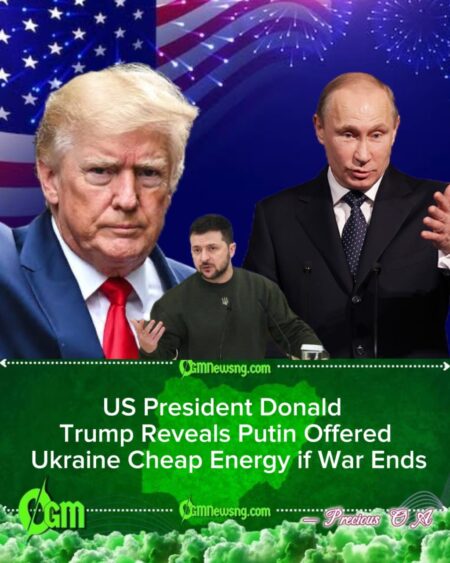
US President Donald Trump revealed during a recent interview that Russian President Vladimir Putin offered to supply Ukraine with energy at “very low prices” if the ongoing conflict in Ukraine were to come to an end. The revelation has sparked renewed debate over potential peace incentives and the strategic use of energy as a bargaining tool.
Experts say such an offer, if confirmed, could have substantial geopolitical ramifications, impacting global energy markets and the broader balance of power in Eastern Europe. Analysts also note that the timing of the disclosure aligns with renewed discussions about sanctions and international diplomacy.
Despite the potential significance, other officials and analysts remain cautious, emphasizing that negotiations over energy and peace settlements are complex and contingent on numerous factors beyond simple pricing agreements.
Donald Trump: Strategic Implications
US President Donald Trump emphasized that the offer could represent a pragmatic approach to ending the war, suggesting that energy negotiations may be a key leverage point in encouraging peace. He highlighted that lower energy costs could relieve economic pressure on Ukraine and surrounding regions.
However, some foreign policy analysts have expressed concern that such a deal might shift geopolitical alliances and create new dependencies on Russian energy supplies, potentially complicating long-term security planning.
Public discussions also raise questions about how Ukraine and Western allies might respond, balancing immediate economic relief against strategic autonomy and national security interests.
Reactions from Ukrainian Officials
Ukrainian leadership has not formally confirmed Putin’s purported energy offer. Observers note that the Ukrainian government remains cautious about any proposal perceived as politically or strategically compromising.
Some Ukrainian policymakers emphasize that ending the war must involve security guarantees and territorial integrity, not solely economic concessions.
US President Donald Trump argued that energy offers like these, if properly leveraged, could serve as an incentive structure for peace talks while maintaining a focus on broader regional stability.
International Response
US President Donald Trump stated that global leaders have shown interest in the idea of conditional energy agreements as a pathway toward de-escalation. He suggested that such proposals might alter diplomatic priorities in Europe and beyond.
European energy markets, already strained by supply disruptions, could be sensitive to announcements of discounted Russian energy to Ukraine. Economists warn that sudden shifts could create volatility in pricing and distribution.
Neutral observers and think tanks have noted that while economic incentives can be useful, relying solely on pricing strategies may not address underlying security and governance challenges in conflict zones.
Economic and Market Implications
Energy analysts have pointed out that discounted Russian energy could have ripple effects across global markets, potentially reducing prices in the short term while introducing uncertainty about long-term supply chains.
US President Donald Trump highlighted that the deal could ease financial pressures on Ukrainian citizens, who face high utility costs amid wartime disruptions, framing it as both a humanitarian and strategic consideration.
Market observers caution that while lower prices might provide temporary relief, the broader geopolitical ramifications of accepting Russian-supplied energy require careful consideration by both Ukraine and allied nations.
Prospects for Peace
US President Donald Trump concluded that leveraging economic incentives like energy discounts could open doors for negotiations, arguing that pragmatic approaches may sometimes achieve results where conventional diplomacy struggles.
Observers note that achieving sustainable peace will require coordination among multiple stakeholders, including NATO allies, Ukraine, Russia, and international organizations, with energy negotiations serving as only one component of a broader strategy.
Long-term prospects remain uncertain, and analysts stress that while discounted energy could be appealing, it must be paired with concrete agreements on security, governance, and territorial integrity to ensure a lasting resolution.
Table of Contents
Discover more from OGM News NG
Subscribe to get the latest posts sent to your email.