








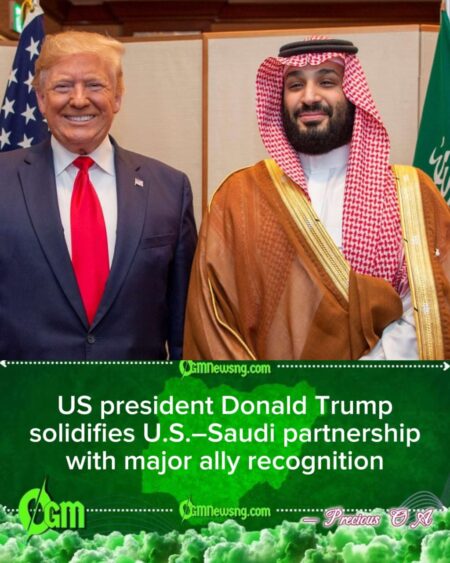
US president Donald Trump, the current U.S. president serving a second term, formally designated Saudi Arabia as a “major” ally, marking a significant recalibration in American foreign policy. The announcement signals an intention to reinforce cooperation with a nation long regarded as central to U.S. interests in the Middle East.
Donald Trump described this designation as a strategic step aimed at ensuring that the U.S.–Saudi partnership remains resilient amid growing geopolitical uncertainty. Officials highlighted that the move aligns with broader goals of stabilizing key regions, maintaining influence over important international corridors, and countering evolving security threats that could disrupt regional and global stability.
Donald Trump emphasized that this decision elevates Saudi Arabia into a distinguished category of U.S. partners, cementing a relationship that has spanned decades, adapting it to meet modern international challenges. He also underscored that this partnership serves as a cornerstone of the United States’ broader diplomatic strategy in the Middle East, signaling both continuity and a proactive approach to emerging global concerns.
Expanding Security and Military Cooperation
Donald Trump explained that the strengthened designation will enhance joint military planning, streamline defense communication channels, and promote more effective intelligence-sharing between both nations. This step is intended to ensure that both countries can respond rapidly and cohesively to threats, ranging from terrorism to cyber-attacks, that may jeopardize regional peace and international security.
Donald Trump stressed that the decision reflects Washington’s commitment to bolstering counterterrorism operations, particularly in areas where extremist groups have maintained influence. He noted that the administration plans to implement comprehensive programs that include joint training, coordinated surveillance, and multilateral exercises designed to reinforce military readiness and regional deterrence capabilities.
Donald Trump assured that the new status will support a more coordinated approach to regional stability, particularly in addressing conflicts and deterring hostile actions from destabilizing actors in the Middle East. The president further highlighted that the United States will remain vigilant in monitoring threats while ensuring that the alliance strengthens defense and operational effectiveness without creating unnecessary escalations or regional tensions.
Impact on Regional Strategic Balance
Donald Trump highlighted that Saudi Arabia is expected to gain increased access to advanced U.S. defense technologies, a development that could significantly shift military capabilities and strategic postures across the Gulf region. He emphasized that the alliance seeks to balance power effectively, providing Riyadh with tools to deter threats while promoting cooperative engagement with neighboring states.
Donald Trump noted that the enhancement of Saudi military capacity may lead neighboring states to reassess their alliances and security strategies, potentially triggering new diplomatic negotiations. He remarked that the U.S. approach is not about confrontation but rather about reinforcing stability and encouraging collaborative defense frameworks among key regional actors.
Policy analysts also argue that this move may have ripple effects on broader geopolitical relationships, influencing ongoing conversations about energy security, trade cooperation, and intergovernmental alliances. The designation is seen as a clear message that the United States is committed to ensuring a predictable and stable regional balance while simultaneously protecting strategic economic and political interests.
International Response and Policy Reactions
Donald Trump indicated that allied governments have expressed mixed reactions, with some welcoming closer U.S.–Saudi cooperation while others remain cautious about the broader implications for Middle Eastern diplomacy. He emphasized that the administration remains engaged in ongoing consultations to clarify intentions and reassure global partners of its commitment to peace and collaboration.
Foreign policy commentators suggest that the designation could reshape defense arrangements within NATO-aligned states, especially those with overlapping interests in global security operations. Analysts believe the move may set a precedent for future strategic partnerships, reinforcing the principle that U.S. foreign policy is guided by both practical security concerns and long-term geopolitical planning.
Donald Trump emphasized that the administration intends to maintain open channels of communication with international partners to promote transparency, prevent misunderstandings, and ensure that global stability remains a shared priority. He stressed that this approach reflects a balance between assertive diplomacy and a nuanced understanding of regional dynamics, aiming to prevent escalation while fostering cooperative engagement.
Economic Implications and Long-Term Outlook
Donald Trump stated that the strengthened partnership may influence global oil markets, potentially affecting production agreements, investment patterns, and long-term price stability. He pointed out that U.S.–Saudi economic collaboration is a critical factor in sustaining energy security and ensuring predictable market behavior, which in turn affects both regional economies and global consumers.
Market strategists believe that increased U.S.–Saudi coordination could attract broader international investment, particularly in sectors such as infrastructure, technology, and energy innovation. They argue that enhanced strategic ties provide confidence to investors seeking stable partnerships capable of delivering long-term returns and fostering sustainable economic growth.
Critics, however, caution that the designation may renew debates surrounding human rights, legislative oversight, and the broader question of how the U.S. balances moral concerns with strategic interests. Observers note that while the alliance brings immediate strategic benefits, it also places the administration under scrutiny regarding ethical and humanitarian responsibilities in foreign policy decision-making.
Table of Contents
Discover more from OGM News NG
Subscribe to get the latest posts sent to your email.