





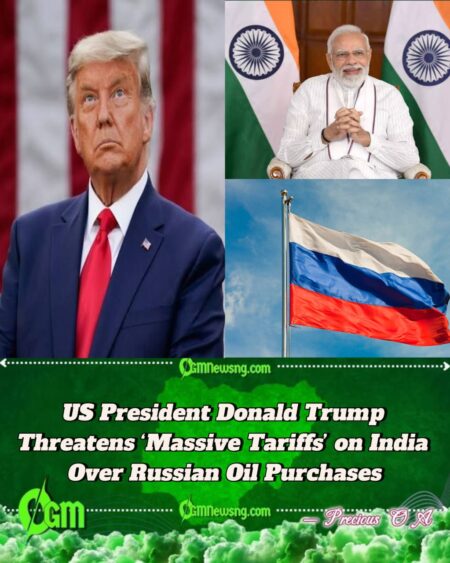
The U.S. President Donald Trump, the outspoken and assertive leader known for his hardline economic policies and unapologetic stance on global trade, has once again made his position clear to the world. On Sunday, he declared that he will maintain “massive” tariffs on Indian goods for as long as India continues to purchase oil from Russia, insisting the measure is essential to prevent funding Moscow’s ongoing war in Ukraine. The announcement, made during an impromptu press conference aboard Air Force One, underscores Trump’s signature blend of economic nationalism and strategic pressure, reinforcing his reputation as a leader unafraid to wield America’s economic power on the world stage.
President Donald Trump said he had personally discussed the issue with Indian Prime Minister Narendra Modi, claiming that Modi assured him India would soon halt all Russian oil imports. “He said he’s not going to be doing the Russian oil thing,” Trump remarked, underscoring his belief that India’s purchases indirectly support the Kremlin’s war machine. “Until they stop, we’re keeping the tariffs—big tariffs. Massive.”
Donald Trump has made economic pressure a central feature of his foreign policy, linking trade, security, and sanctions enforcement into a single strategy of economic leverage. He emphasized that nearly half of the existing 50% tariffs imposed on Indian goods earlier this year are directly connected to India’s ongoing oil relationship with Russia. According to Trump, the tariffs are not punitive but “protective of global order and peace,” arguing that revenue from Russian oil sales must be choked off to hasten an end to the war in Ukraine.
White House officials have framed the move as part of a broader campaign to isolate Moscow economically. Treasury Secretary Scott Bessent defended the policy, accusing Indian refiners of profiting from discounted Russian crude and re-exporting refined products at higher global prices. “They’re making billions from cheap Russian oil and selling to the world at market value,” Bessent said. Several U.S. lawmakers have since proposed extending the measures through the Sanctioning Russia Act, which could impose tariffs up to 500% on countries that persist in purchasing Russian energy.
Donald Trump’s tough rhetoric underscores a growing U.S. frustration with nations seen as undercutting sanctions. In the president’s view, allies must align fully with Washington’s campaign to isolate Russia economically. “You can’t be with us and keep funding Putin,” Trump declared, signaling that India’s choices in the coming months will directly determine its trade privileges with the United States.
India Pushes Back Amid Energy Security Concerns
In New Delhi, the Ministry of External Affairs swiftly dismissed Trump’s claims of an agreement, saying it was “unaware of any such conversation” between Modi and the U.S. president. Officials reiterated that India’s decisions on energy procurement are guided by national interests and energy security, not external pressure. “Our policy is determined by the needs of Indian consumers,” a spokesperson stated.
Donald Trump’s ultimatum has left Indian policymakers facing a delicate balancing act. While India remains a strategic partner of the United States, its dependence on Russian oil has grown sharply since Western sanctions began. Discounted Russian crude now accounts for roughly one-third of India’s total imports, providing critical relief from volatile global oil prices. Cutting that supply abruptly could trigger inflation and energy shortages across the country.
Donald Trump’s aggressive trade stance has, however, forced India to explore diversification. Recent reports suggest New Delhi is negotiating expanded U.S. oil and liquefied natural gas imports to offset any future reduction in Russian supply. Yet experts caution that logistical constraints—such as limited shipping capacity and higher freight costs—make an immediate shift improbable. “Replacing Russian oil overnight is simply unrealistic,” energy analyst Vandana Hari told Reuters.
Donald Trump’s comments have also reignited debate within India’s parliament about how much autonomy New Delhi can maintain in its foreign policy. Opposition leaders criticized Modi for being “too soft” in responding to Trump’s pressure, while others urged caution, warning against endangering India’s export sector. Despite public defiance, India has left the door open for quiet negotiation, signaling a possible compromise if Washington offers economic incentives in return.
Observers in both capitals say Trump’s warning comes at a politically sensitive moment for India, as it seeks to maintain its neutral stance between Western powers and the Russia-China bloc. The government’s immediate goal is to prevent a breakdown in relations with either side, even as both Washington and Moscow intensify pressure.
Economic and Geopolitical Stakes on the Line
Donald Trump’s tariffs and threats of further escalation have sent ripples through financial markets, with Indian exporters expressing concern over declining U.S. orders. The United States remains one of India’s largest trading partners, and any prolonged tariff war could erode billions of dollars in export revenue, particularly for textiles, pharmaceuticals, and information technology services. Analysts warn that a sustained conflict could dampen India’s economic growth just as it begins to recover from last year’s downturn.
Donald Trump’s approach, though controversial, aligns with his broader “America First” economic doctrine—one that seeks to reward allies who align with U.S. strategic goals and penalize those who don’t. Critics, however, argue that punishing India risks alienating a key partner in the Indo-Pacific, especially as Washington seeks to counterbalance China’s growing influence in the region. “The U.S. can’t afford to lose India’s cooperation,” said Michael Kugelman of the Wilson Center.
Donald Trump’s decision also has major geopolitical implications. India’s continued oil trade with Russia provides Moscow with one of its few stable revenue sources amid Western sanctions. Should India bow to American pressure, it would mark a significant diplomatic win for Washington and a setback for the Russia-India partnership that dates back to the Cold War. However, such a move could provoke backlash from Moscow, potentially affecting defense and energy deals worth billions.
Donald Trump’s economic maneuver has also revived questions about global double standards. Critics in India and beyond argue that while Washington targets New Delhi, it has been less vocal about China’s massive Russian oil imports. “There’s a perception of selective enforcement,” said Dr. Rajeswari Pillai of the Observer Research Foundation. “That undermines the credibility of U.S. sanctions and complicates India’s calculus.”
Donald Trump’s administration appears prepared for a drawn-out standoff. Officials have hinted that further tariff increases or targeted sanctions could follow if India does not alter course by the end of the year. Meanwhile, diplomats on both sides are quietly working to prevent a complete rupture in relations. For now, Trump’s message remains firm: the tariffs stay until India stops buying Russian oil. Whether New Delhi yields—or calls Washington’s bluff—will define one of the most consequential foreign policy tests of his second term.
Table of Contents
Discover more from OGM News NG
Subscribe to get the latest posts sent to your email.