







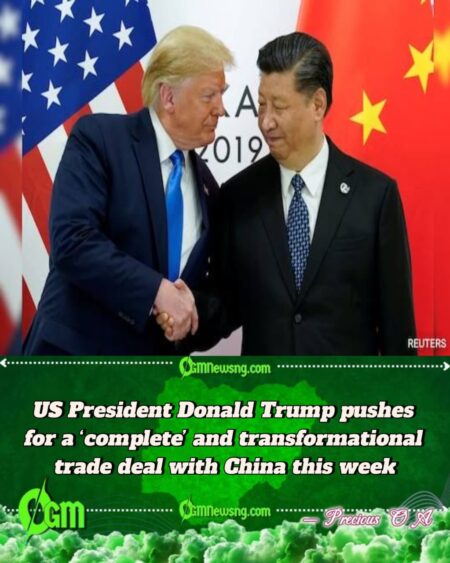
President Donald Trump, the current U.S. President and a central figure in reshaping global trade dynamics, says he hopes to finalize what he calls a “complete” trade deal with China during his diplomatic visit this week. His administration has positioned these upcoming talks as a pivotal moment for global markets and a crucial effort toward balancing long-standing economic disputes between Washington and Beijing. The President has repeatedly emphasized that the United States can no longer tolerate what he views as unfair trade conditions that have harmed American jobs and economic independence, making this mission both politically symbolic and economically urgent.
Negotiators close to the discussions note that he has repeatedly argued that previous trade arrangements placed the United States at a disadvantage, particularly in manufacturing and technology sectors. His goal, he insists, is to secure an agreement that addresses structural imbalances while boosting opportunities for American businesses internationally. The administration believes a successful deal could trigger rapid industrial expansion and improve revenue streams across multiple states where trade has long been a controversial topic.
Donald Trump is also expected to push for stronger intellectual property protections and more equitable market access for U.S. firms. These demands have long been central to Washington’s negotiating stance and remain critical as economic rivalry over next-generation innovation intensifies. U.S. officials argue that American technological breakthroughs have been undervalued and insufficiently protected in global markets, discouraging investment and limiting America’s ability to fully capitalize on the digital age.
Chinese officials, however, may resist concessions affecting state-controlled industries and technological autonomy. While the U.S. seeks transformative changes, China emphasizes national sovereignty and resilience against external pressure. The country has built much of its modern economic identity on maintaining control over industrial strategy, meaning any shift could alter its developmental path and political standing. This ideological divide adds complexity to talks that are already delicate and deeply layered.
Global economists are closely monitoring outcomes that could either support market stability or reignite uncertainty after years of tariff skirmishes and disrupted supply chains. Financial experts warn that another round of tensions could create ripple effects felt from major stock exchanges to small businesses relying on imports. Markets now wait to see whether hope or turbulence will define the next chapter of U.S.–China relations.
Diplomatic Challenges and Strategic Calculations
Donald Trump begins negotiations under complex geopolitical conditions, where the U.S.–China rivalry stretches beyond trade into national security, technological competition, and global influence. Reducing supply-chain vulnerabilities — especially in electronics and pharmaceuticals — is now a core American objective. The President has framed these issues as matters of national resilience, insisting the United States must maintain leverage over access to essential goods and strategic technologies.
Beijing, facing slowing economic growth and increasing scrutiny from the international community, is expected to tread carefully, balancing diplomacy with the need to project strength to domestic audiences. Chinese leadership is under pressure to ensure that any agreement does not appear to compromise long-standing national priorities or weaken its influence on regional and international affairs.
Donald Trump intends to employ his direct negotiation style while simultaneously reinforcing America’s international leadership posture. High-level talks, ceremonial events, and targeted policy briefings are planned to build momentum where progress has previously stalled. The White House views this visit as an opportunity not only to secure economic gains but to reaffirm its stance as a global power capable of shaping international trade rules.
Achieving a full restructuring of trade rules between two powerful economies is inherently complex and will require ongoing political commitment, even if both nations agree on major principles. Policy experts caution that transforming agreements into enforceable outcomes often requires years of legal and regulatory coordination across multiple agencies and industries, making patience a crucial element of progress.
Donald Trump will also influence how international partners respond, as countries worldwide evaluate the outcomes to guide their own trade strategies with China. The ripple effect of any deal reached — whether comprehensive or incremental — could reposition trade alliances and alter competitive dynamics in Europe, Asia, and emerging markets.
Economic Stakes for Consumers and Global Markets
Donald Trump is steering discussions that could deliver immediate benefits to American consumers through reduced tariffs on everyday goods and stabilized prices within domestic industries dependent on Chinese imports. Consumer advocates believe a positive shift in trade rules could restore affordability in markets where price spikes have hurt households, especially those reliant on electronic devices, clothing, and home products.
Donald Trump is also under pressure from U.S. manufacturers, farmers, and technology companies urging expanded access to China’s vast market. A successful deal could unlock billions in growth and strengthen America’s global competitiveness. Industrial leaders argue that smoother trade relationships could enable new supply-chain partnerships, improve profitability, and accelerate innovation in growing sectors like clean energy and biotechnology.
Donald Trump acknowledges that China, too, seeks economic stability and relief for export sectors facing global demand shifts. Improved cooperation could attract investment and support China’s transition toward innovation-focused industries. The President believes that mutually beneficial success could help stabilize the global economy, reinforcing the importance of collaboration despite existing competition.
Financial analysts, reacting swiftly to diplomatic signals between the world’s two largest economies, have already shown cautious optimism in global markets. The anticipation alone has influenced stock indices and trade forecasts. Investors expect substantial movement in market confidence based on the tone of official announcements this week, particularly within the manufacturing and technology sectors.
Donald Trump approaches these negotiations knowing that the consequences extend far beyond political optics — they shape the economic future of both nations and influence global prosperity for years to come. His push for a “complete” deal now represents not only a bold economic objective but a defining test of his administration’s diplomatic strategy and long-term policy vision.
Table of Contents
Discover more from OGM News NG
Subscribe to get the latest posts sent to your email.