







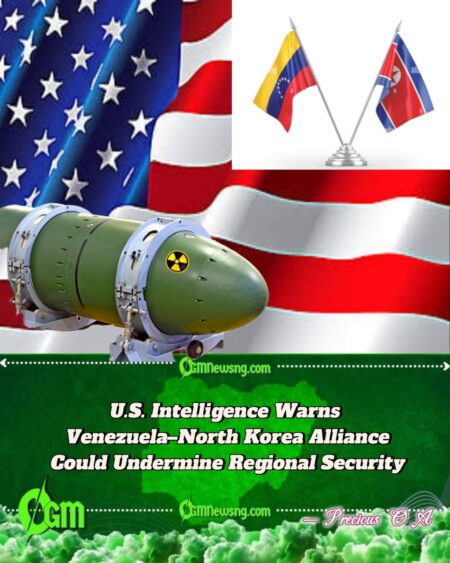
US intelligence reports suggest that North Korea is quietly deepening its strategic partnership with Venezuela in ways that directly challenge American influence in South America. According to sources familiar with recent assessments, Pyongyang has been supplying missile technology, advanced drones, and troop training to Venezuelan forces in exchange for economic and political support. The arrangement is viewed as part of North Korea’s broader effort to expand its global reach while evading international sanctions.
US intelligence indicates that Venezuela has been receptive to the cooperation, seeing North Korea as a willing partner that is not bound by Western restrictions. For Caracas, access to advanced weapons and military expertise is seen as a safeguard against perceived threats from Washington and neighboring states. The reported deal includes not only material transfers but also knowledge-sharing, especially in the field of satellite programming and nuclear stockpile management.
US intelligence further warns that Venezuela’s military modernization is not merely symbolic. The acquisition of advanced missile systems and drone technology provides Caracas with capabilities that could alter the regional balance of power. In particular, drones capable of long-range reconnaissance and missile deployment are viewed as potential game-changers in contested areas, including disputed border regions with Colombia and Guyana.
Analysts point out that this partnership is not happening in a vacuum. Venezuela, isolated by years of sanctions and economic pressure, has long sought allies beyond the Western sphere. North Korea, equally isolated and under heavy sanctions, offers a unique partnership: one that prioritizes shared defiance of Washington over economic profitability. In effect, both countries are demonstrating that sanctions can be circumvented through mutual support and resource exchange.
Implications for Regional Security and U.S. Policy
US intelligence highlights that the deepening relationship between North Korea and Venezuela carries significant implications for regional security. South America has historically been considered an area where U.S. influence remains strong, but an infusion of North Korean weaponry into Venezuela could upend that dynamic. For Washington, the presence of advanced missile systems and foreign-trained troops so close to American borders raises concerns reminiscent of past Cold War flashpoints.
US intelligence assessments emphasize the risks posed by potential proliferation. The transfer of nuclear-related knowledge, if confirmed, would mark a dangerous escalation that could undermine international treaties designed to prevent the spread of weapons of mass destruction. Such developments could embolden Venezuela to adopt more confrontational postures toward its neighbors or leverage new capabilities in disputes with Washington.
US intelligence suggests that military exercises between Venezuelan forces and North Korean advisers have already been documented, raising alarm over how quickly Venezuela could adapt new capabilities. These exercises reportedly include drone deployments, missile targeting simulations, and satellite communications training. If accurate, such activities demonstrate a higher level of integration than previously suspected and could accelerate Venezuela’s military readiness.
Officials also warn that the United States may need to reconsider its current strategies in South America. The prospect of a heavily armed Venezuela backed by North Korean expertise could complicate U.S. foreign policy, forcing Washington to strengthen alliances with neighboring states, expand intelligence-gathering operations, and even adjust its military posture in the region. For countries like Colombia and Brazil, closer alignment with the U.S. may be seen as necessary to counterbalance Venezuela’s newfound strength.
Additional concerns arise over how this cooperation could embolden other adversarial states. If Venezuela successfully leverages North Korean support without facing immediate consequences, it could set an example for other governments under sanctions, such as Iran or Syria, to seek similar clandestine arrangements. Such ripple effects could weaken the global sanctions regime that Washington has relied on for decades to contain its rivals.
International Responses and Strategic Outlook
US intelligence assessments suggest that international reaction to the partnership will likely be divided. Allies of Washington, including Colombia and Brazil, are expected to express strong concern and may call for greater cooperation with the United States to counterbalance Venezuela’s growing power. Meanwhile, nations less aligned with Washington may adopt a cautious stance, wary of becoming entangled in a widening geopolitical confrontation.
US intelligence indicates that the United Nations and international monitoring agencies may face new challenges in enforcing sanctions against North Korea. Pyongyang’s activities in South America could represent a new theater of operations that is harder to track, particularly if transactions are concealed through third-party intermediaries, covert shipping routes, or cryptocurrency-based financial exchanges.
US intelligence officials argue that the relationship also underscores the limitations of existing sanctions regimes. Despite years of international restrictions, North Korea continues to find partners willing to exchange resources and expertise for political alignment. In Venezuela’s case, the partnership offers a chance to break free from isolation while projecting defiance against Washington.
US intelligence ultimately concludes that the evolving North Korea–Venezuela alliance represents more than a temporary partnership. It is a calculated effort by two sanctioned states to undermine U.S. influence while building their own networks of support. For Washington, this development may require a fundamental reassessment of how to secure its interests in the Western Hemisphere, particularly as adversarial powers move closer to America’s geographic sphere.
Looking ahead, experts suggest that Washington will likely respond with a combination of diplomatic pressure, expanded sanctions, and increased regional engagement. However, it remains uncertain whether these measures will be enough to counteract the momentum of this emerging alliance. What is clear is that the collaboration between Pyongyang and Caracas signals a shift in the geopolitical balance of the Americas, one that may prove difficult for the U.S. to ignore.
Table of Contents
Discover more from OGM News NG
Subscribe to get the latest posts sent to your email.