




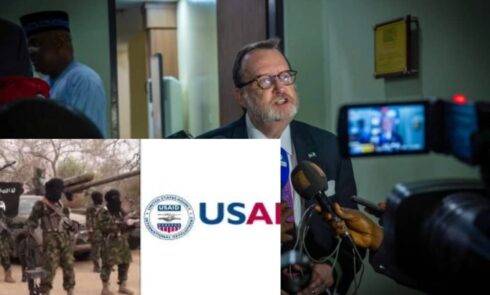
The United States Ambassador to Nigeria, Richard Mills, has firmly denied allegations that the United States Agency for International Development (USAID) is funding Boko Haram or any terrorist group in Nigeria. Speaking after a meeting with the Nigeria Governors Forum in Abuja late Wednesday night, Mills emphasized that the US government strongly condemns Boko Haram’s violence and remains a steadfast ally in Nigeria’s fight against terrorism.
Mills reassured Nigerian authorities and the public that if any credible evidence of USAID funds being misappropriated for terrorist activities emerges, the United States government will collaborate with Nigeria to investigate and address it. His statement comes in response to recent claims by United States Congressman Scott Perry, who alleged that USAID funds were being funneled to terrorist organizations, including Boko Haram.
Congressman Perry’s Allegations Spark Debate
The controversy arose when Congressman Scott Perry, a Republican from Pennsylvania, made a bold statement during a United States congressional hearing on government spending. During the session titled “The War on Waste: Stamping Out the Scourge of Improper Payments and Fraud,” Perry accused USAID of financing terrorist groups like Boko Haram, Al-Qaeda, and ISIS Khorasan through improper payments.
Perry stated, “Your money, $697 million annually, plus the shipments of cash funds in Madrasas, ISIS, Al-Qaeda, Boko Haram, ISIS Khorasan, terrorist training camps. That’s what it’s funding.” His remarks have drawn significant attention, prompting the Nigerian Senate to call on National Security Adviser Nuhu Ribadu, along with heads of intelligence agencies, to address the allegations.
United States Ambassador Reaffirms Commitment to Nigeria’s Security
In response to Perry’s claims, Ambassador Mills reiterated the United States government’s strict policies ensuring that no American assistance, including USAID funds, is diverted to terrorist groups.
“Let me be clear—there is no friend of Nigeria stronger in condemning Boko Haram’s violence and disregard for human life than the United States. We have designated Boko Haram as a foreign terrorist organization since 2013, blocking them from transferring assets to the United States and allowing us to arrest and seize their members,” Mills stated.
He further stressed that the United States closely monitors all assistance programs to Nigeria to prevent any misappropriation. “There is absolutely no evidence of such diversion, and if we ever had evidence that any program funding was being misused by Boko Haram, we would immediately investigate it with our Nigerian partners,” he assured.
US Aid to Nigeria Remains Strong
Contrary to speculation, Ambassador Mills clarified that United States assistance to Nigeria remains unchanged, with only a temporary review process initiated to enhance the effectiveness of aid distribution.
“No assistance has been cut yet, and no decisions have been made about the future of our assistance,” Mills stated. He explained that United States Secretary of State Marco Rubio had emphasized that the goal was not to end foreign aid to Nigeria but to ensure it aligns with United States policies and objectives.
The United States government has implemented a 90-day review period to assess and streamline aid programs, but essential life-saving assistance—such as healthcare support for HIV patients, maternal and child nutrition programs, and aid for internally displaced persons—continues uninterrupted.
Strengthening US-Nigeria Relations
During his meeting with the 36 state governors, Ambassador Mills outlined the US embassy’s vision for strengthening diplomatic and economic ties between the two nations. He highlighted four key priorities for United States-Nigeria relations moving forward:
- Boosting Trade and Investment – The United States aims to improve Nigeria’s business environment to attract more American investors and enhance economic collaboration.
- Enhancing Transparency and Accountability – Efforts to combat corruption and promote good governance in Nigeria will remain a focal point of United States engagement.
- Engagement at Subnational Levels – The United States plans to work more closely with state and local governments in Nigeria to ensure aid programs have a meaningful impact at grassroots levels.
- Strengthening Healthcare Initiatives – United States-backed health programs, such as HIV reduction and polio eradication, will continue with the long-term goal of transitioning them to Nigerian government management for sustainability.
Mills emphasized that the United States remains committed to Nigeria’s development and security, standing as a strong partner in the fight against terrorism while ensuring that aid programs remain transparent and effective.
Table of Contents
Discover more from OGM News NG
Subscribe to get the latest posts sent to your email.