








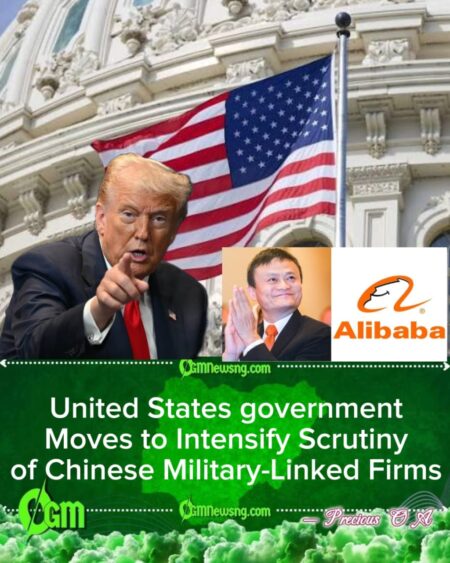
The United States government issues an extensively detailed and highly elaborate statement asserting that Alibaba should be formally added to the list of companies allegedly tied to the Chinese military, framing the move as part of a far-reaching and meticulously calibrated national security strategy. This strategy, according to federal officials, involves reassessing the intricate web of economic relationships, technological dependencies, and geopolitical pressure points that could create strategic vulnerabilities if foreign-owned or foreign-influenced corporations possess access to critical U.S. systems or data. The announcement is delivered with unusually expansive language, signaling the seriousness with which federal agencies are approaching the potential risks associated with multinational technology conglomerates whose size, scope, and opaque governance structures raise long-standing concerns.
United States government officials elaborate that the proposed designation is rooted in a sweeping evaluation of corporate hierarchies and cross-border financial pathways, asserting that Alibaba’s far-reaching influence in e-commerce, supply-chain logistics, artificial intelligence development, and data analytics places it at the center of a growing list of foreign companies warranting heightened scrutiny. According to these officials, the sheer scale of the company—combined with the challenges of verifying the extent of state influence—makes it essential to investigate how its operations may intersect with military-relevant technologies, dual-use innovations, and globally distributed digital infrastructure.
United States government analysts further describe the action as a protective measure intended to reinforce the structural integrity of national resilience. They note that the reassessment of transnational technology firms is not a one-time event but part of an adaptive security doctrine shaped by evolving intelligence insights, shifting geopolitical rivalries, and the increasingly blurred distinction between private-sector technological advancement and state-directed strategic capability. These analysts express that such evaluations are crucial as modern technological ecosystems grow more interdependent and as foreign entities pursue influence across global commercial sectors.
Implications for International Trade
United States government officials warn that including Alibaba on the military-linked list could trigger complex and far-reaching consequences in ongoing trade negotiations, potentially affecting tariff discussions, market access frameworks, and investment protocols. They stress that the economic relationship between the United States and China remains deeply intertwined, and any action involving a corporation of Alibaba’s magnitude is likely to reverberate through numerous bilateral agreements and longstanding trade channels.
United States government trade advisors outline the potential legal and regulatory implications that could come into effect if the designation becomes formal policy. They argue that such a listing may lead to a new wave of export controls, add layers of compliance requirements for American companies relying on Alibaba’s cloud or logistical infrastructure, and reshape the competitive landscape for digital commerce platforms. These advisors also acknowledge that Alibaba’s multinational footprint across Asia, Europe, and developing markets complicates enforcement, requiring coordination with foreign regulators who may interpret U.S. restrictions differently.
Global market observers caution that the move, even in its proposed form, may unsettle investor confidence in technology sectors. They explain that multinational corporations—especially those with vast digital ecosystems—tend to be sensitive to regulatory pressures, and shifts in perception created by military-affiliation designations can set off waves of reassessment among private investors, sovereign wealth funds, and global banks. They also highlight that supply-chain disruptions, changed investment trajectories, and reduced access to U.S. technologies could generate unpredictable ripple effects across multiple continents.
Technology and Cybersecurity Considerations
United States government cybersecurity officials stress that concerns surrounding Alibaba extend beyond traditional economic questions, emphasizing that the company’s deep involvement in cloud services, biometric technologies, cross-border digital payments, and algorithmic data processing creates a vast digital landscape in which national vulnerabilities could emerge. They argue that if any foreign military influence exists within the corporation, sensitive information could theoretically be leveraged for activities such as surveillance, cyber intrusion, or covert data exploitation.
U.S government reports highlight that the rapid expansion of emerging technologies has introduced unprecedented challenges for national-security strategists. The accelerating development of quantum computing, artificial intelligence models, and real-time data aggregation tools has collapsed the historical barrier between civilian and military technological domains. This collapse, officials argue, requires the U.S. to adopt a more aggressive posture in evaluating foreign entities operating at the cutting edge of innovation.
Technology critics note that Alibaba’s expanding reach into digital payments, cloud operations, transnational logistics, smart-city frameworks, and cross-platform social technologies underscores the importance of ensuring airtight security protocols. They add that modern digital ecosystems are vast, interconnected, and constantly shifting—meaning that vulnerabilities in one part of a global network can quickly cascade into others. This, they argue, reinforces the gravity of the U.S. government’s concerns.
Foreign Policy and Strategic Messaging
United States government diplomats frame the proposed designation as part of a broader strategic messaging initiative, asserting that Washington must respond firmly to geopolitical uncertainty by signaling that it will not overlook activities perceived as threats to United States national interests. The move, they explain, is meant to communicate a consistent and forceful stance on foreign corporate entanglements with state power structures.
United States government foreign-policy strategists claim that restricting military-adjacent companies aligns with evolving international standards regarding corporate transparency and data governance. They argue that democratic nations must present a unified front, establishing principles that guide corporate behavior in fields such as cybersecurity, encrypted communications, and cross-border data access.
International relations experts emphasize that this action may intensify competitive pressure between the world’s two leading global powers. They explain that each new regulatory move contributes to an increasingly fragmented geopolitical environment, one in which economic, technological, and diplomatic tensions shape nearly every aspect of global governance. They predict that tensions surrounding Alibaba may serve as a microcosm of broader U.S.–China rivalries.
Reactions From Business and Regulatory Communities
United States government regulators emphasize that the proposed designation is one part of a continuing, multi-layered effort to strengthen oversight of foreign corporations operating within U.S. markets. They clarify that national-security legislation is designed not to stifle economic activity but to protect critical infrastructure from vulnerabilities that could be exploited during times of geopolitical instability.
Industry representatives express concern that the decision could generate far-reaching consequences for American and international firms that rely on Alibaba’s expansive commercial platforms. They warn that supply chains may experience disruptions, customer-service operations may require new protocols, and companies could be forced to evaluate alternative partners should the designation lead to contractual restrictions or compliance complications.
Financial analysts observe that the mere discussion of potential military affiliation can have immediate effects on global financial behavior. Stock volatility, heightened investor caution, and shifts in long-term capital strategies may all arise, particularly when the corporation in question plays a central role in global e-commerce, logistics, and cloud-based technology services.
Potential Global Consequences
United States government experts argue that the implications of the proposed designation extend far beyond United States borders. They assert that allied countries may feel pressured—either formally or indirectly—to adopt similar restrictions if they fear that failing to do so would leave their digital infrastructure exposed to the vulnerabilities identified by Washington.
Some international policymakers warn that the world may be drifting toward a splintered technological landscape in which competing digital ecosystems—one dominated by Western standards and one shaped by Chinese regulations—could emerge. They explain that such fragmentation may hinder global cooperation, undermine shared research efforts, and create long-term inefficiencies in the deployment of advanced technologies.
Academics who specialize in global digital governance stress that actions targeting major technology firms invariably impact broader international frameworks governing privacy, cross-border data flows, and cybersecurity norms. They caution that countries must navigate these issues carefully, balancing national security with the economic benefits of global technological integration.
Table of Contents
Discover more from OGM News NG
Subscribe to get the latest posts sent to your email.