

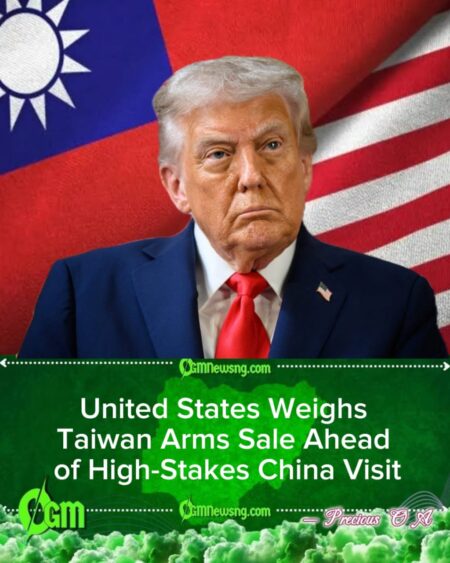
United States officials are weighing approval of a new weapons sale to Taiwan ahead of President Donald Trump’s anticipated visit to China, a move that could significantly affect already delicate U.S.–China relations. The consideration comes amid heightened geopolitical tensions and renewed warnings from Beijing over foreign military support to Taipei.
United States policymakers familiar with the discussions describe the deliberations as part of a broader effort to reinforce deterrence in the Indo-Pacific while maintaining formal diplomatic commitments. The timing, however, has raised concerns among diplomats who worry the decision could complicate high-level engagement between Washington and Beijing.
United States officials have emphasized that any potential arms package would be consistent with longstanding U.S. policy under the Taiwan Relations Act, which allows defensive weapons sales to help Taiwan maintain sufficient self-defense capability.
United States Policy Framework on Taiwan
United States arms sales to Taiwan have historically been framed as defensive rather than escalatory, with successive administrations arguing they contribute to regional stability rather than undermine it. The current discussions reportedly involve systems designed to improve Taiwan’s air defense, surveillance, and maritime deterrence.
United States defense planners argue that Taiwan faces increasing military pressure from China, citing frequent aerial incursions and naval maneuvers near the island. They contend that delaying such sales could weaken deterrence at a moment of growing uncertainty.
United States officials also stress that the policy does not represent recognition of Taiwan as a sovereign state, reaffirming Washington’s adherence to its “One China” policy while opposing unilateral changes to the status quo.
Beijing’s Warnings and Diplomatic Objections
China has repeatedly warned that weapons sales to Taiwan violate its sovereignty and undermine bilateral relations with Washington. Chinese officials have cautioned that such actions could provoke countermeasures and damage prospects for cooperation on global issues.
Diplomatic statements from Beijing have framed the potential sale as particularly provocative given its proximity to President Trump’s planned visit. Chinese leaders view the timing as a test of U.S. intentions and respect for prior diplomatic understandings.
Analysts note that Beijing often responds to arms sales with symbolic sanctions or military demonstrations, signaling resolve without triggering direct confrontation. The current situation, however, carries added sensitivity due to the upcoming diplomatic engagement.
Implications for Trump–Xi Engagement
President Trump’s expected visit to China is seen as an opportunity to address trade, security, and global economic concerns. Any arms sale announcement before the trip could influence the tone and substance of those talks.
Diplomats suggest that Beijing may seek assurances or concessions during the visit, using the Taiwan issue as leverage in broader negotiations. Washington, meanwhile, faces the challenge of balancing reassurance to allies with managing relations with China.
Observers caution that missteps on either side could narrow diplomatic space, increasing the risk of miscalculation in an already tense bilateral relationship.
Regional Security and Allied Reactions
Regional allies are closely monitoring the situation, particularly Japan, South Korea, and Australia, all of which have strong interests in stability across the Taiwan Strait. Some officials privately welcome stronger U.S. support for Taiwan as a signal of commitment to regional security.
Others express concern that heightened tensions could disrupt trade routes and economic ties vital to the Asia-Pacific region. The possibility of retaliatory measures by China adds to uncertainty among regional governments.
Security experts argue that while arms sales may bolster deterrence, they must be paired with diplomatic engagement to prevent escalation and preserve long-term stability.
Balancing Deterrence and Diplomacy
United States officials continue to deliberate internally, weighing strategic benefits against diplomatic costs. The decision reflects broader questions about how Washington manages competition with China while avoiding open confrontation.
United States policymakers emphasize that deterrence and dialogue are not mutually exclusive, pointing to ongoing diplomatic channels and military-to-military communication mechanisms.
United States leaders ultimately face a complex calculation: reinforcing commitments to Taiwan and regional partners while ensuring that high-level diplomacy with Beijing remains viable in a rapidly evolving global landscape.
Table of Contents
Discover more from OGM News NG
Subscribe to get the latest posts sent to your email.