







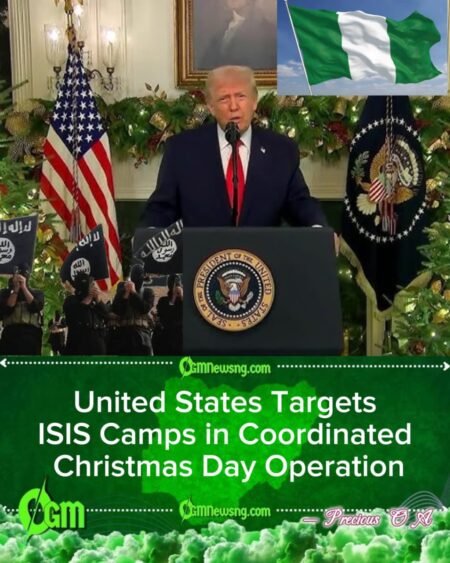
United States military forces carried out confirmed airstrikes on Christmas Day against Islamic State–linked militant camps in northwest Nigeria, marking a significant escalation in Washington’s direct counter-terrorism operations in West Africa. The operation, conducted in coordination with Nigerian authorities, targeted insurgent positions believed to be responsible for repeated attacks on civilians and security forces across parts of Sokoto and neighboring states.
The strikes drew immediate international attention because of their timing on a major religious holiday and the precision with which they were executed. Defense officials said the mission was planned weeks in advance and authorized following intelligence assessments that indicated a heightened threat of imminent attacks by extremist groups operating in the region.
Nigerian government representatives acknowledged the operation and confirmed that it was carried out with their knowledge and cooperation, describing the action as part of broader security collaboration between Abuja and Washington aimed at reducing the growing influence of transnational terrorist networks in northern Nigeria.
Background to the Rising Threat
United States intelligence agencies have increasingly warned about the expanding footprint of Islamic State–affiliated groups in West Africa, particularly in Nigeria’s northwest and northeast corridors. These groups have been blamed for mass kidnappings, village raids, and attacks on infrastructure that have displaced thousands of civilians.
Security analysts note that the northwest region, traditionally plagued by banditry, has in recent years become more ideologically radicalized, creating a dangerous overlap between criminal gangs and extremist factions. This fusion has complicated Nigeria’s internal security response and widened the scope of international concern.
Local communities have repeatedly appealed for stronger action, citing deteriorating safety conditions, school closures, and economic decline. These pressures formed part of the broader context that led to the multinational cooperation now being seen.
United States: Details of the Airstrike Operation
United States defense sources stated that the strikes targeted multiple suspected militant encampments using precision-guided munitions. The operation was designed to minimize civilian casualties while dismantling leadership and logistics hubs used by insurgent fighters.
Initial assessments indicated that several key targets were destroyed, including weapons storage facilities and operational planning sites. Surveillance drones were reportedly deployed before and after the strikes to confirm impact and assess movement in surrounding areas.
Nigerian military units were placed on heightened alert during the operation, with ground forces prepared to respond to any retaliatory actions or attempted regrouping by surviving militants.
Official Statements and Reactions
United States officials confirmed that the mission was authorized at the highest levels of government and carried out under existing security cooperation agreements with Nigeria. The operation was described as part of a broader counter-terrorism strategy aimed at preventing West Africa from becoming a new global extremist hub.
Presidential aides stated that the timing of the strikes reflected urgency rather than symbolism, emphasizing that intelligence indicated an immediate threat requiring rapid action. They also stressed that similar operations would continue if credible threats were identified.
Nigerian officials welcomed the intervention, noting that such cooperation strengthens their own counter-terrorism capacity while signaling to militant groups that international attention remains firmly focused on the region.
Regional and International Implications
United States involvement in Nigeria’s counter-terrorism efforts signals a deeper commitment to stabilizing West Africa, a region increasingly vulnerable to extremist expansion. Analysts suggest that the strikes could deter militant recruitment and weaken cross-border networks linking Nigeria to Niger and Mali.
However, some international observers caution that foreign military action must be balanced with long-term development strategies to address poverty, unemployment, and governance challenges that fuel radicalization.
Humanitarian organizations have urged continued protection for civilians, calling for expanded aid programs to accompany military operations in conflict-affected communities.
What Comes Next
United States military planners are expected to maintain intelligence surveillance over northwest Nigeria in the coming weeks, monitoring potential retaliatory actions and assessing the long-term effectiveness of the strikes.
Security experts predict that further joint operations could follow if militant activity remains high, with an emphasis on training, intelligence sharing, and technological support for Nigerian forces.
As Nigeria and its partners continue to confront extremist threats, the Christmas Day operation stands as a clear demonstration of international resolve to prevent the region from becoming a permanent stronghold for global terrorism.
Table of Contents
Discover more from OGM News NG
Subscribe to get the latest posts sent to your email.