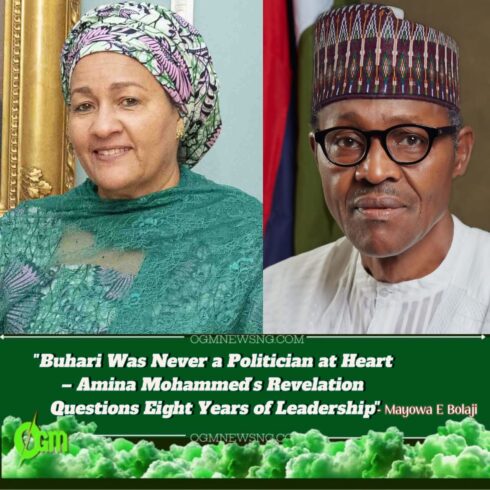
United Nations Deputy Secretary-General, Amina J. Mohammed, stirred a national conversation after revealing that former President Muhammadu Buhari was never comfortable with the nature of Nigerian politics. During a fireside discussion at a high-level governance forum, she described Buhari as “a man who endured politics but deeply believed in the rule of law.” Her statement challenges years of speculation about Buhari’s willingness and enthusiasm for political leadership.
The seasoned diplomat emphasized that while Buhari’s military background might suggest a commanding posture in governance, he was instead a disciplined leader often restrained by constitutional boundaries. Amina’s remarks have now reignited long-standing public scrutiny over Buhari’s presidential style, often criticized as passive, distant, or overly procedural.
Rule of Law Above All: A President Confined or Principled?
Mohammed stressed that Buhari was deeply committed to due process, even when political expediency demanded swift or drastic action. “His belief in the rule of law was not performative,” she asserted. This revelation contrasts sharply with how many Nigerians perceived his administration — one sometimes accused of selectively enforcing justice and tolerating institutional impunity.
Critics argue that Buhari’s deference to legal process was more about strategic detachment than sincere principle. They point to controversial judicial decisions ignored or delayed during his presidency and note his silence in key national crises. Still, Mohammed’s insider insight presents a more complex portrait: a reluctant actor in the drama of power, more concerned with constitutional order than with political dominance.
Behind Closed Doors: Buhari’s Quiet Struggles in Aso Rock
According to Amina Mohammed, Buhari’s eight-year presidency was riddled with internal conflict, often stemming from his discomfort with political deal-making. She described moments when Buhari would rather defer decisions to legal experts or constitutional bodies than engage in the rough-and-tumble negotiations typical of Nigerian politics.
Her claims give credence to reports that key policy decisions, including security appointments and subsidy removals, were frequently delayed or outsourced to cabinet members. Many now see this as evidence of a president more inclined toward quiet governance than public leadership, potentially limiting his administration’s effectiveness in urgent situations.
Divided Reactions: Nigerians React to Amina’s Assertion
Amina Mohammed’s comments have sparked polarized reactions across political and civil society spaces. Pro-Buhari loyalists see her statements as a validation of the former president’s disciplined leadership style, often painted as austere but lawful. They argue that Nigeria needs more leaders like Buhari — not consumed by the greed or theatrics of politics.
However, critics on the other side describe Mohammed’s account as a veiled apology for a “do-nothing presidency.” “You can’t claim a belief in rule of law when your government flouted court orders and failed to act on key corruption cases,” tweeted one human rights lawyer. The debate is heating up, and it shows how divided Nigerians still are on Buhari’s true legacy.
The Irony of a Soldier Who Hated Politics
It is ironic that Buhari, a former military ruler who once took power through a coup in 1983, later became known for discomfort with democratic politics. According to Amina, this transformation was part of Buhari’s internal evolution from authoritarian commander to constitutional leader. She credits this shift to his strong respect for institutions and national stability.
But analysts argue that Buhari’s military past left behind shadows he never truly escaped. While he outwardly respected democratic norms, many believe the militaristic instincts of control and hierarchy remained embedded in his style of governance, albeit cloaked in legalism. Amina’s narrative may unintentionally raise questions about whether Buhari ever truly adapted to civilian leadership — or simply tolerated it.
Legacy in Question: Was Buhari Too Passive for a Changing Nigeria?
With the nation still grappling with insecurity, economic distress, and institutional distrust, Amina Mohammed’s comments beg a bigger question: Was Buhari’s reluctance to fully engage with political power a liability for Nigeria? While some praise his restraint, others believe it resulted in inertia that worsened the country’s many crises.
As Nigeria reflects on its democratic journey, Buhari’s presidency continues to be a study in contrasts — a man who gained power by force, yet governed by process. Amina Mohammed’s bold remarks may now redefine how history remembers him: not as a power-hungry strongman, but as a reluctant statesman haunted by a duty he never truly desired.
Table of Contents
Discover more from OGM News NG
Subscribe to get the latest posts sent to your email.