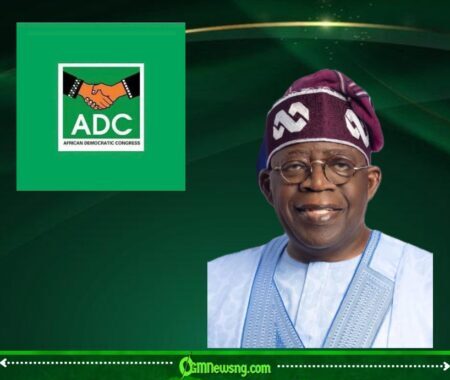





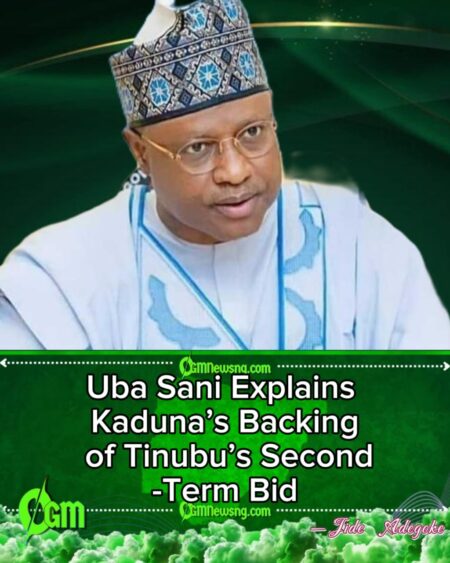
Kaduna State Governor, Uba Sani, has outlined the reasons his administration and political allies in the state are inclined to support President Bola Ahmed Tinubu’s re-election bid. Speaking within the context of governance outcomes and party alignment, the governor said the decision is anchored on what he described as policy continuity, shared political values, and perceived gains recorded under the current federal administration.
According to Sani, Kaduna’s position is shaped not by sentiment but by an assessment of federal–state collaboration, reform direction, and the expectations of citizens who seek stability and measurable progress. He emphasized that support for the president is tied to performance and alignment with the ruling All Progressives Congress (APC)’s agenda.
Alignment of Policies and Party Ideology
Governor Sani said Kaduna’s support for President Tinubu reflects a convergence of policy priorities between the state and the federal government. He noted that both administrations subscribe to similar economic and governance philosophies, particularly on fiscal reforms, decentralisation, and strengthening subnational governments.
He explained that such alignment has helped reduce friction between Abuja and Kaduna, allowing projects and programmes to move forward without political bottlenecks. In his view, continuity at the centre would sustain this cooperation and enable states to plan more effectively over the medium to long term.
Sani also pointed to party cohesion within the APC, arguing that internal unity remains critical to governance. He maintained that supporting the party’s incumbent president is consistent with democratic practice and helps avoid distractions that could arise from internal divisions.
Security, Infrastructure and Federal Support
On security, the governor credited the federal government with backing efforts to stabilise troubled areas of Kaduna State. He said improved collaboration between federal security agencies and the state government has contributed to a reduction in violent incidents in some previously affected communities.
He further cited ongoing and completed federal infrastructure projects as another reason for Kaduna’s stance. According to him, investments in roads, rail, and energy have had multiplier effects on the state’s economy, easing movement and supporting trade and agriculture.
Sani added that continued federal attention would be necessary to consolidate these gains, arguing that a second term for President Tinubu would allow projects already underway to be completed rather than abandoned or delayed by policy shifts.
Continuity, Reforms and Electoral Calculations
The governor stressed that Kaduna’s position is also influenced by the broader reform agenda of the Tinubu administration. He acknowledged that some policies have been difficult but argued that they are aimed at long-term economic stability rather than short-term political comfort.
According to Sani, abandoning reforms midway could reverse progress and worsen economic uncertainty. He said many stakeholders in Kaduna prefer continuity that allows time for policies to mature and deliver tangible benefits to citizens.
While acknowledging that the final decision rests with voters, the governor maintained that his administration would continue to engage residents on the rationale behind its political choices, insisting that democratic persuasion must be based on record and vision, not coercion.
Table of Contents
Discover more from OGM News NG
Subscribe to get the latest posts sent to your email.