







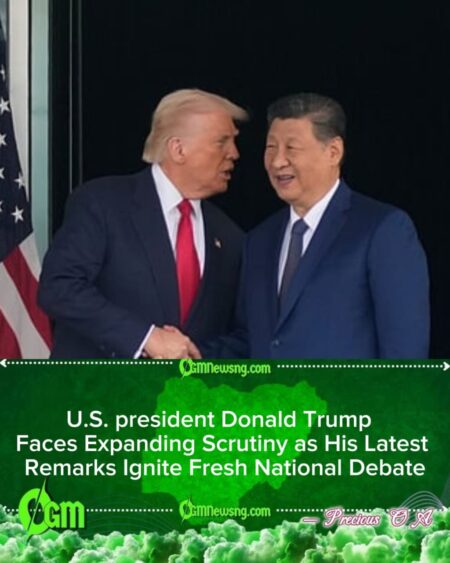
U.S. president Donald Trump announced that Chinese President Xi Jinping has agreed to significantly accelerate the purchase of U.S. goods, emphasizing that the renewed commitment marks what he described as a promising step forward in stabilizing bilateral trade relations that have faced recurring turbulence. He portrayed the development as a substantial achievement emerging from prolonged negotiations, stressing that faster purchasing schedules will benefit American producers seeking reliable markets.
According to the administration, the agreement reflects a broader willingness by China to demonstrate tangible cooperation in areas where previous progress had been slower or more symbolic. The accelerated purchase framework is designed to create visible economic benefits quickly, especially for U.S. exporters who have experienced prolonged uncertainty in recent years.
This development is being described by trade officials as a notable shift toward more predictable behavior between the two nations, with enhanced purchase timetables expected to help rebuild confidence among industries that have struggled with erratic orders and inconsistent communication from international buyers.
Impact on American Farmers and Agricultural Markets
Donald Trump emphasized that American farmers stand to benefit immediately from China’s accelerated purchase commitments, arguing that the arrangement will absorb excess supply and bring renewed stability to many agricultural markets. He highlighted soybeans, sorghum, poultry, and other high-volume exports as key beneficiaries of the accelerated timetable.
Farmers across multiple states have expressed guarded optimism about the announcement, noting that more consistent purchasing patterns could help reverse cycles of declining confidence in rural communities. Many have pointed out that improved stability in export expectations has long been overdue.
Donald Trump insisted that the agricultural sector’s recovery has been a major priority in his administration’s policy planning, outlining that the acceleration agreement supports the broader objective of restoring long-term economic reliability to regions disproportionately affected by global trade shifts.
Manufacturing and Energy Sector Advantages
Donald Trump stated that beyond agriculture, the manufacturing and energy sectors are expected to experience significant growth as China increases its purchase of industrial machinery, technological components, and liquefied natural gas. He suggested that these expanded commitments could stimulate additional hiring and production increases within heavily industrialized states.
Industry analysts suggest that the energy markets in particular could see substantial benefits from more consistent Chinese demand, arguing that long-term purchase commitments may help support infrastructure expansion and encourage private investment. Energy exports, they note, are becoming central to America’s modern economic strategy.
Donald Trump predicted that manufacturing hubs, many of which have expressed concerns about foreign competition, will gain renewed leverage through sustained demand from China. He argued that predictable export flows can strengthen domestic production cycles and help stabilize job markets in industrial regions.
Geopolitical Implications and Strategic Messaging
Donald Trump suggested that the accelerated purchase agreement demonstrates a broader geopolitical understanding between Washington and Beijing, portraying the development as a sign that cooperative diplomacy remains achievable even amid tensions. He stated that strengthened commercial ties can serve as a stabilizing force between the two global powers.
Diplomatic observers believe that future engagements will likely cite these commitments as evidence that China remains receptive to firm negotiation backed by strategic economic planning. They emphasize that consistent follow-through from both countries will be essential to maintaining credibility.
Donald Trump argued that this new trajectory may influence broader international markets, suggesting that improved U.S.–China trade relations could signal a more balanced and predictable global economic environment if both sides maintain their commitments and communication channels.
Concerns About Implementation and Verification
Donald Trump acknowledged that the success of the agreement will depend on strict monitoring and transparent verification processes, emphasizing that China’s follow-through will be closely scrutinized by U.S. agencies. He stated that the administration intends to track the accelerated purchases in real time.
Oversight officials have indicated that past delays and unfulfilled targets highlight the need for more rigorous monitoring procedures in the next phase of the partnership. They argue that measurable benchmarks are essential for confirming compliance and maintaining accountability.
Donald Trump maintained that if discrepancies emerge or expectations are not met, the administration is prepared to respond with corrective measures designed to protect American commercial interests and preserve the benefits promised to domestic industries.
Long-Term Economic Outlook
Donald Trump expressed optimism that the accelerated purchase plan will generate long-term economic momentum for exporters, stating that steady demand from China could help stimulate investment, expand production, and strengthen confidence across affected industries.
Economists studying global trade warn that the long-term success of this agreement will depend on whether both nations maintain consistent policies and transparent communication. They also note that global competition continues to evolve, requiring the U.S. to balance opportunity with strategic caution.
Donald Trump concluded that sustained cooperation with China, coupled with consistent commercial engagement, may help position the United States for greater economic flexibility and stability in a rapidly shifting global marketplace, reinforcing sectors that have long depended on predictable international trade flows.
Table of Contents
Discover more from OGM News NG
Subscribe to get the latest posts sent to your email.