





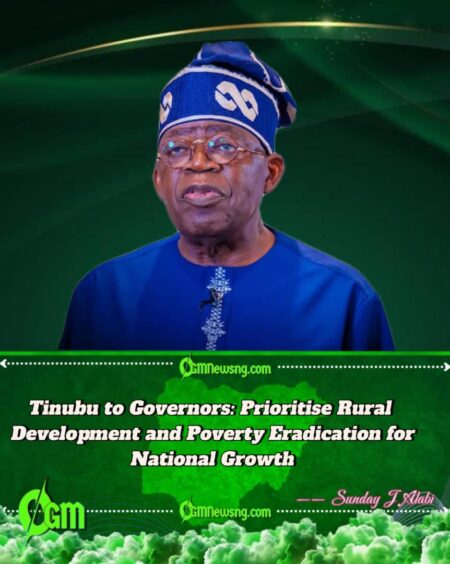
President Bola Ahmed Tinubu has urged state governors across Nigeria to prioritise the welfare of citizens by scaling up investments in rural electrification, agricultural mechanisation, poverty eradication, and infrastructure development. Speaking at the 150th National Economic Council (NEC) meeting held on Thursday at the State House, Abuja, the President called for a unified, grassroots-based approach to national development.
“I want to appeal to you; let us change the story of our people in the rural areas,” Tinubu said, according to a statement by Stanley Nkwocha, the Senior Special Assistant to the President on Media and Communications (Office of the Vice President). “The economy is working. We are on the path of recovery, but we need to stimulate growth in the rural areas.”
Tinubu emphasized the need for deeper collaboration between federal and state governments to bring about inclusive development that reflects in the lives of ordinary Nigerians. He warned that failure to reach the grassroots would undermine national efforts to achieve sustainable economic growth.
President Tinubu Push for Rural Mechanisation and Security Reform
Underscoring the importance of modernising agriculture, President Tinubu said that mechanisation must become central to Nigeria’s food production strategy. He noted that traditional farming methods could no longer meet the country’s growing food demand, especially amid security challenges that threaten food supply chains.
“We have to embrace mechanisation in agriculture, fight insecurity and improve school enrolment through school-feeding,” the President declared. He highlighted how the synergy of agricultural reforms and improved education would provide a dual benefit—boosting food security and human capital development.
In addition, Tinubu stressed the importance of stabilising rural areas through improved security frameworks to ensure that development interventions are not derailed. He also directed the NEC to establish a committee tasked with ensuring the seamless execution of legacy infrastructure projects critical to national integration.
Renewed Hope Ward Development Programme Endorsed
A key highlight of the NEC meeting was the formal endorsement of the Renewed Hope Ward Development Programme (RHWDP), a new strategy aimed at boosting double-digit economic growth through targeted interventions at Nigeria’s 8,809 administrative wards. The initiative, presented by Minister of Budget and Economic Planning, Senator Abubakar Bagudu, aligns with Tinubu’s ambition to build a $1 trillion economy by 2030.
RHWDP will be a tripartite collaboration involving the federal, state, and local governments, with implementation focused at the ward level to ensure inclusion and accountability. According to Bagudu, the programme’s design is rooted in constitutional mandates, particularly those embedded in the 1999 Constitution and the Fifth Alteration Act, which call for equitable development and food security.
Each ward will benefit from economic stimulation programs targeting at least 1,000 economically active residents in small wards and 2,000 in larger ones. These initiatives will include support for smallholder farmers, local artisans, micro-enterprises, and youth entrepreneurship.
Presidency Takes Over Surveyor-General’s Office to Fast-track Projects
In another major policy directive, President Tinubu announced the transfer of the Office of the Surveyor-General of the Federation from its current administrative structure to the Presidency. The move, he explained, is designed to eliminate bureaucratic delays and accelerate the implementation of his administration’s critical infrastructure projects.
Specifically, Tinubu mentioned the Lagos-Calabar and Sokoto-Badagry Super Highways as cornerstone legacy projects that would significantly improve Nigeria’s transport and trade corridors. By placing the surveyor’s office under direct presidential supervision, the government hopes to avoid procedural bottlenecks and ensure timely delivery of these national assets.
“This decision is about efficiency and clarity of purpose. These projects must move faster than the usual pace. We cannot afford the old delays,” Tinubu stated, reinforcing his commitment to infrastructural transformation.
National Steering Committee to Oversee Implementation
To guarantee accountability and broad-based stakeholder engagement, the Renewed Hope Ward Development Programme will be governed by a National Steering Committee composed of representatives from Nigeria’s six geopolitical zones. The Ministry of Budget and Economic Planning will serve as the programme’s secretariat.
The President reiterated that his Renewed Hope Agenda is not just a slogan but a working framework aimed at achieving results that touch the lives of Nigerians at the most local level. He encouraged all stakeholders to treat the programme not as a federal initiative but as a collective national effort.
“The time has come to bring development closer to our people. We must collaborate in the spirit of true federalism to achieve the Nigeria of our dreams,” Tinubu said, concluding a message that was both a charge and a challenge to Nigeria’s political leadership.
Table of Contents
Discover more from OGM News NG
Subscribe to get the latest posts sent to your email.