


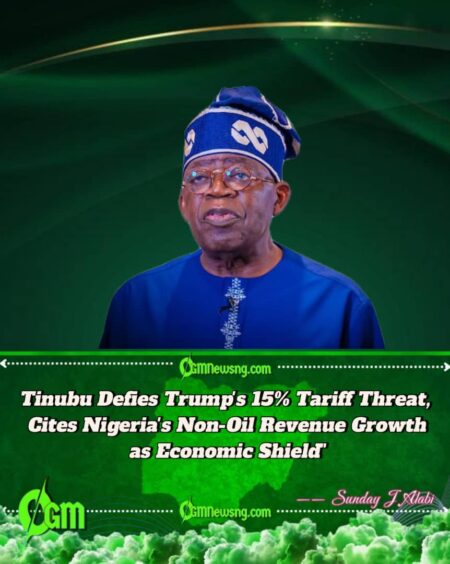
President Bola Tinubu has boldly declared that Nigeria remains unshaken by United States President Donald Trump’s aggressive trade policies, positioning the country’s growing non-oil revenues and strengthened fiscal position as shields against external economic pressures. Speaking during a solidarity visit by members of The Buhari Organisation at the Presidential Villa in Abuja on Tuesday, Tinubu’s confident stance comes as Nigeria faces a 15% tariff on its exports under Trump’s sweeping “America First” trade agenda.
The President’s declaration signals a significant shift in Nigeria’s approach to international trade relations, emphasizing economic independence and domestic revenue diversification as key strategies to weather global trade storms.
Nigeria’s Economic Fortification Against External Shocks
President Tinubu outlined Nigeria’s robust economic trajectory as the foundation for his administration’s confidence in facing Trump’s protectionist policies. The President highlighted that Nigeria has already met its 2025 revenue target as of August, demonstrating unprecedented fiscal performance that provides a buffer against trade disruptions.
“If non-oil revenue is growing, then we have no fear of whatever Trump is doing on the other side,” Tinubu stated emphatically, underlining his administration’s focus on economic diversification. This strategic pivot away from oil dependency has been central to Nigeria’s economic policy since Tinubu assumed office in May 2023.
The President also pointed to the stabilization of the naira as evidence of his administration’s economic management success. The currency has appreciated significantly to around N1,450 per dollar from a previous rate of N1,900 following the unification of exchange rates implemented shortly after Tinubu took office. This currency stability provides additional insulation against the potential impacts of increased trade costs from U.S. tariffs.
Trump’s Comprehensive Tariff Assault on Global Trade
President Trump’s second-term trade policy has introduced unprecedented changes to the global trading landscape, with Nigeria caught in the crosshairs of his protectionist agenda. The policy framework includes a 10% baseline tariff on nearly all imports into the United States, with additional country-specific levies designed to address what the Trump administration views as unfavorable trade imbalances.
Nigeria now faces a 15% tariff on its exports to the United States, effective from August 7, following an initial 14% rate announced in April during Trump’s Liberation Day trade policy announcements. This places Nigeria alongside other sub-Saharan African partners in facing significant trade barriers that could potentially impact export revenues and economic growth.
However, the policy includes strategic exemptions for energy commodities, including oil and gas, which represent Nigeria’s largest export categories to the United States. Despite these exemptions, reports indicate that heightened trade tensions and global tariff impositions have already dampened energy product exports worldwide in early 2025, creating disruptions in demand flows for crude oil, gasoline, and diesel that could indirectly affect Nigeria’s energy sector revenues.
Agricultural Revolution as Poverty Eradication Strategy
Beyond addressing trade concerns, President Tinubu used the occasion to highlight his administration’s agricultural reform agenda as a cornerstone of Nigeria’s economic resilience strategy. The President outlined a massive mechanization program being implemented across all regions of the country, aimed at transforming Nigeria’s agricultural productivity and achieving food security.
“If we remove hunger, we have defeated poverty,” Tinubu declared, positioning food security as fundamental to Nigeria’s broader economic recovery and stability. This agricultural focus represents a strategic approach to building domestic economic strength that reduces reliance on international trade dynamics and provides sustainable employment for millions of Nigerians.
The mechanization program spans multiple regions and aims to modernize farming techniques, increase yields, and reduce post-harvest losses. By strengthening the agricultural sector, the administration seeks to create a robust domestic economy that can withstand external pressures while providing essential food security for the population.
Historical APC Formation: Tinubu Reveals Buhari Clash Over Party Symbol
In a lighter moment during Tuesday’s meeting, President Tinubu provided rare insights into the internal dynamics that shaped the formation of the All Progressives Congress (APC), revealing his disagreements with the late former President Muhammadu Buhari over fundamental aspects of the party’s identity. The President recounted how he and Buhari clashed over the party’s logo during the merger talks that led to the APC’s creation in 2013.
“We disagreed to agree… We even argued over a symbol. He (Buhari) insisted on parliament, and I insisted on broom,” Tinubu revealed amid laughter from attendees. The President described Buhari as “so stubborn” in these negotiations, highlighting the strong personalities involved in forging the opposition coalition that would eventually unseat the ruling People’s Democratic Party.
The broom symbol, which ultimately became the APC’s logo, was chosen to represent collective action against corruption and poor governance, according to party leaders. This symbol became iconic in Nigerian politics, representing the coalition’s promise to “sweep away” the perceived failures of the previous administration and usher in a new era of progressive governance.
Political Consolidation Ahead of 2027 Electoral Cycle
Tuesday’s meeting brought together key northern party leaders, including Katsina State Governor Dikko Radda and former Governor Aminu Masari, in what political analysts view as a strategic consolidation of party ranks ahead of the 2027 electoral cycle. The gathering of The Buhari Organisation members represents an important bridge-building exercise within the APC’s diverse coalition.
The APC was officially formed in February 2013 through the historic merger of four opposition parties: the Action Congress of Nigeria (ACN), the Congress for Progressive Change (CPC), the All Nigeria Peoples Party (ANPP), and a faction of the All Progressives Grand Alliance (APGA). Tinubu, who served as National Leader of the ACN and former Governor of Lagos State, played a pivotal role in orchestrating this merger alongside Buhari, who led the CPC.
The President acknowledged that differing political cultures among the merger partners often created tensions in the run-up to registration by the Independent National Electoral Commission. However, these challenges were ultimately overcome, leading to the APC’s historic victory in the 2015 elections that brought Buhari to power and ended the PDP’s 16-year rule. The current political consolidation efforts suggest similar strategic thinking as the party prepares for the next electoral contest, with Tinubu working to maintain unity among diverse regional and ideological factions within the APC coalition.
Table of Contents
Discover more from OGM News NG
Subscribe to get the latest posts sent to your email.