



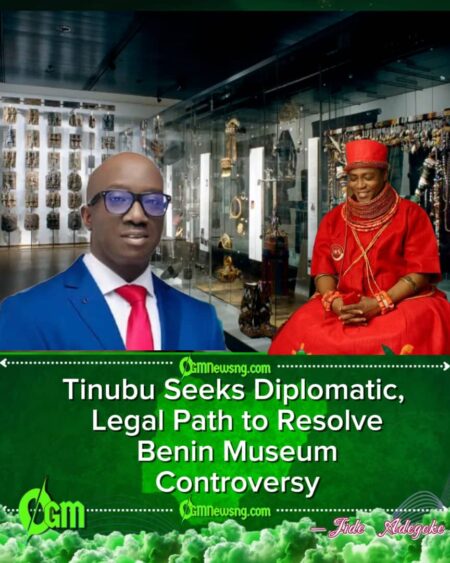
President Bola Ahmed Tinubu has approved the immediate constitution of a high-level presidential committee to address the escalating dispute surrounding the Museum of West African Art (MOWAA) in Benin City, Edo State. The move follows public protests at a preview exhibition, the revocation by Governor Monday Okpebholo of the museum’s certificate of occupancy (C-of-O), and objections from the Oba of Benin, Ewuare II, over the demolition of the former Central Hospital site to build the museum. The committee is chaired by the Minister of Art, Culture, Tourism and the Creative Economy, Hannatu Musa Musawa, and includes federal, state, palatial and international stakeholders tasked with negotiating a peaceful, legally sound resolution.
President Tinubu: Committee composition and mandate
Tinubu constitute panels to resolve MOWAA dispute President Tinubu’s committee is led by Hannatu Musawa and brings together representatives from the federal ministry of art, culture, tourism and the creative economy, the Presidency, the National Council for Arts and Culture, the Edo State government, the palace of the Oba of Benin, the Ministry of Foreign Affairs, the German and French embassies, the National Commission for Museums and Monuments, and MOWAA itself. The broad composition signals an attempt to balance domestic legal and traditional claims with diplomatic considerations given European involvement in funding and restitution discussions.
Tinubu constitute panels to resolve MOWAA dispute The committee’s mandate, as stated in government announcements, is to investigate the facts that precipitated the crisis, propose immediate steps to de-escalate tensions and recommend a framework for the custodianship, display and stewardship of contested cultural artefacts and the museum site—while observing Nigerian law and international restitution norms. Observers say the inclusion of foreign mission representatives reflects the diplomatic sensitivity of artefact returns and donor relationships.
President Tinubu: Public order, heritage and legal questions
Tinubu constitute panels to resolve MOWAA dispute The unrest at MOWAA—where a preview was disrupted by protesters pledging loyalty to the Oba and opposing the museum’s occupation of the former Central Hospital site—prompted swift official responses, including the Edo governor’s revocation of the land title and statements urging calm from federal cultural authorities. The security and public-order dimensions intersect with heritage policy: local communities, the palace and state officials each insist their interests in custodianship and public access be respected.
Tinubu constitute panels to resolve MOWAA dispute Legal complexities arise from competing claims over land titles and statutory custodianship of repatriated artefacts—notably the Benin bronzes—which have been the subject of bilateral returns and domestic legal provisions. Any committee recommendations will need to navigate property law, the governor’s recent revocation, prior agreements reached under earlier administrations, and 2023 and subsequent positions regarding rightful custodianship, all while seeking to avoid further confrontation.
President Tinubu: Diplomatic and cultural stakes
Tinubu constitute panels to resolve MOWAA dispute International partners and donors—principally European governments and cultural institutions that supported MOWAA and the restitution process—have a vested interest in a durable, transparent settlement that preserves provenance, access and conservation standards. The committee’s inclusion of the German and French embassies aims to preserve diplomatic channels and ensure that returned or loaned objects remain properly accounted for, conserved and displayed in ways acceptable to stakeholders in Nigeria and abroad.
Tinubu constitute panels to resolve MOWAA dispute Cultural commentators stress that, beyond legalities and diplomacy, the outcome will shape Nigeria’s broader restitution narrative: how returned looted artefacts are stewarded, the relationship between modern institutions and traditional authorities, and local communities’ trust in cultural projects. The committee therefore faces the twin tasks of restoring calm and producing a credible, consultative roadmap for heritage governance.
The presidential committee is expected to engage stakeholders, review legal and historical records, and propose immediate and medium-term measures to protect lives, property and Nigeria’s cultural patrimony. By convening national and international actors, the Tinubu administration has signalled an intention to resolve a volatile mix of heritage, legal and political concerns through structured dialogue; the committee’s findings and recommendations will be closely watched in Benin City, across Edo State and by international partners.
Table of Contents
Discover more from OGM News NG
Subscribe to get the latest posts sent to your email.