







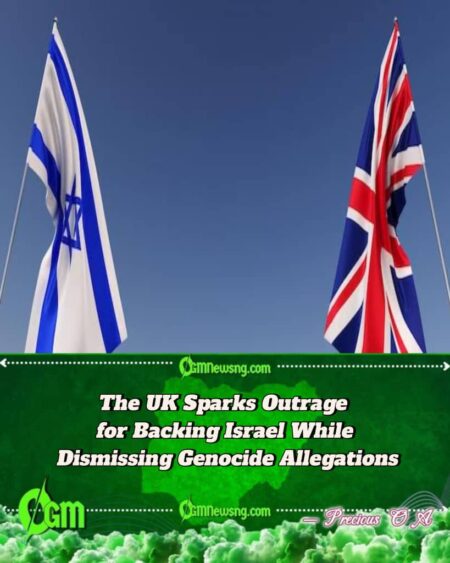
The government in London has ruled that Israel’s military campaign in Gaza does not constitute genocide, concluding that the legal requirement of “specific intent” has not been met. Foreign Secretary David Lammy communicated the decision in a letter to the International Development Committee, stressing that while civilian suffering is immense, evidence does not establish the deliberate aim to destroy a people in whole or in part. The announcement signals a striking change in Britain’s approach, since previous administrations maintained that only international courts could make such determinations.
UK: Legal Definition Anchors Government’s Ruling
The UK framed its conclusion around the Genocide Convention of 1948, which defines genocide as the intentional destruction of a national, ethnic, racial, or religious group. Officials underscored that intent is the most crucial element and that the evidence presently available does not prove Israel is pursuing such a goal. Civilian deaths, displacement, and destruction, though tragic, were described as outcomes of war rather than evidence of exterminatory purpose.
The government explained that stepping forward with its own judgment was necessary in light of mounting international debate. By clarifying its position, Britain aims to offer legal certainty on how it interprets the convention while still acknowledging that Israel’s conduct raises other grave humanitarian and human rights concerns.
UK: Political and Diplomatic Context
The UK issued its assessment during a moment of diplomatic intensity. Prime Minister Keir Starmer has been meeting with both Israeli and Palestinian officials, urging restraint and humanitarian access while balancing the realities of a long-standing strategic alliance. The government is attempting to maintain credibility on the world stage while also addressing growing domestic criticism of its Middle East policy.
Ministers announced a suspension of 30 arms export licences to Israel, yet key exemptions remain, particularly in relation to components for F-35 fighter jets. London defended the decision by pointing to NATO obligations and transatlantic security priorities, a stance that has divided opinion both at home and abroad.
UK: Internal Tensions within the Foreign Office
The UK position has deepened rifts inside its own diplomatic service. Hundreds of Foreign Office staff members expressed objections, some warning that continued military cooperation risks complicity in violations of international law. Letters of protest circulated internally, with calls for the government to align policy more closely with humanitarian imperatives.
Officials responded by affirming that current policy is fully compliant with both domestic and international obligations. Ministers made clear that while dissent is tolerated, staff unwilling to execute government policy should consider stepping aside. This hard line has heightened frustration within a department already grappling with the moral weight of the conflict.
International and NGO Reactions
Reactions abroad have been starkly divided. The United Nations human rights chief, Volker Türk, labeled the soaring civilian death toll a “mass killing” and warned that some Israeli actions may amount to war crimes. He refrained, however, from adopting the term genocide, emphasizing the role of ongoing judicial processes such as the case at the International Court of Justice.
Non-governmental organizations voiced sharper criticism. Amnesty International and Médecins Sans Frontières rejected London’s finding outright, asserting that the threshold for genocide has been met and accusing Britain of enabling further abuses by continuing certain arms exports. Their reports highlight patterns of destruction, dehumanizing rhetoric, and deliberate targeting of civilian infrastructure as evidence.
Repercussions and Wider Implications
Legal experts note that genocide carries unique obligations: every state party to the convention must act to prevent and punish it, regardless of direct involvement. By ruling out genocide, Britain may avoid the legal duty to intervene more forcefully but risks undermining its credibility in international forums.
Commentators warn that this approach could invite future challenges, particularly if international courts ultimately reach a different conclusion. Questions of moral responsibility are likely to persist long after the fighting ends, shaping Britain’s reputation as a defender—or underminer—of international law.
Academic and Civil Society Divisions
Scholars are themselves divided. The International Association of Genocide Scholars passed a resolution asserting that Israel’s actions met the definition, yet fewer than one-third of members participated in the vote. Critics argue the resolution was rushed and politically motivated, undermining its weight.
A counter-group, Scholars for Truth about Genocide, condemned the resolution and urged greater caution. They contend that overuse of the term genocide dilutes its meaning and risks politicizing a crime whose definition must remain precise. The dispute illustrates how even academic circles struggle to balance moral outrage with legal rigor.
UK: Precedents and Broader Global Context
The UK finds itself aligned with a number of Western allies that oppose South Africa’s genocide case against Israel at the ICJ. Officials argue that supporting the case could set a precedent that weakens the application of the genocide convention in future conflicts, where intent is less clear.
Scotland has taken a different course. First Minister John Swinney publicly described Israel’s campaign as genocide, citing what he called “plausible evidence.” His statement was met with strong backlash from Jewish organizations, who warned that such language heightens fear and hostility. The divergence between Edinburgh and London underscores the sensitivity of the issue within the United Kingdom itself.
Crisis Overshadows Diplomatic Balancing
The humanitarian situation in Gaza continues to overshadow diplomatic maneuvering. Health authorities report tens of thousands of deaths, mass displacement, and entire neighborhoods reduced to rubble. Aid agencies describe catastrophic shortages of food, medicine, and clean water, with restrictions on humanitarian access compounding the crisis.
Images of children pulled from collapsed buildings and families crowding into makeshift shelters dominate international media. These realities mean that no legal conclusion, however carefully reasoned, will shield Britain from public scrutiny. Pressure is mounting for stronger action, even as ministers insist they are navigating the crisis with both principle and pragmatism.
Conclusion:
The UK Government’s decision—that Israel’s actions do not constitute genocide—has clarified its legal stance but intensified political and moral controversy. By limiting the scope of its obligations under the Genocide Convention, Britain hopes to maintain strategic partnerships while projecting an image of legal seriousness. Yet with civilian suffering worsening daily, critics argue that the judgment reflects political expediency rather than moral clarity.
The coming months will test whether this position holds as courts deliberate, allies debate, and public anger grows. For now, the government has charted a path that prizes legal precision over sweeping condemnation, but it remains to be seen whether history will view this as principled restraint or a failure of conscience.
Table of Contents
Discover more from OGM News NG
Subscribe to get the latest posts sent to your email.