








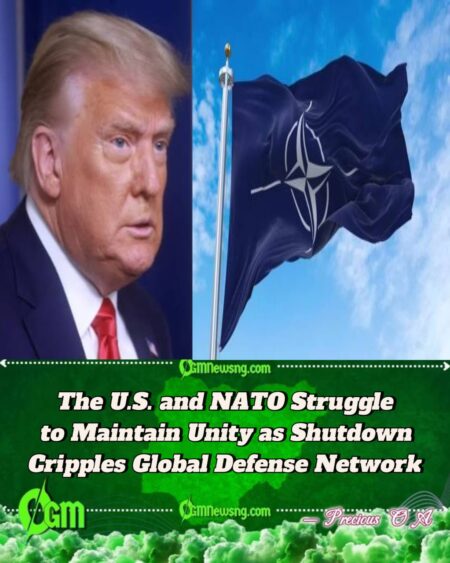
The United States and NATO are now facing severe operational paralysis as Washington’s government shutdown reaches its 40th day, marking one of the longest and most destabilizing political deadlocks in modern American history. What began as a partisan standoff over budget allocations has spiraled into an international crisis, threatening the flow of weapons, aid, and intelligence crucial to NATO operations in Eastern Europe and beyond. The alliance’s unified posture, carefully constructed over decades of coordination, now appears strained under the weight of domestic dysfunction within the United States.
The U.S. and NATO forces have found themselves hampered by disrupted funding pipelines, frozen defense contracts, and the absence of congressional approval for critical spending bills. Key NATO supply chains—particularly those facilitating armament deliveries to Eastern Europe—have stalled, leaving several allied nations voicing frustration over the lack of predictability from Washington. The situation is not only undermining NATO’s logistical strength but also eroding global confidence in America’s capacity to lead during geopolitical turbulence.
The U.S. and NATO military coordination has also been deeply affected by the temporary suspension of joint exercises and planning sessions. Analysts warn that this paralysis risks opening strategic gaps that adversaries could exploit, especially in light of ongoing tensions in Eastern Europe and the South China Sea. Without timely communication, command synchronization, and funding assurance, the cohesion that defines NATO’s deterrent capability is being severely tested.
Observers note that this prolonged impasse signals a broader erosion of trust in America’s political system. European allies who have long depended on the U.S. as a stabilizing force within NATO now find themselves questioning Washington’s reliability. The shutdown, they argue, reflects internal political fragmentation that could have lasting consequences for the credibility of Western defense commitments.
Diplomatic Friction Grows as Global Security Operations Falter
The U.S. and NATO are both under increasing diplomatic strain as member nations scramble to adjust to the new reality of delayed funding and stalled decision-making. European defense ministers have voiced growing concerns over how the shutdown could disrupt NATO’s readiness and the timely delivery of support to nations on the alliance’s eastern flank. Without the steady stream of resources and leadership traditionally provided by the United States, European command structures are being forced to improvise short-term contingency plans.
Tensions within NATO councils have been heightened by differing levels of preparedness among member states. Smaller countries heavily reliant on U.S. military assistance are struggling to maintain operational continuity, while larger powers such as Germany and France are being pressured to shoulder additional logistical responsibilities. The situation underscores the deep asymmetry within the alliance—a dynamic long tolerated but now impossible to ignore as Washington’s domestic paralysis reverberates globally.
The U.S. and NATO are facing growing calls from within and outside the alliance to find immediate solutions to the funding gridlock. Senior officials have warned that prolonged disruption could embolden rival states, who may interpret Western indecision as a signal of weakness. In recent days, intelligence reports have already hinted at increased military activity from adversarial powers testing NATO’s readiness along vulnerable regions.
While diplomatic channels remain open, several envoys have quietly expressed frustration over the perceived lack of urgency from Washington. The inability to reach bipartisan compromise in Congress is not just a domestic issue—it is now an international liability affecting collective security and the deterrence posture that NATO depends on. The longer the stalemate continues, the more pronounced the damage becomes, both materially and reputationally.
Economic and Strategic Fallout Deepen Across Allied Nations
The U.S. and NATO economies are beginning to feel the ripple effects of the prolonged shutdown, particularly within the defense and technology sectors that underpin military cooperation. Contractors responsible for weapons production and intelligence systems have been forced to halt or scale back operations due to delayed payments, leading to cascading disruptions in both employment and supply networks. These setbacks are beginning to strain the long-standing industrial partnerships that support the transatlantic defense architecture.
Beyond economics, the political symbolism of the crisis has grown impossible to ignore. The U.S. and NATO were founded on principles of unity, resolve, and shared democratic values—yet the current dysfunction reveals vulnerabilities that adversaries are watching closely. Analysts warn that Russia, China, and Iran could use this period of Western disorganization to expand influence, challenge borders, and test alliance thresholds. The paralysis in Washington is thus more than a political inconvenience; it is a strategic liability that could reshape the balance of power.
The U.S. and NATO diplomatic corps continue to reassure allies that the situation will soon stabilize, but private briefings suggest deep concern over the long-term implications. European leaders are increasingly exploring ways to reduce dependence on Washington’s funding mechanisms, potentially paving the way for a more autonomous European defense initiative. While such efforts may strengthen Europe’s independence, they also risk fragmenting the unity that has historically defined the NATO alliance.
Amid this uncertainty, global confidence in America’s political and administrative stability has eroded. Markets have reacted to the ongoing stalemate with volatility, and defense analysts caution that even when the shutdown ends, the damage to alliance trust may linger for years. The U.S. and NATO now stand at a crossroads—either emerge from this crisis with renewed coordination or continue down a path of gradual disintegration that could permanently weaken their global influence.
Table of Contents
Discover more from OGM News NG
Subscribe to get the latest posts sent to your email.