




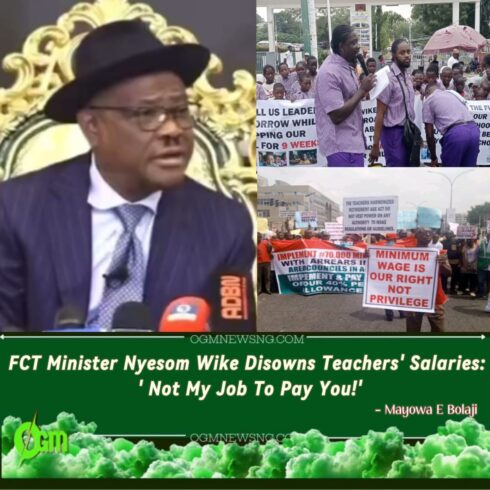
FCT Minister Nyesom Wike has come out swinging amidst growing criticism over the protracted strike by teachers in the Federal Capital Territory. He categorically stated that the responsibility of paying teachers’ salaries lies squarely on the shoulders of local government area councils, not the FCT Administration.
Wike, during a fiery media briefing in Abuja, said, “Let’s get it clear: It is not the FCT that is responsible for paying the salaries of teachers; it is the local government area councils. People should stop misleading the public and politicizing issues for personal gains.” His remarks triggered a storm of controversy, sparking outrage among education stakeholders and parents.
Teachers Accuse Wike of Dodging Responsibility
While Wike distances himself from the salary impasse, the Nigerian Union of Teachers (NUT), Abuja chapter, insists the minister cannot wash his hands off the crisis. They argue that as the political head of the FCT, Wike bears overarching responsibility for ensuring basic education systems function.
Comrade Stephen Akwashiki, the union’s chairman, noted, “We’re disappointed by the minister’s remarks. He can’t play Pontius Pilate. The FCT is not a typical state structure; its administration is hybrid, and he must take the lead in resolving this crisis.”
Students Left Behind: Learning Grinds to a Halt
As the strike drags into its third month, public school students in Abuja are the ultimate victims. Classrooms remain locked, playgrounds empty, and parents increasingly anxious about their children’s academic future.
Several schools in Bwari, Gwagwalada, and Kwali have turned into ghost compounds, with some teachers resorting to part-time jobs just to survive. “This is a government-induced educational blackout,” lamented Mrs. Chioma Igwe, a mother of four affected children.
FCT Area Councils Silent, Funding Questions Emerge
Despite Wike’s finger-pointing, the six area councils—Abaji, Abuja Municipal, Bwari, Gwagwalada, Kuje, and Kwali—have remained eerily silent. Investigations reveal that many of them are struggling financially, with internally generated revenue (IGR) barely enough to cover recurrent costs.
A leaked financial report from one of the councils shows that over 60% of their monthly allocation goes into political appointments and inflated administrative overheads, leaving little for education. Critics say this systemic mismanagement contradicts the minister’s deflection.
Public Reactions: Sympathy or Scorn for Wike?
Public opinion on Wike’s stance is sharply divided. While some see his statement as factual and constitutionally grounded, others accuse him of being insensitive and evasive. Social media has exploded with hashtags like #WikeOwnIt and #PayOurTeachersNow.
“I used to admire Wike’s boldness, but this time, he’s simply wrong,” tweeted @NkechiWrites. Others, however, argue that the media is unfairly targeting the minister. “He’s only stating the truth—why blame him for what the local councils should handle?” said FCT resident Ahmed Lawal.
Senate May Step In as Educational Crisis Deepens
Amidst the growing public outcry, members of the National Assembly have hinted at an intervention. The Senate Committee on Education has summoned the FCT Minister and the six council chairmen to appear before it for a fact-finding hearing next week.
Senator Lawan Gidado stated, “The children of Abuja must not be abandoned. Whether it’s a constitutional ambiguity or an administrative failure, this must be resolved swiftly.” The fate of thousands of FCT students now hangs on the outcome of this legislative showdown.
Table of Contents
Discover more from OGM News NG
Subscribe to get the latest posts sent to your email.