









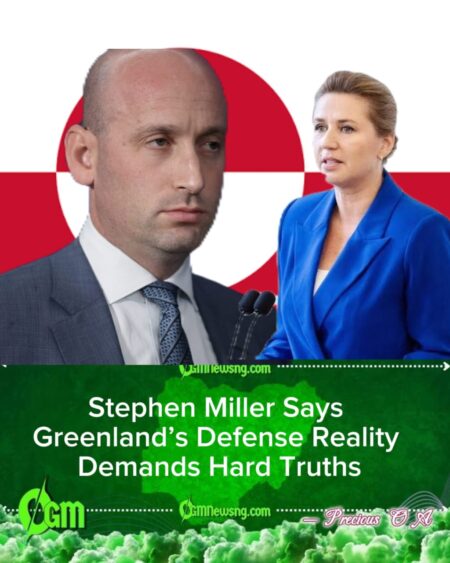
Stephen Miller said the debate over Greenland’s security has moved from academic discussion to urgent geopolitical reality, arguing that recent developments have exposed serious vulnerabilities in the Arctic region. He framed Greenland not just as a distant territory, but as a strategic asset whose location places it at the center of emerging global competition.
The White House deputy chief of staff emphasized that Greenland’s geography makes it critical for transatlantic defense, missile detection, and Arctic navigation routes that are opening as ice coverage recedes. He noted that these shifts have accelerated interest from major powers seeking to expand their influence in the High North.
Observers say the remarks reflect a broader reassessment within Washington of Arctic defense assumptions that held for decades. Greenland, long viewed as secure under NATO’s umbrella, is now being discussed in terms of readiness, infrastructure, and rapid response capabilities.
Stephen Miller and the Question of Danish Defense Capacity
Stephen Miller argued that Denmark’s ability to independently defend Greenland is limited by scale, resources, and distance, pointing to the sheer logistical challenges involved in protecting such a vast and remote territory. He suggested that while Denmark is a capable NATO ally, Greenland presents unique demands that exceed traditional national defense planning.
He cited the island’s sparse population, limited military infrastructure, and extreme weather as factors that complicate rapid deployment and sustained operations. According to his assessment, effective defense would require substantial coordination and support from allies, particularly the United States.
Stephen Miller also stressed that his comments were not meant as an indictment of Denmark, but as a call for realism. He framed the issue as one of capacity rather than intent, arguing that alliance planning must reflect operational realities rather than assumptions rooted in past stability.
Denmark’s Position and Official Response
Stephen Miller’s remarks prompted renewed attention to Denmark’s longstanding position that Greenland’s defense is a shared responsibility within NATO. Danish officials have previously highlighted ongoing investments in Arctic patrols, surveillance capabilities, and cooperation with allied forces.
Copenhagen has emphasized that it works closely with the United States through existing defense agreements, including the long-standing U.S. military presence at Thule Air Base. Danish leaders argue that these arrangements already provide a credible deterrent against potential threats.
Despite this, analysts note that Denmark’s defense budget and force size limit how much it can project power independently in the Arctic. The debate has therefore centered less on sovereignty and more on how responsibilities should be balanced within the alliance.
U.S. Strategic Interests in the Arctic
Stephen Miller linked the Greenland discussion to broader U.S. concerns about increased activity by Russia and China in Arctic regions. He warned that the melting ice has transformed previously inaccessible areas into viable corridors for military and commercial use.
He argued that the United States has a responsibility to ensure that strategic chokepoints and early-warning systems remain secure. From this perspective, Greenland is not an isolated issue but part of a wider network of defense considerations stretching across the polar region.
Stephen Miller maintained that clarity about defense roles is essential to avoid miscalculation by adversaries. He suggested that ambiguity about who can respond quickly and decisively could invite unwanted testing of alliance resolve.
Alliance Dynamics and NATO Considerations
NATO officials have long described the Arctic as a region of growing importance, and recent statements have reinforced the need for enhanced coordination among member states. The Greenland debate has highlighted how uneven capabilities within the alliance can complicate collective defense planning.
Some analysts argue that Miller’s comments reflect internal discussions already taking place behind closed doors. These conversations focus on burden-sharing, infrastructure investment, and the modernization of Arctic-capable forces.
Stephen Miller has been cited as advocating for a more explicit articulation of U.S. responsibilities in Greenland, paired with increased allied contributions. Supporters of this view say it strengthens deterrence by presenting a unified and credible posture.
Broader Political and Diplomatic Implications
Stephen Miller acknowledged that his remarks could be diplomatically sensitive, but insisted that open discussion is preferable to strategic complacency. He argued that allies benefit from candid assessments that allow them to plan proactively rather than react under pressure.
Critics, however, warn that such statements risk straining relations if perceived as dismissive of an ally’s capabilities. They stress the importance of balancing realism with respect for national sovereignty and partnership.
Stephen Miller countered that strong alliances are built on honesty and shared objectives. As Arctic dynamics continue to evolve, he said, the United States and its allies will need to adapt together, ensuring that Greenland’s security remains a cornerstone of transatlantic stability.
Table of Contents
Discover more from OGM News NG
Subscribe to get the latest posts sent to your email.