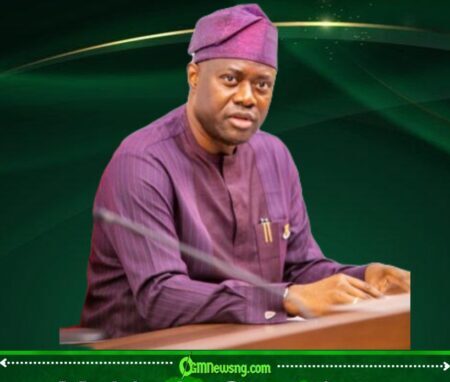






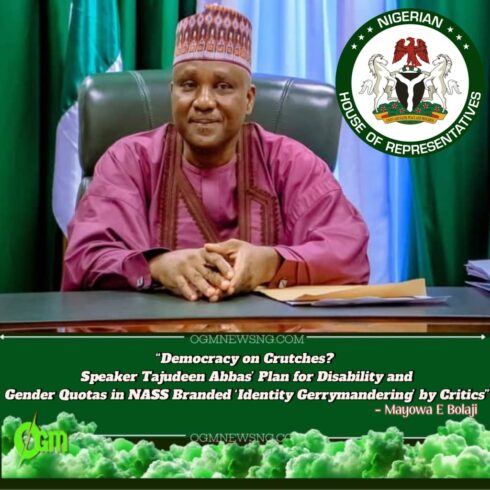
Tajudeen Abbas, the Speaker of the House of Representatives opened the debate with an emphatic statement: “At independence, women held less than 1% of seats. Today, it has barely moved.” Speaking at the 2nd Legislative Open Week in Abuja, the Speaker criticized Nigeria’s gender and ability representation as “embarrassingly primitive” and signaled an urgent need to shift constitutional paradigms. According to Abbas, the time has come for legal architecture to enforce inclusivity, not just rhetoric.
Abbas further clarified that the constitutional amendment aims to institutionalize affirmative action with legal teeth, ensuring that 10% of all National Assembly seats go to women and 5% to persons with disabilities (PWDs). “This isn’t tokenism,” he declared, “It’s structural justice.” The new quotas—55 seats in the House and 27 in the Senate—would be protected through direct elections conducted on separate ballots.
82 Seats for Inclusion: Democracy or Division?
Tajudeen Abbas insisted that the additional 82 seats are not just symbolic, but critical to building a representative Nigeria. “We cannot continue to operate a democracy where half of the population is invisible in policymaking,” he said. With Nigeria’s current female representation at less than 5% in the National Assembly and virtually zero seats for PWDs, the plan seeks to institutionalize equity.
However, critics argue the proposed quota system violates the universal suffrage principle. Political analysts warn that carving out seats based on identity markers could fragment the electorate and politicize disabilities. Some lawmakers from the opposition describe it as a “constitutional apartheid”, warning that it may set a dangerous precedent for other identity-based demands.
Separate Ballots, United House? Abbas Says Yes
Tajudeen Abbas outlined a new voting process that would require Nigerians to cast additional ballots solely for women and PWD representatives. “It’s an innovative approach—separate ballots ensure visibility and choice without undermining general elections,” he said. He stressed that this format prevents token appointments and ensures democratic legitimacy.
The Speaker further revealed that for PWD seats, nominations would be managed by accredited advocacy groups, whose members will screen, nominate, and vet aspirants. “We want credible voices from the disability community, not political proxies,” Abbas emphasized. Still, critics worry this could open the door to elitist gatekeeping within civil society.
Legal Storm Ahead: Constitutional Amendment Faces Hurdles
Tajudeen Abbas admitted that amending the constitution is a legal minefield but remained optimistic: “We’ve passed constitutional amendments before; this is achievable with political will.” He noted that the bill will need support from two-thirds of the National Assembly and at least 24 of Nigeria’s 36 state assemblies—a steep political hill.
Already, murmurs from conservative blocs within the legislature indicate resistance. Some northern lawmakers are reportedly preparing to block the bill on cultural and religious grounds. “This will not pass without a bruising legal and moral fight,” Tajudeen Abbas acknowledged, hinting that public engagement and media pressure may play a decisive role.
Political Earthquake or Progressive Evolution?
Tajudeen Abbas sees the proposal as a progressive leap forward. “Every democracy must evolve. Ours must do so by expanding the tent,” he said, arguing that static representation leads to stale governance. He noted that Rwanda, Ethiopia, and South Africa have all implemented similar measures with noticeable gains in inclusivity.
Nonetheless, some political watchers claim the bill is a smokescreen to distract from deeper systemic issues like corruption, insecurity, and economic stagnation. “This looks good on paper, but it’s not the reform Nigerians are desperate for,” said one critic. The fear is that Tajudeen Abbas’ plan may rearrange the chairs without fixing the ship.
2027 Elections May Mark Historic Shift
Tajudeen Abbas hinted that if passed swiftly, the amendment could take effect by the 2027 general elections. “Let’s not wait for another decade. We can make history now,” he urged fellow legislators. If approved, Nigeria would join a rare group of nations with constitutionally enshrined identity-based legislative quotas.
Yet, the electoral commission, INEC, has raised preliminary concerns about logistics and cost. “Multiple ballots, training, and advocacy require massive infrastructure upgrades,” an insider said. Abbas responded by saying democracy isn’t cheap, but failing to represent the people is costlier.
Table of Contents
Discover more from OGM News NG
Subscribe to get the latest posts sent to your email.