









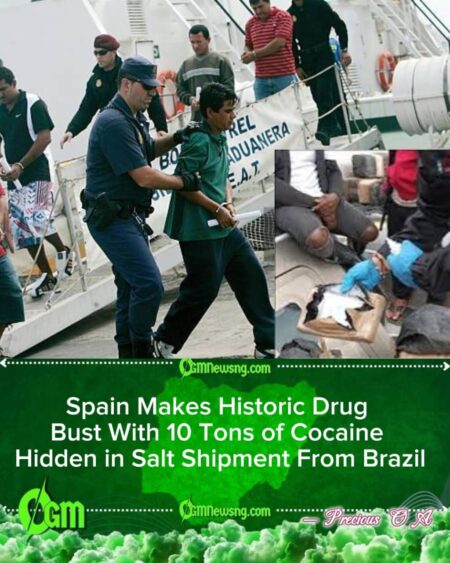
Spain stunned European security agencies after announcing its largest-ever cocaine seizure, intercepting more than 10 metric tons of the drug concealed inside a massive salt shipment arriving from Brazil. The bust immediately sent shockwaves through maritime security circles, as officials confirmed that the quantity seized could have flooded multiple European cities with narcotics for years.
Authorities revealed that the shipment was intercepted during a routine cargo inspection at a major southern port, where scanners detected unusual density irregularities within containers labeled as industrial salt. What initially appeared to be a legitimate bulk cargo quickly became one of the most significant narcotics cases in the nation’s modern history.
The seizure has been described by investigators as a turning point in the fight against transatlantic drug trafficking, highlighting both the sophistication of criminal smuggling networks and the rising scale of narcotics flows into Europe.
Spain’s Ports on High Alert
Spain moved swiftly to place all major ports under elevated security following the discovery, issuing internal alerts to customs officials, port authorities, and maritime police units nationwide. Inspectors were instructed to intensify scanning and physical inspections of bulk cargo shipments, particularly those arriving from high-risk trafficking corridors in South America.
Officials say the intercepted shipment was part of a larger trafficking pipeline that has increasingly relied on legitimate trade goods to conceal massive quantities of cocaine. Industrial salt, with its uniform appearance and high volume, has now been identified as a growing method for smuggling narcotics undetected.
Security analysts warn that traffickers are deliberately exploiting the heavy flow of raw materials into European ports, knowing that bulk commodities often receive less scrutiny due to their low-risk commercial classification.
The Smuggling Route from Brazil
Spain confirmed that the salt shipment originated from Brazil, a nation that has become a central export corridor for cocaine produced in neighboring countries. Drug traffickers have increasingly moved operations closer to major Brazilian ports, blending illicit cargo into legitimate shipping networks.
Investigators believe the shipment was designed to be distributed across multiple European countries once cleared through Spanish customs. From Spain, the cocaine would have been moved by land to organized crime hubs throughout Western and Central Europe.
Law enforcement sources say the sophistication of the operation suggests coordination among several criminal organizations operating across continents, making the seizure a significant disruption to international trafficking networks.
Economic and Social Impact
The intercepted cocaine was estimated to have a street value reaching into the billions of euros, underscoring the massive financial stakes involved in global drug trafficking. Analysts say that had the shipment reached the streets, it could have fueled violent crime, addiction, and social instability across dozens of European communities.
Public health officials warn that such a large influx of narcotics could have placed enormous pressure on healthcare systems, rehabilitation services, and law enforcement agencies already strained by rising substance abuse trends.
Community leaders across Europe have praised the seizure as a critical blow against criminal enterprises that profit from addiction and social harm.
Spain and the Expansion of Maritime Crime
Spain has increasingly found itself at the center of Europe’s fight against maritime drug smuggling due to its strategic geographic location and extensive port infrastructure. Criminal networks view Spanish ports as a gateway to the European Union, making them high-value targets for trafficking operations.
Authorities say recent years have seen a surge in attempts to smuggle drugs through commercial shipping lanes, with traffickers employing increasingly elaborate concealment techniques to evade detection.
This latest seizure has prompted calls for expanded international cooperation, improved scanning technology, and stricter cargo screening standards across European ports.
Global Ramifications
Spain has already begun sharing intelligence gathered from the seizure with international law enforcement agencies, including Europol and authorities in South America. Officials believe the information could lead to further arrests and dismantling of trafficking cells operating along the Brazil-Europe corridor.
Spain also confirmed that multiple suspects are currently under investigation, with financial trails being analyzed to identify laundering operations tied to the shipment. Additional port inspections are ongoing in several countries.
Spain emphasized that the operation represents not just a single success, but a warning to international criminal organizations that European ports are strengthening defenses and intensifying global coordination.
Looking Ahead
Spain has now formally declared the seizure a milestone case, calling it one of the most consequential drug enforcement operations in the nation’s history. Officials say the discovery will shape future port security strategies and international counter-narcotics cooperation.
The case continues to unfold as investigators analyze shipping records, financial transactions, and communications linked to the smuggling network. Several arrests are expected as authorities widen the investigation.
With more than 10 tons of cocaine removed from circulation, law enforcement leaders say Europe has narrowly avoided one of the most damaging drug influxes in modern history — and that this seizure may mark the beginning of a new, more aggressive phase in the global fight against narcotics trafficking.
Table of Contents
Discover more from OGM News NG
Subscribe to get the latest posts sent to your email.