









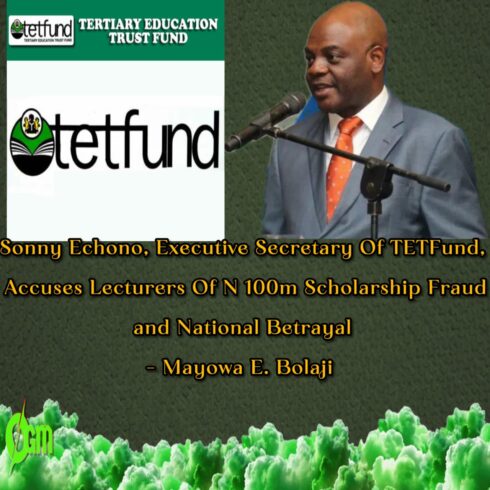
Sonny Echono, Executive Secretary of TETFund, has exposed a deeply disturbing trend in Nigeria’s academic funding scheme: lecturers sponsored abroad on federal scholarships vanishing after receiving massive financial support. According to Echono, some individuals were paid as much as N100 million each for foreign postgraduate studies but never returned to contribute to Nigeria’s education sector as mandated.
In a public address that has sparked heated debate, Echono disclosed that several beneficiaries of TETFund’s foreign scholarship program absconded after securing their funds, leaving both the education system and taxpayers defrauded. The TETFund boss expressed disappointment, calling the trend “criminal, disheartening, and a betrayal of national trust.”
Sonny Echono Labels It “Academic Banditry” as Lecturers Exploit TETFund
Sonny Echono did not mince words, describing the act as “academic banditry,” where scholars, entrusted with Nigeria’s hopes, game the system for personal gains. “They pretend to go for research and capacity development but run away with the money,” Echono stated, citing it as an alarming trend that threatens Nigeria’s human capital development agenda.
The Executive Secretary emphasized that such actions not only constitute economic sabotage but also cripple the purpose of the scholarship program, which is to train specialists who would return and elevate Nigeria’s education and innovation sectors. “We are losing minds, money, and moral ground,” he said sharply.
Sonny Echono Reveals Loopholes: No Collateral, No Accountability
According to Sonny Echono, a major flaw contributing to the high number of abscondments is the weak enforcement of bond agreements. “Most of these scholars sign documents with no enforceable collateral, so when they vanish, we are left with paper promises,” he revealed. The absence of stringent follow-up mechanisms has emboldened others to attempt the same fraud.
Echono further stated that efforts to recover the funds or compel return have been largely ineffective due to international legal limitations and inadequate cooperation from foreign institutions. “We can’t keep hemorrhaging billions in the name of intellectual development without solid accountability structures,” he insisted.
Sonny Echono Calls for Reform: Foreign Sponsorship May Be Suspended
In light of the rising cases of fraud, Sonny Echono hinted that TETFund may drastically reduce or suspend foreign scholarships. “We are considering focusing more on local capacity building and inviting global scholars to train here instead,” he declared. The pivot is aimed at safeguarding national investments and reducing capital flight through misuse of scholarships.
Echono warned that while international exposure is beneficial, it should not come at the cost of national betrayal. “Why should we be paying millions for someone to get trained in Canada or the UK, only for them to ghost us and work there instead? That’s unacceptable,” he stated with visible frustration.
Sonny Echono Advocates Legal Sanctions: Defaulting Scholars Face Jail or Repayment
Sonny Echono announced that TETFund is now working with the Federal Ministry of Justice and the ICPC to track, prosecute, and recover funds from defaulters. “Anyone who absconds will either repay every kobo or face jail. This isn’t free money—it’s a national investment,” he said.
He confirmed that some cases are already in court, and others are under investigation. “We have begun naming and shaming. We’ll blacklist these individuals, notify foreign embassies, and publish names if necessary,” he warned. This move is designed to deter future scholarship abuse and restore public trust.
Sonny Echono Urges Universities to Vet Candidates Better
In closing, Sonny Echono placed part of the blame on tertiary institutions for nominating candidates who may not have been committed to national service. “Universities must not send just anyone for funding. We need moral strength, not just academic grades,” he stated.
He urged vice-chancellors to establish stronger monitoring and alumni-tracking units that can ensure scholars abroad are meeting their obligations. “It’s not just about funding education—it’s about funding loyalty, responsibility, and integrity,” Echono concluded, demanding a cultural and operational shift within the system.
Table of Contents
Discover more from OGM News NG
Subscribe to get the latest posts sent to your email.