









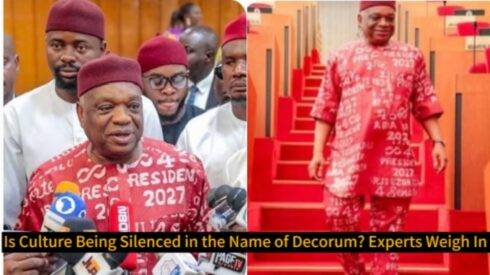
Senator Orji Uzor Kalu, the former Governor of Abia State and current Chief Whip of the Nigerian Senate, triggered a wave of nationwide discourse following his dramatic and unconventional appearance in the Red Chambers on Tuesday. The seasoned lawmaker walked into the Senate dressed in a full-length traditional Isi Agu robe adorned with flamboyant embroidery and paired with red Igbo chieftaincy beads—an outfit rarely seen in the hallowed halls of Nigeria’s legislature.
The attire, though deeply rooted in Igbo cultural identity, sharply contrasted with the generally conservative and Eurocentric dress code associated with Nigeria’s legislative proceedings. His bold fashion statement instantly went viral, drawing the attention of fellow senators, media analysts, and social commentators alike, many of whom questioned the intent and implications of such a daring sartorial choice within a legislative context.
Calls for Dress Code Review Emerge Amid Mixed Reactions
The moment Senator Orji Uzor Kalu took his seat, murmurs spread across the chamber, with some lawmakers expressing discomfort while others applauded the cultural symbolism. Some Northern and Western senators reportedly raised objections informally, stating that such attire, while culturally significant, might “undermine the institutional decorum” expected in the Senate.
In response, several civil society groups and cultural advocates came to Senator Orji Uzor Kalu’s defense, calling his appearance a legitimate form of cultural expression protected under Nigeria’s pluralistic constitution. The incident has since reignited a broader conversation about the rigid Eurocentric dress codes imposed in formal political spaces, and whether they are reflective of Nigeria’s rich ethnic diversity or colonial legacies in disguise.
Is Culture Being Silenced in the Name of Decorum? Experts Weigh In
Prominent cultural historians argue that Senator Orji Uzor Kalu’s attire highlights a growing tension between post-colonial African identity and inherited Western institutional norms. Professor Uchenna Nwosu of the University of Nigeria Nsukka posits that the uproar signals a “deep-seated discomfort with African identity in elite political spaces,” suggesting that this event could mark a watershed moment in how cultural representation is viewed in governance.
Conversely, political analyst Musa Haruna warned against “misplaced priorities,” asserting that “the Senate is a policy-making institution, not a cultural festival.” He criticized Orji Uzor Kalu’s choice as a calculated political stunt aimed at diverting attention from pressing legislative matters. Yet, the depth of public engagement in the debate suggests that the issue taps into more profound questions about Nigeria’s national identity and unity.
Social Media Explodes With Hashtags and Commentary
Within hours, social media platforms exploded with reactions, with trending hashtags like #OrjiUzorKaluStyle, #SenateFashionWar, and #CulturalFreedomNow dominating Nigerian Twitter and Instagram. Many users praised Kalu for “redefining political aesthetics,” while others lambasted the senator for what they described as “theatrics that belittle the seriousness of governance.”
Videos of his entrance, combined with split-screen edits comparing the traditional outfit with standard Senate attire, have garnered millions of views. The online engagement has also revealed deep generational divides—while younger Nigerians largely celebrated the cultural defiance, older netizens remained largely skeptical or outright disapproving of the shift away from formal, Western-style norms.
The Senate’s Response: Unofficial Displeasure, No Formal Sanction Yet
Despite the uproar, the Senate leadership has so far refrained from issuing any formal reprimand or statement concerning Senator Orji Uzor Kalu’s attire. However, insiders close to the Senate President’s office disclosed that there are ongoing behind-the-scenes consultations about potentially updating or enforcing a more explicit dress code for members to avoid future ambiguities.
Senator Orji Uzor Kalu, unfazed by the controversy, told reporters that his appearance was “a proud celebration of culture and heritage” and “a visual protest against the erasure of our indigenous identity in elite politics.” He doubled down on his right to express cultural pride, asserting that if Nigeria is to progress, “we must stop apologizing for being African.”
Legal and Constitutional Implications: Is a Dress Code Even Binding?
Legal scholars are now weighing in on whether the Senate has any constitutional backing to regulate the attire of its members beyond the ambiguous expectations of “professional decorum.” Human rights lawyer Aisha Anifowoshe noted that while internal rules exist, they must not infringe on personal liberties, especially when such liberties are tied to ethnic and cultural identity.
Senator Orji Uzor Kalu’s action may inadvertently prompt a constitutional challenge, should any sanction be attempted against him. As public interest continues to swell, many are urging lawmakers to embrace inclusivity, arguing that the National Assembly must reflect the cultural tapestry it claims to represent. For now, Kalu stands at the center of a culture-versus-convention storm that shows no signs of quieting.
Table of Contents
Discover more from OGM News NG
Subscribe to get the latest posts sent to your email.