








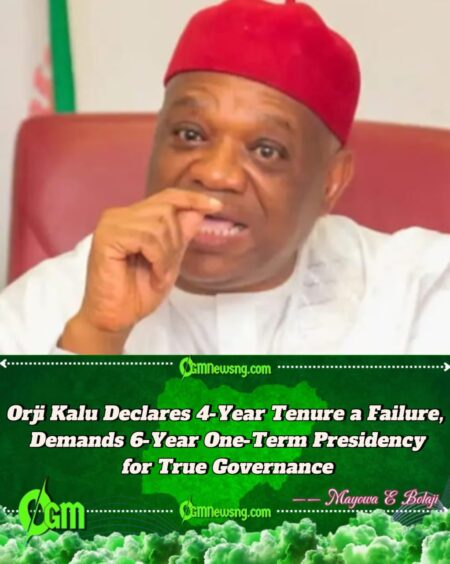
Senator Orji Kalu has advanced a bold proposal to amend the 1999 Constitution of the Federal Republic of Nigeria by introducing a single six-year term for the President and state governors, rather than the current four-year renewable term. According to Kalu, this major constitutional shift would recalibrate the governance calendar, enhance focus on delivery rather than re-election campaigns, and reduce the recurring cycle of politicking that many see as a drain on national resources.
He argues the change is necessary because “people are busy fighting after four years. They are fighting for another term,” and that by fixing the tenure at one non-renewable six-year span, “let everybody who is coming know that he is just coming for a six-year single term, and there will be no rancour or problems.”
Kalu further posits that the six-year model would serve Nigeria’s “developing country” context far better than exported constitutional models that may not match Nigeria’s economic and political reality. He states that this move would “reduce political tension, promote stability, and allow elected leaders to focus on governance rather than electioneering.”
Potential Impacts: Stability, Governance Quality and Democratic Renewal
Under Kalu’s proposal, one of the prime anticipated outcomes is greater political stability. With no looming re-election cycle, leaders are less likely to engage in posturing for re-election and can instead deploy their energies into policy implementation, infrastructure, and public welfare. Kalu asserts that “everybody needs enjoyment… That single tenure can give them what they want, provide food on their table, provide adequate transport, provide access to movement…, and security.”
Another key effect would be on governance quality and accountability. The idea is that officials would carry out their responsibilities without the constant distraction of campaigning, thereby acknowledging that their term is a fixed six-year window to perform rather than preparing for another term. Kalu believes this structure will also discourage corruption linked to efforts at prolonging tenure or securing re-election.
Furthermore, the reform is pitched as a pathway for democratic renewal — offering voters a clear, decisive mandate period and then a natural transition. By limiting leaders to one term, the system could avoid entrenchment of power, reduce incumbency advantage contest-after-contest, and refresh the political landscape more predictably. Kalu suggests the timeframe could begin as early as 2027 or 2031, depending on constitutional consensus.
Challenges, Criticisms and the Road Ahead for Constitutional Amendment
While the proposal holds significant promise, it also confronts notable challenges. Critics argue that a single six-year term could deprive the electorate of the opportunity to renew a performing leader’s mandate, thereby reducing flexibility in democratic choice. The risk of locking in underperformance for six years looms as a serious concern. Kalu’s camp will need to address these counter-arguments comprehensively.
Another hurdle is the constitutional amendment process itself. Amending the 1999 Constitution requires not just legislative action by the National Assembly, but also concurrence of the majority of state houses of assembly and, in some cases, a referendum. The proposal’s timetable is subject to political alignment, stakeholder buy-in, and managing competing interests at federal and state levels. Kalu has indicated flexibility on when the reform would take effect — either 2027 or 2031.
Looking ahead, the road to realisation will depend on how Kalu and allies frame the narrative, build public consensus, and navigate political resistance. The reform must not only be justified rhetorically, but also operationalised in law, with clarity on transition arrangements, safeguarding democratic safeguards, and ensuring that the six-year tenure does not inadvertently weaken accountability or entrench power. The coming months will test whether the buzz around a six-year single term can translate into legislative reality.
Table of Contents
Discover more from OGM News NG
Subscribe to get the latest posts sent to your email.