









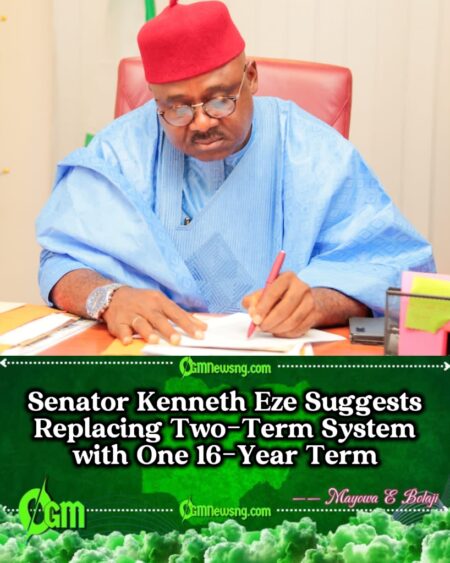
Senator Kenneth Eze has ignited a nationwide conversation after proposing a single 16-year presidential tenure to replace Nigeria’s current two-term, four-year system. The lawmaker, who represents Ebonyi State under the All Progressives Congress (APC), argued that frequent election cycles disrupt governance and hinder long-term national development. His remarks have triggered debate across political, legal, and civic circles about the future of Nigeria’s democratic structure.
Speaking at his country home in Ohigbo-Amagu, Ezza South Local Government Area, Senator Kenneth Eze emphasized that the present constitutional arrangement compels leaders to shift focus from governance to re-election campaigns almost immediately after assuming office. According to him, by the third year of a four-year term, political attention is already diverted toward electoral survival rather than sustained policy implementation.
The senator insisted that his proposal is not designed to undermine democracy but to strengthen it through stability and continuity. He called for an open and participatory national dialogue that would allow Nigerians to weigh the merits and potential risks of adopting a single extended presidential tenure as part of broader constitutional reform efforts.
Senator Kenneth Eze Argues 16-Year Tenure Will Boost Policy Continuity and National Development
At the core of Senator Kenneth Eze’s proposal is the argument that policy continuity is essential for meaningful development. He pointed out that critical sectors such as power generation, infrastructure expansion, agriculture modernization, and fiscal reforms require consistent leadership and long-term strategic planning. According to him, repeated electoral cycles often interrupt ambitious projects before they can deliver measurable impact.
The senator specifically referenced initiatives like irrigation schemes, mechanized farming systems, and energy sector reforms, noting that these programs demand sustained commitment over many years. He argued that under the current two-term structure, leaders are often pressured to prioritize short-term achievements that can be showcased during campaigns, rather than investing in reforms that may take a decade or more to mature.
Senator Kenneth Eze maintained that a single 16-year tenure would eliminate the distraction of re-election politics, allowing presidents to concentrate fully on governance. In his view, this shift would encourage long-range economic planning, strengthen institutional reforms, and create a more stable policy environment attractive to both local and foreign investors.
National Debate Emerges Over Democracy, Accountability, and Governance Structure
The proposal by Senator Kenneth Eze has sparked mixed reactions among political analysts, civil society organizations, and constitutional scholars. While some supporters believe that an extended single term could enhance stability and reduce campaign-related expenditure, critics argue that longer tenures may weaken democratic accountability and reduce citizens’ ability to evaluate leadership performance through periodic elections.
Nigeria currently operates under a constitutional framework that permits a maximum of two four-year presidential terms. Any move to adopt a single 16-year tenure would require significant constitutional amendments and widespread public consultation. Observers note that such a change would demand rigorous legislative processes, public referendums, and consensus-building across political parties and regional blocs.
Despite the controversy, Senator Kenneth Eze has reiterated that his suggestion is merely a starting point for national reflection. He urged journalists, teachers, civil servants, and parents to promote civic responsibility and national values, stressing that constitutional reform alone cannot transform the country without active citizen engagement. As the debate unfolds, the proposal has placed governance reform, policy continuity, and democratic accountability at the forefront of Nigeria’s political discourse.
Table of Contents
Discover more from OGM News NG
Subscribe to get the latest posts sent to your email.