







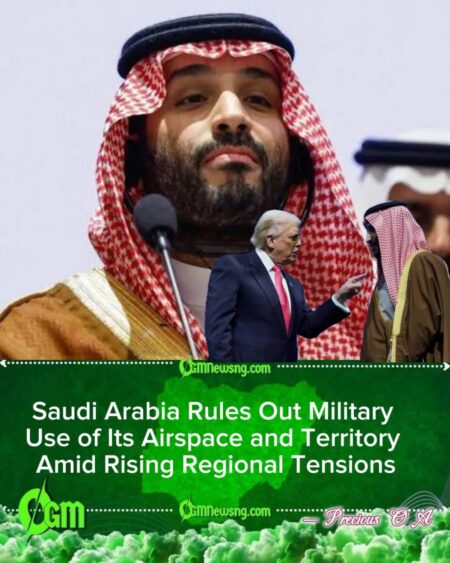
Saudi Arabia has informed Iranian officials that it will not permit its airspace or territory to be used for any military action, according to diplomatic sources familiar with the exchange. The message was delivered through established regional channels and emphasized Riyadh’s commitment to preventing escalation at a time of heightened sensitivity in the Middle East.
The communication underscored that the kingdom’s position is rooted in principles of sovereignty and regional stability, rather than alignment with any prospective military operation. Officials indicated that the statement was meant to remove ambiguity and reduce the risk of miscalculation as regional actors assess rapidly evolving security dynamics.
Observers note that such clarity reflects a broader effort by Gulf states to insulate themselves from conflicts involving external powers. The emphasis on non-involvement signals an intent to maintain balanced relations while prioritizing domestic security and economic continuity.
Regional Security Calculations
The decision not to allow military use of airspace or land aligns with long-standing concerns among regional governments about becoming transit points for conflict. By closing off logistical pathways, states can reduce the likelihood of retaliation or spillover effects that might threaten civilian infrastructure.
Security analysts say this approach reflects lessons learned from past regional crises, where indirect involvement carried significant consequences. Governments across the Middle East have increasingly sought to draw clear boundaries around their participation, even as they engage diplomatically with multiple sides.
Such moves are also seen as part of a collective interest in avoiding disruptions to trade routes, energy production, and aviation networks that are critical to global markets. Stability, in this sense, is framed as a shared responsibility rather than a unilateral choice.
Saudi Arabia’s Message to Iran
Saudi Arabia framed its message to Iran as a precautionary measure rather than a rebuke, according to officials briefed on the discussions. The language reportedly stressed mutual respect and the importance of preventing misunderstandings that could escalate into broader confrontation.
Diplomats familiar with the exchange said the kingdom emphasized that it does not wish to see its territory implicated in actions that could undermine regional dialogue efforts. The tone was described as firm but measured, designed to convey resolve without provoking diplomatic backlash.
Saudi Arabia has in recent years invested heavily in recalibrating its regional relationships, including cautious engagement with Tehran. Analysts suggest that this communication reflects that recalibration, balancing deterrence with an ongoing interest in de-escalation.
International Reactions and Diplomatic Context
International observers have viewed the statement as consistent with a wider trend of regional actors asserting autonomy amid great-power rivalries. By setting explicit limits, countries aim to avoid being perceived as extensions of external military strategies.
Some Western diplomats privately welcomed the clarity, arguing that well-defined red lines can reduce the risk of accidental escalation. Others noted that such positions complicate operational planning for any actor seeking regional basing or transit options.
Saudi Arabia’s stance was also interpreted as reinforcing international norms around sovereignty and consent, principles that are frequently cited in diplomatic forums when addressing regional security concerns.
Energy Markets and Economic Considerations
Energy analysts pointed out that statements affecting regional security often have immediate implications for oil and gas markets. While the announcement did not trigger significant price volatility, it reinforced perceptions that Gulf producers are keen to shield energy infrastructure from geopolitical shocks.
Saudi Arabia remains a central player in global energy supply, making stability in its airspace and territory a matter of international interest. Ensuring that the kingdom is not drawn into military action helps reassure markets concerned about supply disruptions.
Economists added that predictable security conditions support investment and long-term economic planning, particularly as regional states pursue diversification agendas and large-scale development projects.
Prospects for De-escalation
Saudi Arabia reiterated, through diplomatic channels, its support for dialogue and conflict prevention, according to regional officials. The emphasis on non-use of territory was paired with calls for restraint and adherence to international law.
Diplomats suggest that such messages may encourage parallel communications among other regional actors, reinforcing a shared preference for de-escalation. Back-channel discussions are expected to continue as governments seek to manage tensions without public confrontation.
Saudi Arabia’s position ultimately reflects a strategic choice to prioritize stability over alignment, signaling that while the kingdom remains engaged diplomatically, it intends to avoid direct involvement in military actions that could destabilize the region further.
Table of Contents
Discover more from OGM News NG
Subscribe to get the latest posts sent to your email.