







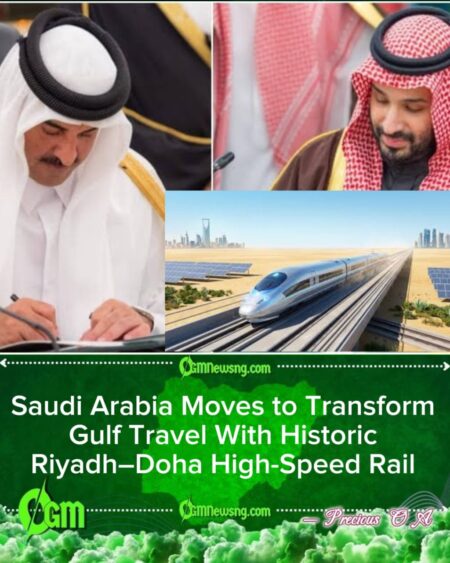
Saudi Arabia announced a landmark transportation initiative, revealing plans for a high-speed rail corridor that will directly link Riyadh to Doha, a move widely regarded as one of the most ambitious joint infrastructure undertakings in recent Gulf history. Saudi officials described the moment as a defining milestone in regional modernization, explaining that the project demonstrates how strategic transportation networks can serve not only economic goals but also long-term national aspirations for smoother mobility and more interconnected Gulf societies. Analysts say the announcement represents a new phase of forward-looking cooperation that blends technological determination with a desire to reshape the travel experience across the region.
Saudi Arabia emphasized that the project, designed to drastically reduce travel times and strengthen regional mobility, is expected to set new standards for high-speed rail development in the Middle East, combining technical ambition with unprecedented diplomatic coordination. The Kingdom clarified that early feasibility studies have already identified the corridor as a high-impact route capable of transforming both business and leisure travel by linking two rapidly expanding cities through a system engineered to operate at world-class levels of speed and efficiency. The resulting transportation network, officials contend, will reshape movement between the two nations and support long-term national development frameworks.
Saudi Arabia stressed that the rail agreement represents a visible symbol of warming relations and growing trust between the two nations, reinforcing a shared regional vision rooted in economic diversification, long-term partnership, and modernization. The government further noted that this renewed sense of cooperation signals a commitment to future collaboration across multiple sectors, especially as both nations continue adjusting their regional priorities to reflect global economic shifts. Throughout the Gulf, observers are pointing to the project as a tangible example of what diplomatic stability can achieve.
Economic Integration and Strategic Cooperation
Saudi Arabia outlined that the high-speed rail line is poised to stimulate large-scale cross-border commerce, enhance tourism flows, and create new logistical efficiencies that will benefit both countries’ rapidly expanding non-oil sectors. Officials noted that the initiative fits directly into the Kingdom’s broader plans to strengthen transport infrastructure as foundational support for trade diversification and international business engagement. Beyond boosting commercial influence, the connection is expected to create smoother travel patterns for tens of thousands of annual visitors.
Saudi Arabia projected that this initiative would encourage joint investment platforms, attract global transportation partners, and draw significant interest from multinational engineering firms eager to participate in a transformative regional project. Economists believe that once operational, the railway will generate new business hubs, support hospitality and retail sectors, and allow companies to operate with greater confidence in the reliability of their cross-border operations. The resulting commercial ecosystem could reshape the Gulf’s competitive position within global markets.
Regional analysts note that businesses across the Gulf are preparing for a surge in commercial exchanges, recognizing that a direct Riyadh-Doha rail corridor could reshape supply chains, open new trade routes, and reduce reliance on slower air or road travel. Some regional experts argue that these improvements will create ripple effects across the wider GCC economy, particularly as entrepreneurs, manufacturers, and logistics providers adapt to new opportunities enabled by faster and more predictable transportation.
Diplomatic Significance and Regional Stability
Saudi Arabia reaffirmed that improved physical connectivity has long been viewed as a practical mechanism for enhancing diplomatic understanding, especially as both nations have renewed commitments to regional unity after years of strained relations. The Kingdom emphasized that transportation networks have historically played a significant role in stabilizing cross-border relations by encouraging sustained economic collaboration and shared infrastructural responsibilities.
Saudi Arabia stated that senior officials view the railway not only as a transportation system but also as a confidence-building framework that deepens intergovernmental coordination, strengthens bilateral communication, and reinforces ongoing reconciliation efforts. According to regional diplomats, the steady improvement in Gulf diplomatic environments reflects a strategic choice to emphasize cooperation over rivalry, and the construction of shared infrastructure provides an effective platform for that shift.
Diplomatic observers argue that the project illustrates how strategic infrastructure can stabilize the region, encourage cooperative security planning, and reduce political tensions by fostering shared economic and developmental priorities. Many believe the Riyadh-Doha corridor will become a reference point for future joint undertakings across the Gulf.
Technological Innovation and Engineering Requirements
Saudi Arabia highlighted that the planned rail line will incorporate advanced high-speed technologies, including next-generation propulsion systems, sophisticated safety architectures, and real-time monitoring networks designed to guarantee performance and reliability. Engineers working on the project expect that the final system will reflect some of the most advanced transportation concepts currently deployed in global high-speed rail.
Saudi Arabia emphasized that engineering teams from both countries will collaborate on route design, environmental impact studies, land acquisition frameworks, and construction sequencing to ensure the rail system adheres to global standards while accommodating local terrain challenges. The collaboration between technical teams, officials noted, symbolizes the merging of shared resources, scientific expertise, and logistical capabilities across national boundaries.
Technical consultants working on early development phases expect construction to require specialized tunneling operations, elevated track installations, and climate-resilient materials suitable for Gulf heat conditions, sand exposure, and long-distance high-speed operations. These requirements underline the engineering sophistication necessary to sustain safe and efficient travel in a demanding environment.
Public Response and Social Expectations
Saudi Arabia reported that early public reaction within the Kingdom has been overwhelmingly enthusiastic, with citizens expressing excitement over a travel innovation that promises smoother mobility, easier tourism, and greater regional connectivity. Many online commentators say the project represents the kind of futuristic infrastructure long promised in national development plans.
Saudis and Qataris across social media platforms are praising the decision, viewing it as a forward-thinking investment that demonstrates regional leadership and a commitment to enhancing everyday quality of life for residents and frequent travelers. This enthusiasm reflects a public increasingly supportive of large-scale modernization efforts.
Public-opinion researchers note that the high-speed rail concept aligns strongly with a youthful Gulf population eager for modern transportation, international integration, and infrastructure systems that reflect global megacity standards. Analysts argue that such public support will be crucial during construction phases.
Long-Term Vision and Future Expansion
Saudi Arabia noted that plans for the Riyadh-Doha railway may eventually serve as a foundational segment in a broader GCC rail grid, one that could connect additional capitals and commercial hubs across the Arabian Peninsula. Such a network would symbolize regional unity through functional, interconnected development.
Saudi Arabia suggested that long-term development frameworks envision a future in which high-speed travel becomes a central pillar of Gulf economic diversification strategies, linking cities across borders with the efficiency of European and East Asian transport networks. Policymakers view this as an essential step toward competing with global metropolitan corridors.
Infrastructure experts believe the Riyadh-Doha initiative could pave the way for expanded freight lines, digital ticketing ecosystems, and integrated mobility platforms that would elevate the region’s global competitiveness and enhance strategic interdependence. Many expect the project to shape the next generation of Gulf transportation policy.
Table of Contents
Discover more from OGM News NG
Subscribe to get the latest posts sent to your email.