




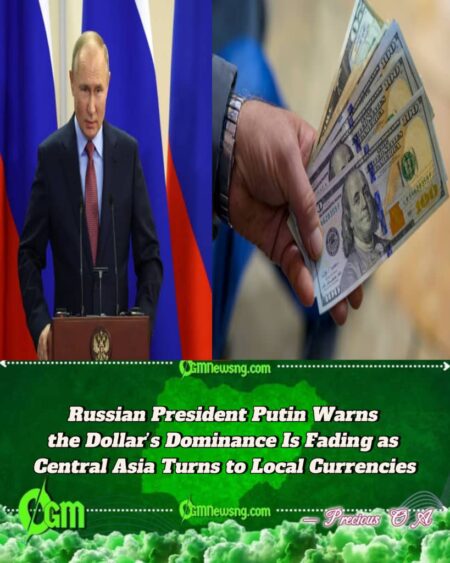
Russian President Vladimir Putin has asserted that countries in Central Asia are increasingly abandoning the U.S. dollar in favor of their own national currencies when conducting trade. Speaking at a recent Russia–Central Asia summit in Dushanbe, Putin emphasised that the shift represents a deliberate strategy to assert financial sovereignty and reduce dependency on external currencies. With trade between Russia and Central Asia surpassing US$45 billion in 2024, the move to national currency settlement has already achieved considerable momentum.
President Putin stated that Russia and its Central Asian neighbours are “systematically switching to national currencies” in trade, marking what he described as one of the most significant economic realignments in recent years. He noted that the transition now extends far beyond isolated bilateral transactions and covers major trade sectors, including energy, agriculture, and manufacturing. According to him, this development represents both an economic and political rebalancing of regional power.
President Putin revealed that the trade volume between Russia and Central Asia surpassed US$45 billion in 2024, with an overwhelming share now settled in national currencies. He emphasised that the adoption of national payment systems was not a short-term measure but part of a “permanent structural reform” aimed at protecting the region from external economic shocks and sanctions.
President Putin highlighted Kazakhstan as a leading example of successful transition, with 95% of its trade with Russia now conducted in local currencies. Similar progress, he said, has been made with Tajikistan, where more than 96% of all transactions are completed in rubles. He added that Uzbekistan, Kyrgyzstan, and Turkmenistan are rapidly moving in the same direction, signaling that dollar dependence is “in irreversible decline.”
President Putin stressed that this movement is not only reactive but also proactive. While it was accelerated by Western sanctions, he said the broader goal is to strengthen monetary sovereignty, reduce exchange rate risks, and create a regional financial system less susceptible to external interference. He described it as a “foundation for true economic independence.”
Strategic Motivations and Global Context
President Putin asserted that the decision to move away from the U.S. dollar stems from what he called “the misuse of global financial instruments as political weapons.” He explained that overdependence on the dollar exposes nations to sudden financial blockades and asset freezes, which can destabilize entire economies. In his view, moving to national currencies restores fairness and predictability to international trade.
President Putin further emphasized that national currency settlements help stabilize domestic markets. By eliminating the need for constant currency conversion, he said countries can shield themselves from global exchange rate volatility and the costs of dollar-based transactions. He described this as “not only an economic necessity but a strategic safeguard for future generations.”
President Putin remarked that the transition aligns with Russia’s long-term regional vision under the Eurasian Economic Union (EAEU). He said Moscow’s cooperation with Central Asian states goes beyond trade — it includes shared investment frameworks, coordinated financial regulations, and development of a common payment infrastructure. He framed the move as part of a broader mission to “unite Eurasia under principles of mutual respect and economic equality.”
President Putin also connected the trend to a global phenomenon known as “de-dollarization,” in which countries like China, India, and Brazil are increasingly using their own currencies for international settlements. He said the collaboration between Russia and Central Asia is a regional reflection of that global realignment. In his words, “The world is entering a post-dollar era where no single currency dictates the terms of trade.”
President Putin maintained that Central Asian partners have welcomed this change because it strengthens their economic autonomy. He praised leaders in the region for their “political courage” and readiness to embrace a new model of cooperation that prioritizes sovereignty over dependency. According to him, this collective commitment is what gives the policy “historic weight and global consequence.”
Challenges, Risks, and the Emerging Financial Order
President Putin acknowledged that despite the progress, the transition to national currencies is not without challenges. He cited the need for stable financial infrastructure, sufficient liquidity in regional currencies, and improved monetary coordination among participating nations. Without these, he cautioned, the new system could face instability or technical delays in cross-border settlements.
He pointed out that legacy systems tied to the dollar remain deeply embedded in regional trade. Existing contracts, pricing models, and banking instruments still rely on dollar benchmarks, requiring a gradual process of reconfiguration. Moscow, he assured, is offering technical assistance and digital payment solutions to ease this transition.
He noted that market confidence in national currencies must be sustained through sound fiscal and monetary management. Central Asian central banks, he urged, should coordinate policies, enhance currency convertibility, and maintain inflation control. Through mutual trust and discipline, he said, the system could achieve long-term stability.
He warned that the process of de-dollarization will test the resilience of global financial structures. While the U.S. dollar will not disappear overnight, he said its monopoly is eroding as more regions establish independent settlement systems. This shift, he added, “marks the dawn of a multipolar financial world” — one based on partnership, not dominance.
President Putin concluded that the move away from the U.S. dollar is not just an economic measure but a declaration of sovereignty. He said Central Asia’s resolve to build financial independence demonstrates “a new confidence in regional identity and shared destiny.” The future, he asserted, “belongs to those who trade freely and stand firmly on their own economic feet.”
Table of Contents
Discover more from OGM News NG
Subscribe to get the latest posts sent to your email.