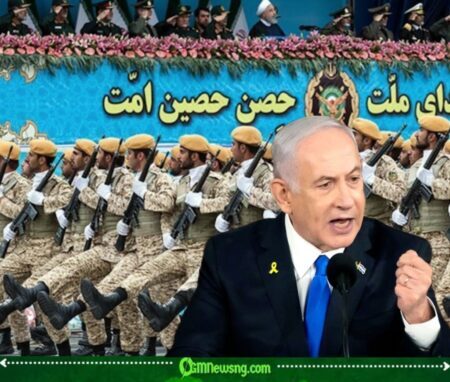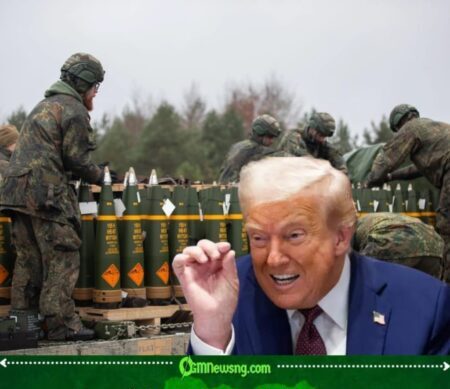









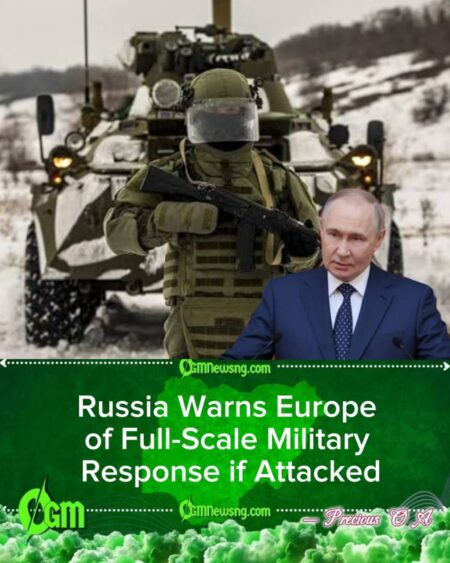
Russia opened the latest chapter in rising East–West tensions by declaring that any direct military attack from European nations would trigger a full-scale response, a statement that immediately reverberated through diplomatic, security, and financial circles. The warning, delivered through official channels, framed the situation as a matter of national survival rather than conventional deterrence, underscoring how sharply relations have deteriorated.
The declaration followed weeks of heightened rhetoric, military exercises, and strategic signaling on both sides, with officials in Moscow arguing that Europe’s defense posture has crossed from precaution into provocation. Analysts note that the language used was unusually blunt, designed less for negotiation and more for deterrence through fear of escalation.
Across European capitals, the response has been cautious but serious, as leaders attempt to balance public reassurance with private contingency planning. The warning has also renewed debates over whether existing security frameworks are sufficient to prevent miscalculation in an increasingly polarized environment.
Escalating Rhetoric and Strategic Posturing
Military analysts say the warning reflects a broader shift toward maximalist language that leaves little room for ambiguity or back-channel compromise. Such statements, while not new in international politics, take on added weight when paired with visible troop movements and weapons testing.
Russia has repeatedly argued that Europe’s growing coordination with allied military blocs threatens its strategic depth, insisting that what Western leaders describe as defensive measures are viewed in Moscow as offensive preparations. This perception gap, experts warn, is one of the most dangerous elements in the current standoff.
European officials, meanwhile, emphasize that no plans exist for an offensive strike, pointing instead to deterrence and collective defense obligations. Even so, the increasingly absolutist tone on both sides has narrowed diplomatic space, making de-escalation more complex.
Military Readiness and Red Lines
Defense planners across the continent are quietly reassessing readiness levels, supply chains, and response times, wary that political statements could rapidly translate into operational demands. Exercises scheduled months in advance are now being scrutinized for how they might be interpreted by adversaries.
Russia has signaled that its red lines are no longer abstract concepts but concrete thresholds tied to specific actions, such as troop deployments or weapons transfers. By defining these limits more explicitly, Moscow appears intent on shaping Europe’s strategic calculations before any crisis erupts.
Security experts caution that while clarity can reduce misunderstanding, it can also harden positions, making compromise politically costly. Once red lines are publicly declared, backing away from them risks domestic backlash and perceived weakness.
Russia and the European Security Order
The current confrontation has reignited debates about the post–Cold War security architecture that governs relations between Europe and its eastern neighbor. Many analysts argue that frameworks designed decades ago are struggling to accommodate today’s realities of multipolar power and rapid technological change.
Russia has long claimed that the existing order marginalizes its interests, contending that repeated expansions of European security arrangements came at its expense. This grievance forms the backbone of its argument that firm warnings are necessary to force a strategic reset.
European policymakers counter that the rules-based system is voluntary and defensive, insisting that no country is entitled to veto the sovereign choices of others. The clash between these narratives lies at the heart of the current impasse.
Diplomatic Channels Under Strain
Behind the scenes, diplomats continue to engage in talks aimed at preventing escalation, though progress has been slow and fragile. Communication lines remain open, but trust has eroded to the point where even routine exchanges are treated with suspicion.
Russia has indicated that dialogue is possible only if Europe acknowledges its security concerns as legitimate, a condition that many European leaders are reluctant to accept without reciprocal concessions. This standoff has turned negotiations into a test of endurance rather than problem-solving.
International mediators warn that prolonged stalemate increases the risk of accidental confrontation, especially in crowded air and maritime spaces where military assets operate in close proximity.
Global Implications and Market Reactions
The warning has extended far beyond Europe, prompting reactions from global powers and international markets alike. Energy prices have fluctuated as traders weigh the risk of supply disruptions, while defense stocks have seen renewed interest amid uncertainty.
Russia’s statement has also complicated diplomatic efforts in other regions, as allies and partners reassess commitments and contingency plans. The ripple effects underscore how regional security crises can quickly assume global dimensions.
For now, observers agree that the situation remains one of tense deterrence rather than imminent conflict. Yet the combination of hardened rhetoric, strategic mistrust, and limited diplomatic flexibility means that stability depends heavily on restraint—and on avoiding the kind of misstep that could turn warnings into warfare.
Table of Contents
Discover more from OGM News NG
Subscribe to get the latest posts sent to your email.